-
Savoury chickpea pastry parcels and dog walking, matador-style
If you ever happen to be in the ‘Landes’ forest and spot someone dressed in full body armour, brandishing a big red cape, matador-style, that’ll be me. Hugo’s 30 kilos of muscular dynamisn, a by-product of daily triathlon training, plus an ardent passion for ‘walkies’ have become a mortal combination. He charges back and forth like a bull, playing ‘chicken’ with my unsuspecting shins and leaving it to the very last possible second to swerve to avoid them (or not as the case may be!) He also grabs my shoes in his jaws, willing them to move faster. I’ve been knocked flying on several occasions, which unfortunately has only ever served as a pretext for much guilt-induced licking which, frankly, I could live without…
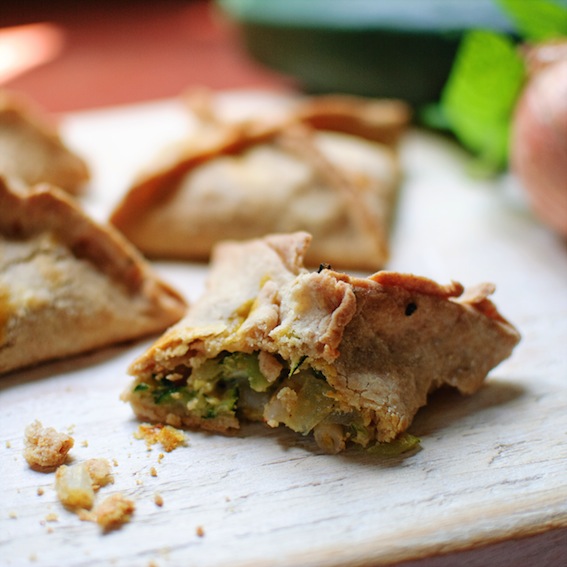
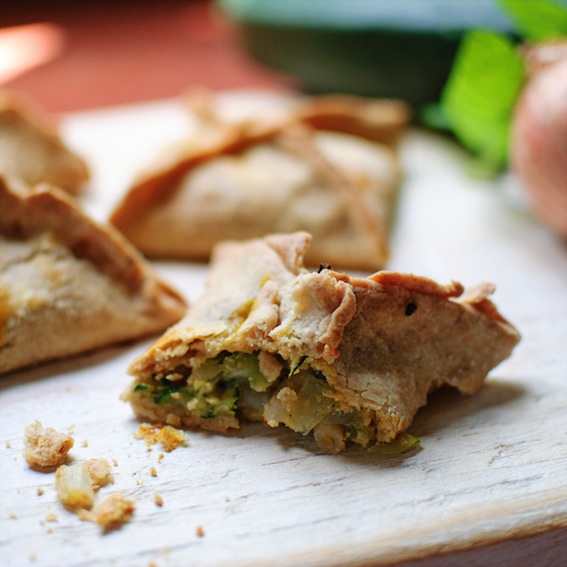
These savoury parcels are finger-licking good, as well as being very nutritious and quick and easy to make. They are wheat-free.
Ingredients for chickpea pastry (makes about 4 parcels)
80g spelt flour
50g chickpea flour
50g butter
2 tablespoons olive oil
Pinch of sea salt
Roughly 6 tablespoons of cold water
Ingredients for filling
1 courgette, grated
1 potato, boiled and chopped into cubes
1 onion, chopped
2 cloves garlic, chopped
4 tablespoons parmesan, grated
2 tablespoons pine nuts
6 fresh mint leaves, cut into pieces
Sea salt to taste
1 teaspoon paprika
To make the pastry, begin by cutting the butter and into small cubes. Sift the flours and a pinch of salt together into in a mixing bowl, also adding the cubes of butter. Rub in and blend by hand until the mixture becomes crumbly. Add the olive oil and combine well and then add the cold water, mixing rapidly with a spoon. Remove the mixture from the bowl onto a lightly floured surface. Knead until you obtain a ball of pastry (if the mixture isn’t ‘sticky’ enough to form a ball, you may need a drop more water). Wrap in a clean cotton tea towel or some cling film and leave to ‘rest’ in the fridge for about two hours. This relaxes the dough and makes it easier to use.
To make the filling, combine the ingredients in a bowl, mix well and then press a little with your fingers so that the mixture gains in density.
Preheat the oven to 180°C. Roll the pastry out on a clean, dry, floured surface. Cut into squares of approximately 15cm, put a good tablespoon of mixture into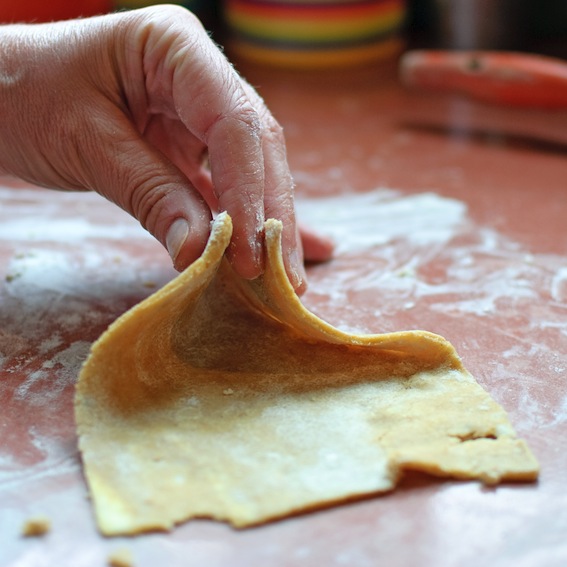 the middle and then fold back the edges to meet in the middle and form a parcel. Press the edges together until the pastry sticks.
Place the parcels on a lightly oiled baking tray and cook for 20 minutes. -
Tandoori chicken and shameless squatters

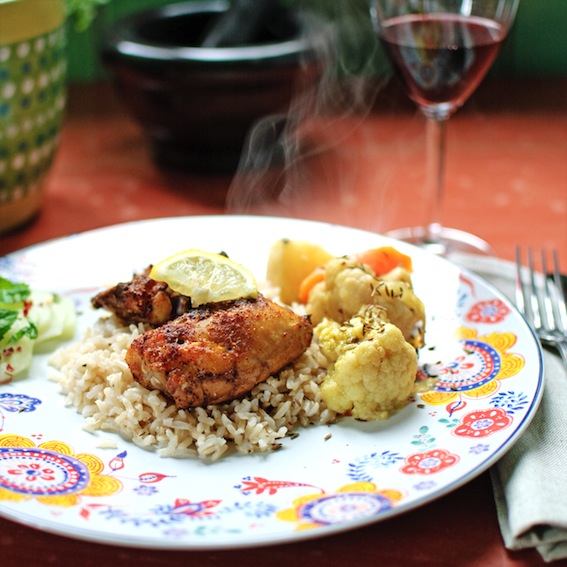
I’ve arrived at the conclusion that our animals need to be brought to heel. When we were first married, someone actually suggested my husband bring me to heel (yes, really :lol:), but don’t let’s go there today. The hens, having been told in no uncertain terms that hoarding is NOT on, have now taken up squatting. I suppose bad habits are never really eradicated, just replaced with other bad habits – they’ll no doubt be smoking and chewing gum next. Unfortunately they are particularly fond of squatting the most comfortable chair on the terrace, the only one we own that doesn’t dig menacingly into your back. Having made Tandoori chicken yesterday, I’m thinking of investing in a Tandoor oven and was wondering whether they would understand the veiled threat 😉 ?

A Tandoor is a cylindrical clay oven, typically found in Central, Western and Southern Asia. The heat source is a wood or charcoal-burning fire and temperatures can reach over 450°C. If you don’t have a Tandoor to hand, obviously a hot regular oven will do.
Ingredients (serves 4)
8 skinless chicken thighs
1 red onion, chopped finely
Juice of 1 lemon
2 tablespoons olive oil
For the marinade :
150ml greek yoghurt
1 piece of fresh ginger, grated
4 garlic cloves, crushed
1 teaspoon cumin seeds
½ teaspoon chilli powder
½ teaspoon paprika
½ teaspoon turmeric
½ teaspoon sea salt
Slash the chicken thighs several times then cover them with the lemon juice and chopped onions. Set aside in a deepish dish. Mix the marinade ingredients together and pour over the chicken, making sure that all bits are well covered. Leave to chill for at least an hour or overnight if possible. Preheat the oven to 220°C. Carefully place the chicken thighs on a lightly oiled baking tray and cook for about 25 minutes, depending on the size of the thighs. They are cooked through properly when the juice runs clear when prodded with a fork. May be served with basmati rice, naan bread, chickpea pancakes (recipe here), or vegetable curry. Delicious with chutney too. -
The fats you need for a healthy diet
I totally agree with this interesting ‘history of fats’…
-
Olive, red pepper and anchovy cake and a volatile hoarder

To follow on from this post, unfortunately our black hen died. Hens seem to be so vulnerable to attack from disease, foxes, dogs and perhaps even other hens. I imagined she was suffering from depression when maybe she was just sad to be sick. 🙁
We were (when I say ‘we’ I suppose I mean ‘I’ as, unlike me, neither husband nor son obsesses about our animals) rather worried about the white hen who had disappeared suddenly. We eventually found her over a week later under two enormous bales of hay in a little-used barn, sitting on no fewer than 23 eggs; The little minx had obviously been hiding, laying and hoarding! Don’t ever let it be said that hens can’t multitask. So to add to our animals’ extensive list of mental disorders, we now appear to be the proud owners of a compulsively hoarding hen. Can anyone tell me where I can get my hands on an animal that doesn’t have ‘issues’?
This savoury cake is based on an old French recipe and goes beautifully with soup or hors d’oeuvres. It’s quite light and crumbly and, being made with spelt flour, healthy, wheat-free and low GI.
Ingredients
175g spelt flour
1 teaspoon baking powder
1 teaspoon bicarbonate of soda
1 teaspoon paprika
1 pot of yoghurt (125g)
3 organic eggs, beaten
100ml olive oil
50g red pepper, finely chopped
40g black olives, stones removed
50g sun dried tomatoes
6 anchovies
Preheat the oven to 180°C. Combine the flour, baking powder, bicarbonate of soda and paprika and add the eggs and yoghurt, mixing well. Continue mixing and add the olive oil until you obtain a homogenous paste. Stir in the other ingredients and once well combined, spoon the mixture into a medium-sized, oiled loaf tin. Cook for about 40 minutes, or until a fork comes out clean.
-
Spelt flour crêpes and the chaos theory according to Hugo
by Hugo, Canine Correspondent

In the interests of transparency (have you noticed the trendy lingo I’m picking up?), I asked to write today’s blog because I don’t think that the Bossy One is always very honest with you.
The way she presents her recipes would have you believe that she’s a domestic goddess (I heard that on the television), when in fact, nothing could be further from the truth. The havoc she creates in the kitchen is quite something. Not that I’m not complaining because the more the food ends up on the floor, the happier I am. 🙂
Today’s recipe, for example, should really read something like this:
Sift the flour, salt and bicarbonate of soda into a mixing bowl, use a large shovel to scoop up the ingredients that somehow landed outside the bowl, whilst simultaneously trying to recover from violent coughing and sneezing fit caused by inhaled flour. Make a well in the centre and break the eggs into it, mutter obscenities and pick the broken bits of eggshell out with your fingernails. Whisk the eggs, little by little incorporating the surrounding flour. If you use an electric whisk, you can be sure that a substantial amount of mixture will end up on the surrounding walls, sometimes even the ceiling. Combine the almond milk and water and add little by little to the flour/egg mixture. Turn the whisk to SLOW before pouring in liquid, otherwise it will ricochet alarmingly which isn’t good because it causes more mad muttering (I can also do alliteration :-)). Once all the liquid has been added, continue to whisk until you obtain a smooth batter, the consistency of thin cream (yeah right; in her dreams!). Push back messy hair, smothering small amount of ‘smooth’ ( 😆 ) batter over face.
I won’t go on because she can be a bit sensitive when it comes to criticism, even if it is constructive, and I’d like to continue this writing lark. I will leave you with this thought though: this is a simple recipe – just imagine the scenario with a complicated one 😉

Thank you for your kind words Hugo, I think I’ll take over now. This is based on Delia Smith’s recipe for ‘basic pancakes’, which I have adapted to use with spelt flour and almond milk.
Ingredients (makes about 10 crêpes)
110g spelt flour
pinch of salt
pinch of bicarbonate of soda
2 large eggs
200ml almond milk
75ml water
butter or coconut oil for cooking
Sift the flour, salt and bicarbonate of soda into a mixing bowl, make a well in the centre and break the eggs into it. Whisk the eggs, little by little incorporating the surrounding flour. Combine the almond milk and water and add little by little to the flour/egg mixture. Once all the liquid has been added, continue to whisk until you obtain a smooth batter, the consistency of thin cream.
To cook the crêpes you will need a shallow frying, or preferably a crêpe pan. Melt the butter or coconut oil making sure that the base of the frying pan is coated. Pour a small amount of batter into hot fat in the pan, tipping from side to side to distribute evenly. Cook until golden brown on both sides.

-
Vegetable couscous and crestfallen hens

As if a deeply neurotic dog isn’t enough to cope with, I now appear to have a depressed hen on my hands. She’s been a bit down in the beak since the arrival of the young louts and has taken to spending time alone, presumably heeding the French adage ‘Il vaut mieux être seul que mal accompagné’ (it’s better to be alone than badly accompanied). I’m a dab hand at dealing with dippy horses (two headcollars ripped to shreds in under five minutes today; a record even by our standards) and bipolar dogs, but this is somewhat baffling…
I made this vegetable couscous with her in mind as it meant lots of vegetable peelings and some remnents of couscous grain to perk her up a bit. I used spelt couscous which is nutty, subtle and lighter than wheat couscous, but you can use either. I’m a big fan of spelt, an ancient protein-rich grain offering a far broader range of nutrients than wheat (manganese, phosphorus, vitamin B3, magnesium, copper…). It also seems to cause fewer digestive problems than wheat, although it does contain gluten.
Ingredients (serves 4)
2 tablespoons olive oil
4 carrots, peeled and cut into large pieces
1 potato, peeled and cut into large chunks
1 onion, peeled and sliced
4 cloves of garlic, peeled
1 red pepper (sliced)
2 tomatoes (blanched, peeled and sliced)
1 large courgette, cut into approximately 4cm slices
4 baby turnips, peeled
100g pre-cooked chickpeas
1 bay leaf
Sea salt and freshly ground black pepper
3 teaspoons ras-el-hanout
200ml chicken or vegetable stock
200g couscous
handful of raisins
harissa and fresh mint to serve
Fry the onions in the olive oil, gradually adding the other vegetables. Add the seasoning, spices and stock and simmer for about 30 minutes until the vegetables are tender. Prepare the couscous according to instructions, adding the raisins to the boiling water. Serve the couscous and ladle the vegetables and sauce over the top. This is good either on its own or to accompany grilled or barbecued sausages and meat. -
Lemon and ginger mini cheesecake tarts (gluten free and low glycemic index)
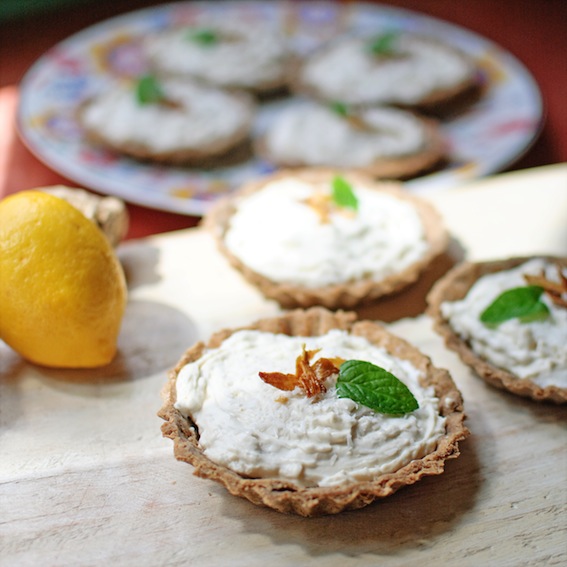
There are times when only cheesecake will do and yesterday was one of those times 🙂 As the only ingredients I had to hand were mascarpone, lemons and ginger (four hens and not an egg in sight, but don’t let’s go there), I created these tartlets. I have to say, they were divine and my cheesecake yearning was well and truly satisfied.
These tarts are gluten free and have a low glycemic index (neither buckwheat nor coconut flours contain gluten and they both have a low GI, as do all dairy products).
Ingredients for pastry (makes about six mini tarts)
75g buckwheat flour
35g coconut flour
30g butter
30g coconut oil
½ teaspoon powdered ginger
Pinch of sea salt
Roughly 6 tablespoons of cold water
Ingredients for cheesecake filling
250g mascarpone cheese
Juice of one lemon
1 tablespoon of freshly grated ginger
3 tablespoons chestnut purée
2 tablespoons desiccated coconut
Candied ginger and mint leaf to garnish
To make the pastry, begin by cutting the butter and coconut oil into small cubes. Add to the flours and a pinch of salt in a mixing bowl. Blend by hand until the mixture becomes crumbly. Add the cold water, mixing rapidly with a spoon. Remove the mixture from the bowl onto a lightly floured surface. Knead until you obtain a ball of pastry (if the mixture isn’t ‘sticky’ enough to form a ball, you may need a drop more water). Wrap in a clean cotton tea towel or some cling film and leave to ‘rest’ in the fridge for about two hours. This relaxes the dough and makes it easier to use.
Preheat the oven to 180°C. Roll out the pastry on a clean, lightly floured surface and fill the tart tins. Bear in mind that buckwheat and coconut flour pastry is extremely crumbly as it contains no gluten to ‘stick’ it together. You’ll probably need to patch and press the pastry into the tins as opposed to just cutting and placing it in as you would with normal pastry. Cook the pastry for 15 minutes.
Blend all of the ‘cheesecake’ ingredients together well, fill the precooked tart cases and garnish with candied ginger and mint. Chill for at least an hour before serving. -
Pot roast guinea fowl with orange, herbs and leeks
by Hugo, Canine Correspondent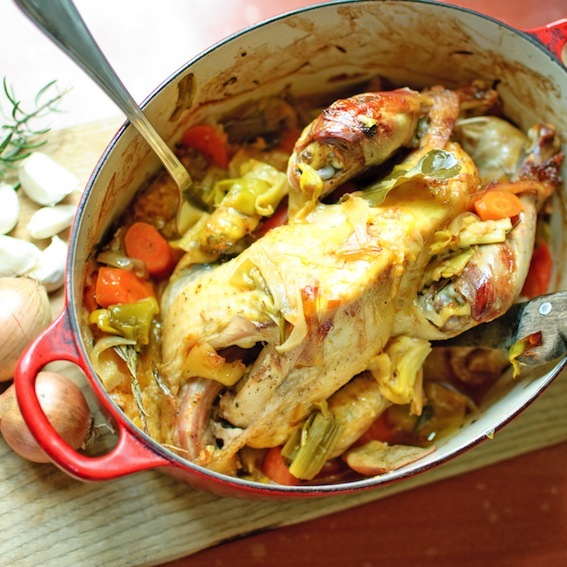
I’m rather down in the dumps today. I don’t usually complain about Her Bossiness but I can’t help feeling she’s a bit blasé sometimes; The young hens have turned into ruffians. Shy and retiring when they first arrived a few weeks ago, they have become rather cocky and full of a sense of entitlement that just isn’t appropriate in a hen. Especially in hens that don’t even lay eggs yet. The worst thing is when their haughtiness involves my food bowl. They nonchalantly stroll into the house, plant themselves on my bed and dig in to my food. Surely that’s just not right is it? 🙁
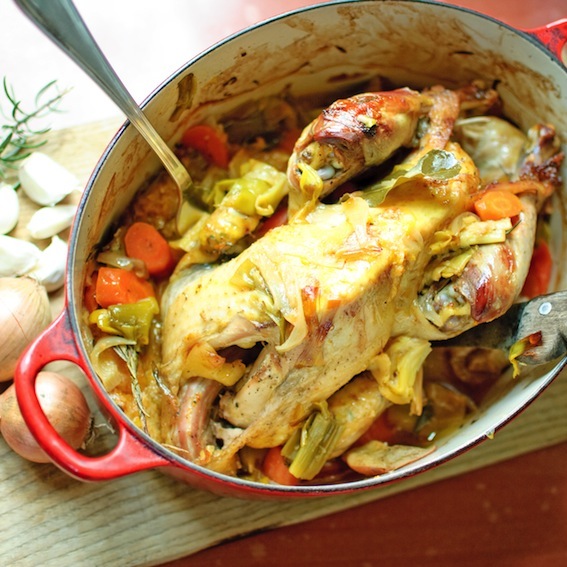
I’m very keen on this guinea fowl dish, because I get to chew the carcass afterwards. I’m not ashamed to admit that while doing so, I fantasise that I’m devouring one of my volatile companions. 🙂
Ingredients (serves 6)
1 large (or 2 small) guinea fowl (about a kilo)
4 oranges, peeled and sliced
1 onion, peeled and sliced
a handful of fresh thyme
a handful of sage leaves
1 tablespoon of olive oil
60g butter
8 cloves of garlic, peeled
4 carrots, peeled and sliced
2 leeks, washed and sliced
seasoning: sea salt, freshly ground black pepper, paprika
350ml dry white wine
This is adapted from a Jamie Oliver recipe. Preheat the oven to 180°C. Empty the bird and rinse well. Mix the oranges with the onion and herbs and season with salt and pepper. Stuff the guinea fowl(s) with the mixture and place in a casserole dish (dutch oven) along with the butter, olive oil, carrots, garlic, leeks and seasoning. Fry until golden brown and then add the wine, which should be brought to a simmer. Put the lid on the dish and cook in the oven for just over an hour, or until the ‘sauce’ is beginning to caramelise slightly. -
Tomato and goat cheese tart (gf) and upside down tortoises
Our last skiing weekend of the season was an unmitigated success after a slightly shaky start. I tend to be a bit bossy (as I think Hugo has mentioned), meaning that I pay a lot of attention to telling other people what to do, and less attention to what I should be doing. A case in point: on Saturday we took the first chairlift of the day with two other people and my backpack, which could quite legitimately have had a seat of its own, filled as it was with clothes, water, food, camera and video material. One would have been forgiven for assuming we were about to climb Everest, not spend a leisurely day in the Spring snow. In the interests of pedagogy, I explained to Léo on the ride up that, especially when there are four people on the lift, it’s important to go straight forward when you disembark. Five minutes later, I had ended up on my back with my skis in the air like a tortoise on its shell, unable to stand up due to the sheer size and weight of my backpack. The chairlift operator was very kind and stopped the lift (presumably to avoid a tortoise roadkill scenario) and hauled me up with a large smile (or snigger?) and a gracious ‘bienvenue Madame!’
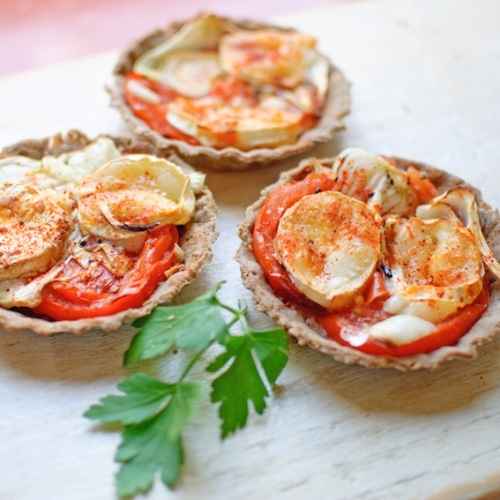
These savoury tarts are quick and easy to make (particularly if you’ve made the pastry cases in advance) and will be even more delicious when tomatoes come into season properly.
Ingredients for pastry (makes about six mini tarts):
110g buckwheat flour
30g butter
20ml olive oil
Pinch of sea salt
Roughly 6 tablespoons of cold water
Ingredients for filling:
2 shallots, finely chopped
3 cloves of garlic, finely chopped
3 tomatoes, cut into thin slices
6 slices of goats cheese
Sea salt, freshly ground black pepper, paprika
To make the pastry, begin by cutting the butter into small cubes. Add to the flour and a pinch of salt in a mixing bowl. Blend by hand until the mixture becomes crumbly. Add the olive oil, blending well and then the cold water, mixing rapidly with a spoon. Remove the mixture from the bowl onto a lightly floured surface. Knead until you obtain a ball of pastry (if the mixture isn’t ‘sticky’ enough to form a ball, you may need a drop more water). Wrap in a clean cotton tea towel or some cling film and leave to ‘rest’ in the fridge for about two hours. This relaxes the dough and makes it easier to use.
Preheat the oven to 180°C. Roll out the pastry on a clean, lightly floured surface and fill the tart tins. Bear in mind that buckwheat pastry is extremely crumbly as it contains no gluten to ‘stick’ it together. You’ll probably need to patch and press the pastry into the tins as opposed to just cutting and placing it in as you would with normal pastry. Precook the pastry for 10 minutes.
Fill the tarts with the shallots, garlic and tomato slices, finishing up with a slice of goats cheese on top. Season and cook for about 15 minutes, or until the tomatoes are ‘mushy’ and the cheese has melted. -
Coconut chocolate mousse cake (gf)

Asparagus season is here again and with it, the Great Asparagus Stand-off; my husband likes them best lightly boiled, I am partial to roasted. Léo likes them not at all, so I’m doing a recipe for chocolate cake. 😆
This cake, adapted from the recent cookbook ‘Honestly Healthy‘, is positively ambrosial. I’m sure it would be delicious without my alterations, but I have an almost pathological need to customise recipes. This cake also freezes well; I always freeze cakes in ready-cut slices because they would disappear far too quickly otherwise. Even a card-carrying chocoholic like me refuses to stoop so low as to actually break her teeth on frozen food in order to get a ‘fix’.
Ingredients (serves 10)
100g coconut flour
50g organic cocoa powder, sifted
500ml almond milk
60g coconut oil (melted)
60g salted butter (melted)
130g agave syrup
2 tablespoons yacon syrup*
4 eggs, beaten
Preheat the oven to 150°C and lightly grease a cake tin (I used a 24cm diameter tin). Combine the coconut flour and cocoa in a bowl. In another bowl combine the ‘wet’ ingredients (milk, oil, syrups, butter and eggs) and then fold the two lots of ingredients together. Transfer the mixture to the cake tin and bake for about 40 minutes (or until a skewer inserted into the centre of the cake comes out clean). Leave the cake to cool before transferring to a plate and dust with cocoa powder before serving.
* Yacon syrup is extracted from the roots of the yacon plant, indigenous to the Andes mountains. It has low glycemic index (it’s suitable for diabetics) containing up to 50% FOS (fructooligosacharides).