-
Cassoulet and mouthfuls of sand

My annual flirtation with vegetarianism will have lasted almost a month. Hugo, our labrador, is having a whale of a time ‘playing’ with pheasants at the moment. He waits until I’m in the saddle, then goes out in front to lift a pheasant as close to the horse’s nose as possible. This makes my horse spook flamboyantly (Iberian horses are total show-offs and exceedingly supple to boot) and I end up, more often than not, with my nose in the sand. Which brings me back to why I’ve surmised that hunting isn’t all bad; I’m anxious for them to hurry up and butcher a few of the pheasants near us, to give myself a fighting chance at staying in the saddle 😉
This cassoulet is, perhaps for some people, slightly unorthodox in that it has no breadcrumbs on top. In any case, it’s well worthy of a break from half-hearted vegetarianism and is the epitome of ‘real’ food.
Ingredients (serves 8)
1 large onion, sliced
1 red pepper
4 chilli peppers
1 tablespoon olive oil
8 mushrooms
4 medium-sized carrots, peeled and cut into large pieces
5 cloves of garlic, crushed
8 Toulouse sausages
300g salted pork breast
4 pieces of duck confit
2 sprigs of rosemary
2 glasses of dry white wine
5 medium tomatoes, blanched and skinned
500g white haricot beans (these should be soaked overnight if dry)
Seasoning to taste (seasalt, black pepper, Espelette pepper or paprika)
1 teaspoon juniper berries
Start by de-fatting the duck confit in a pan, heating and removing the fat gradually. Put the onions, garlic and olive oil into a large casserole dish and gently brown. Add the mushrooms, carrots, red pepper, chilli peppers and tomatoes and continue to brown on a low heat. Add the sausages, duck and pork and continue to cook for a couple of minutes. Add the white wine, juniper berries and rosemary and bring back to a simmer. Lastly, add the white beans and season well. You will need to add some water – probably about 500ml – enough to come about half the way up the casserole dish. Cook on a lowish heat (140°C) for about two and a half hours, checking from time-to-time that there is sufficient liquid.
This is a very rich dish and should just be served with a crisp green salad. -
Salt and Pepper

We have two hens called Sel and Poivre (Salt and Pepper). We bought them in the hope of being able to teach Hugo, our dog, that chickens are to be admired from a respectable distance and not eye-balled viciously, whilst sinking sharp canine teeth into their necks. He had taken to sloping off to the neighbouring farms to ‘play’ with their hens in a way that would have earned him an ASBO if he lived in the UK.
Six weeks on and the hens are still alive, which is nothing short of miraculous when I think back to the way he greeted their arrival. But the hens’ biggest passion is the horses; they preach at the alter of all things equine. If the horses are lying down in the sun, so are they; if the horses are eating hay in the grange, the hens will be pecking away next to them. And when the horses gallop around the field, they follow as fast as their little legs will carry them.
Anyway, we moved the horses down the road a couple of days ago to ‘mow’ a neighbouring field, and the hens (who live in the horses’ stabling) went into a sharp decline. To such an extent that one of them (Salt) stopped laying. I’m not quite sure how that works, but I’ve been assured by People Who Know that hens, contrary to appearances, are really quite emotional beings. We brought the horses back this evening (I was getting hungry!) and they were met by two very very happy ladies. They’re cuddling up as I type.
The original aim of this post was actually to point out the fact that eggs are Very Good News from a nutritional point of view, and not go into our poultry’s state of heart in such detail. So, eggs contain substantial quantities of high-quality protein and most vitamins (with the exception of vitamin C) and minerals; valuable components in a healthy diet. From a culinary point of view, as well as being healthy and delicious, they are incredibly versatile – they can be boiled, poached, fried, scrambled or made into omelette, quiche, tarts, sauces, mousses…
From your point of view as well as the hens’, please buy free-range. -
Tunisian meatloaf
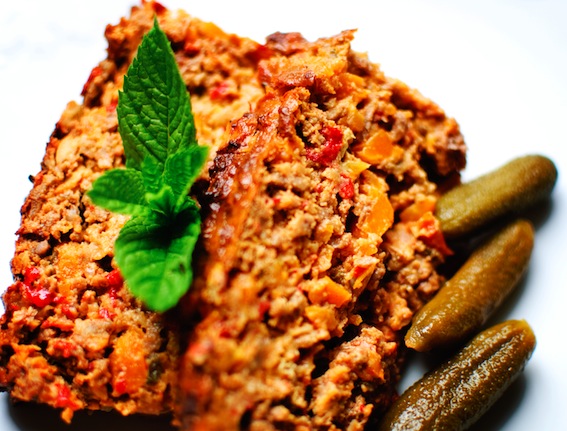
Although I never let slip a chance to take a cheap pop at vegetarians (our horses, for example – how could anyone in their right mind just eat grass all day?), I’m not exactly a flesh-ripping carnivore myself. In fact, the better meat is disguised, the happier I am.
It’s complicated serving meat in this house. My husband and son, in true French male style, get inconsolably hysterical if they think it’s overcooked and I ‘come over queer’ if it’s underdone. Hugo, the labrador, is extremely conciliatory (or greedy?) and eats it either way.
This fragrent meatloaf ticks all the boxes; vegetables for me so that I forget I’m eating meat, and just enough meat for my carnivourous husband and son to satisfy their Neanderthal instincts.
Ingredients (serves six to eight)
2 onions
3 carrots
1 aubergine
2 garlic cloves
3 medium tomatoes
Olive oil
200g pre-cooked chickpeas
300g minced beef or lamb
3 eggs
1 tbsp Lee and Perrins sauce
Parsley
Rosemary
Bay leaf
50ml tomato ketchup
seasoning to taste (seasalt, pepper, cumin, coriander, cayenne pepper)
Cut the aubergine into slices and leave to ‘sweat’ out the moisture with seasalt. Brown the vegetables (including the aubergine) in olive oil in a large frying pan cooking over a medium heat for about 20 minutes. Add the rosemary and seasoning and set aside. Combine the meat, beaten eggs, Lee and Perrins sauce and ketchup in another bowl. Roughly blend the vegetable mixture, chickpeas and fresh parsely until it forms a lumpy paste (ie not blended too much) and add it to the meat mixture. Spoon the combined mixture into a loaf tin and cook for about an hour and a half in a medium oven (180°C). Leave to sit for ten minutes before slicing.
May be served hot with couscous cooked with mint, sultanas and peas and a hot tomato sauce, or cold with crisp green salad and gherkins.
-
Floating islands

After three years’ pretending that he’s So Not Bothered by storms, our neurotic labrador has suddenly decided that they absolutely terrify him. He’s gone from superior nonchalence to quivering wreck in one furl swoop; no half-measures with Hugo. Which means that when it’s stormy (which is quite often here in the Spring), I gain an appendage of 30 kilos of black fur, which is a bit of a hindrance for moving around the kitchen (and certainly not a good look).
In spite of my appendage (or perhaps thanks to), I somehow managed to make this which is really delicious. The recipe came from my late mother-in-law.
Ingredients (serves about 6, depending on greed)
1 litre of full-fat milk
120g cane sugar
1 vanilla pod
1 tablespoon of cornflour
4 eggs (preferably free-range)
1 tablespoon of rum (optional)
Heat a glass of the milk and sugar mixture in a saucepan until it starts to simmer. Dilute the cornflour in a tiny bit of water and add to the milk and sugar mixture. Separate the eggs and four yolks to the mixture.
Beat the egg whites (adding a pinch of salt) until firm, then separate with a serving spoon and cook in the remaining milk which should be simmering (this should take about two minutes; one minute on each side). Sieve once cooked.
Add the cooking milk to the milk/cornflour/egg mixture with a whisk and bring to the boil until the mixture thickens (a couple of minutes). Add the rum and pour into a bowl and place the cooked egg whites on top. Refrigerate and serve chilled.


