-
Coconut crab risotto and bathroom devotion
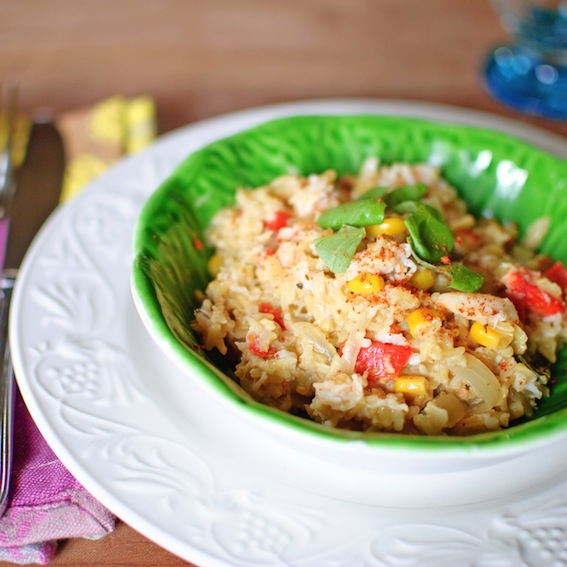
Admittedly an unfortunate juxtaposition for my risotto, but I spent today mixing concrete. Never let it be said that I don’t lead a glamorous life. For the uninitiated amongst you, cement mixing is not dissimilar to mixing a very large cake, which I suppose doesn’t say much for my cakes. It’s very therapeutic though, concrete; I now better understand Winston Churchill’s passion for building walls. There was a bit of a low point this morning when I tripped and fell flat on my face, leaving 25kg of sloppy concrete mix to ooze in my wake, but other than that I think I did quite well. Although I’m obviously no expert, one top tip would be to keep the dogs well out of the way, because they will be tempted to come and ‘help’:

We’re in the process of building another bathroom – my husband is a big fan; adding on bathrooms is a hobby of his. If publications such as ‘Bathroom Weekly’ or ‘Faucets and Drains Today’ existed, he would certainly subscribe. In our previous house, last count, we had ten bathrooms. This is why we had to sell really – we had exhausted its bathroom potential. We’ve been in our present house for seven years and are now on our fourth. Hopefully we won’t break through the bathroom ceiling any time soon though because I like it here…
This is a recipe for a quick, easy but nonetheless delicious risotto. It never fails to please. And if ever you need advice on mixing cement, I’m your girl.
Ingredients (serves 4)
2 tablespoons coconut oil
3 shallots, finely chopped
1 red pepper, sliced and chopped
2 cloves of garlic, crushed
1 teaspoon of fresh ginger, grated
280g rice (I used whole basmati)
120ml white wine
700ml chicken or vegetable stock
Sea salt and freshly-ground black pepper
1 teaspoon chilli powder
150g sweetcorn
200ml coconut milk
300g tinned crabmeat
Handful of fresh basil, shredded
Heat the oil in large pan over a low heat, add the shallots and cook for five minutes until softened. Add the pepper, garlic and ginger and cook a little more. Add the rice and stir until it’s well coated with oil. Pour in the wine, stirring until all the liquid has been absorbed. Add the stock little by little and stir until almost completely absorbed. Repeat this process, adding the stock a ladle at a time, stirring constantly until all the stock has been used up (about 20 minutes). Add the seasoning and you can add more water if the rice isn’t cooked (this will be the case if you’re using whole basmati, as I did). Add the sweetcorn and coconut milk, stirring until the coconut milk absorbs. Add the crabmeat, cover and leave to heat through for about five minutes. Add the shredded basil to serve. -
Vegetable fritters (gf) and visually-challenged Setters


I think that Java needs glasses. Either that or a new brain, but I’m going to be charitable and go with the glasses theory. (As an aside, she also needs to learn which holes she can and can’t stick her nose into, because it’s looking a bit mangled at the moment. Still, we can’t all be hole experts.) Even allowing for the fact that she’s not the brightest, I’ve noticed her a few times recently rather proudly ‘marking’ plastic bags. I know plastic bags can flap in the wind a bit and do very fine bird imitations, but still: Really Java? You’re a dog with a supposedly superior sense of smell. I’m not sure how to broach the subject with her though; it’s a tricky one. Apparently English Setters are extremely sensitive to criticism, and I wouldn’t want to be responsible for tipping her over the edge by pointing out her mistake, tempted though I might be. I think I’ll just leave it to Bossy and her finely-tuned diplomacy skills to explain her error. Watch this space for one horribly humiliated English Setter *wicked dog chuckle*.
Ingredients (serves 4)
2 eggs, beaten
75g chickpea flour (although any flour will work)
½ teaspoon bicarbonate of soda
125ml water
1 potato, peeled and grated
2 courgettes, peeled and grated
1 carrot, peeled and grated
1 onion, finely chopped
1 clove garlic, crushed
4 leaves fresh mint, cut into strips
Sea salt and freshly ground black pepper
1 teaspoon curry powder
1 tablespoon of ghee for frying (you can use butter or oil)
Combine the beaten eggs, flour and bicarbonate of soda, gradually adding about 125ml of water to achieve a fairly thick pancake batter consistency. Add the grated vegetables, onion, garlic, fresh mint and seasoning and combine well, making sure that the vegetables are well incorporated. Heat the ghee in a large frying pan over a medium heat until melted and create several two tablespoon-sized fritters. Fry until golden brown (roughly 5 minutes), turn and repeat until all the fritters are cooked. -
Coconut cake and Hugo’s scuppered plans

I would like to set the record straight about my recent excavation venture, because I thought that Bossy portrayed me as a bit of a halfwit by suggesting that I was stuck down my magnificent hole. I admit that I did let her haul me out with a rope (there was lots of swearing on her part), but only to shut her up. The plan was, once I’d finished what I’d set out to do (we won’t go into details to spare any squeamish readers), I was going to create a tunnel back to the top at a gradient of about 30%. Of course, this would have taken quite a long time and I’m not sure where I would have ended up, but anything that gets me away from Bossy’s incessant blabbering and Java’s stubborn insubordination can only be a good thing. As an aside, are you impressed at how my vocabulary is becoming more and more sophisticated? Bossy says that I must be careful to avoid becoming too verbose, although she’s a fine one to talk. Anyway, the upside was, she was so convinced that I had been traumatised by my adventure, when we got home she gave me an extra-large piece of camembert. Sometimes it pays to just go with the flow…
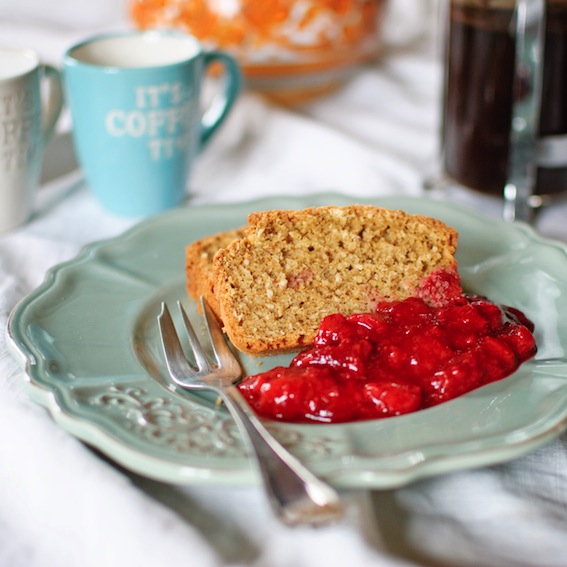
Thank you Hugo for telling your side of the story, although I think we could have done without the reference to my ‘blabbering’! This wonderfully light cake is inspired by ‘Love, bake, nourish’.
Ingredients (serves 8-10)
175g spelt flour
120g desiccated coconut
1 teaspoon baking powder
½ teaspoon bicarbonate of soda
75g cane sugar
1 egg, beaten
200ml coconut milk
1 teaspoon vanilla extract
Preheat the oven to 180°C. Grease and prepare a medium-sized loaf tin. Combine the flour, coconut, baking powder, bicarbonate of soda and sugar in a large bowl and then add the egg, coconut milk and vanilla extract. Mix thoroughly and transfer into the prepared tin. Bake for about 35 minutes, or until a skewer inserted into the centre comes out clean. Leave to cool and serve with strawberry coulis or Greek yoghurt (or both!). -
Chicken with bacon and white wine and the latest dog horseplay

As I have absolutely no wish to linger on last weekend and Léo’s ‘totally cool skis that go backwards as well as forwards’ (this, according to the man in the rental shop, was a selling point), I’m going to talk about the dogs and their latest antics. Hugo and Java are a generation apart in dog years. While Hugo certainly isn’t averse to a bit of television (Scooby Doo being his favourite), he doesn’t really ‘do’ computers. Java does, and she apparently has strong opinions on graphics; yesterday she took unusual and hysterical exception to the screensaver that Léo had installed. I don’t blame her really – it was a sort of Grufallo monster menacingly yielding a leg of lamb. Anyway, she was ear-splittingly inconsolable until the offending image was replaced with something more serene. Meanwhile, Hugo was outside digging the World’s Biggest Hole. He was gone a couple of hours and, after frantic searching, I found him stranded 2m below ground level, covered in mud and sand trying to ‘liberate’ an unidentified, and no doubt petrified, small animal. He looked quite relieved to see me and my sturdy rope because I think he realised there was no way he was getting out on his own. In future Hugo: When you’re in a hole, stop digging!
This dish is quick and easy to make, but no less delicious for it. It is adapted from ‘Nigella Express’.
Ingredients (serves 4)
1 tablespoon olive oil
1 leek, washed and cut both ways
1 onion, chopped
4 mushrooms, sliced
4 rashers bacon
4 chicken escalopes (approx. 125g each)
100ml white wine
Sea salt and freshly ground black pepper to taste
Put the olive oil in the frying pan and heat. Add the leek, onion, mushrooms and bacon and fry until the bacon is crisp. Remove the bacon and set aside. Fry the chicken until cooked through (a couple of minutes on each side). Put the bacon back into the pan, add the wine and cook until the wine bubbles. Season to taste and serve with rice and a salad or green beans. -
A handful of salt

Salt is essential to life. Sodium is one of the seven macrominerals (along with calcium, chloride, magnesium, phosphorus, potassium and sulphur) and is used for a multitude of biochemical processes such as fluid and acid-alkaline balance and electrical signaling in the nervous system. It is also necessary for adrenal gland function.
All salts are mainly made up of sodium chloride. Table salt is manufactured by cooking to 1200°F, which removes the other trace minerals. Chemicals and anti-caking agents are then added and it is bleached to make it white. This type of salt has almost no benefits and plenty of drawbacks; in many cases it is positively toxic, causing high blood pressure, kidney problems and impaired muscle and nerve function. It should be avoided at all costs.
While sea salt is a far better option than table salt because the other minerals are still present, sea pollution means that producers are having to refine their products, meaning that some of the natural goodness is taken away. Probably the purest sea salt available is from the salt marshes in Brittany where it is still produced using ancient methods.
My favourite salt is Himalayan crystal salt. Not only is it a pretty pink colour (shallow? Moi?), it contains 84 minerals and trace elements in ionic state, meaning that they are tiny enough for the body’s cells to absorb them easily. Its benefits include :- Water regulation
- Healthy pH balance
- Healthy blood sugar
- Generation of hydroelectric energy in the cells
- Food and nutrient absorption
- Respiratory health
- Prevention of muscle cramps
- Sleep and relaxation
- Blood pressure regulation
Not only is Himalayan salt an excellent choice for use in the kitchen, a few handfuls added to warm (but not hot) water makes a wonderfully relaxing and detoxifying bath. Soaking in a Himalayan salt bath provides an effective treatment for dry skin and psoriasis, soothes insect bites and relieves muscle pain or cramping, as well as easing arthritis. Finally, it reduces stress and promotes a good night’s sleep.
-
Pear cake and an exhausting email exchange
I engaged in a slightly surreal email exchange with a ski instructor recently. I wanted to reserve a skiing lesson for Léo for this weekend – a lesson in which he would hopefully learn a) how to leave the other mountain users vertical and intact, and b) that posts, signs (particularly ones that say ‘slow down’) and barriers are there for reasons other than to be uprooted while flying past. I asked for a one hour private lesson on Monday morning, Mr Ski Genius replied that he could offer a two hour lesson on Sunday afternoon. So I enquired about a two hour lesson on Monday afternoon, which he was afraid he couldn’t do, but he could perhaps fit in a one hour lesson on Sunday morning, assuming that I was the person that had originally wanted to book for Tuesday afternoon. There were numerous other variants discussed far too tortuous to go in to, including, if I remember correctly, the possibility of a one and a quarter hour lesson from midnight on Sunday, which was obviously very tempting. Anyway, the upshot is that I lost the will to live and conceded defeat. We’re just going to wing it and give him a call when we get there to try to arrange (although frankly, the thought of a ‘phone conversation with him brings me out in a cold sweat). I just hope that his lessons are less convoluted than his emails. Failing that, we can pray that the other skiers and signposts are more robust than last time. It could all prove to be very interesting…
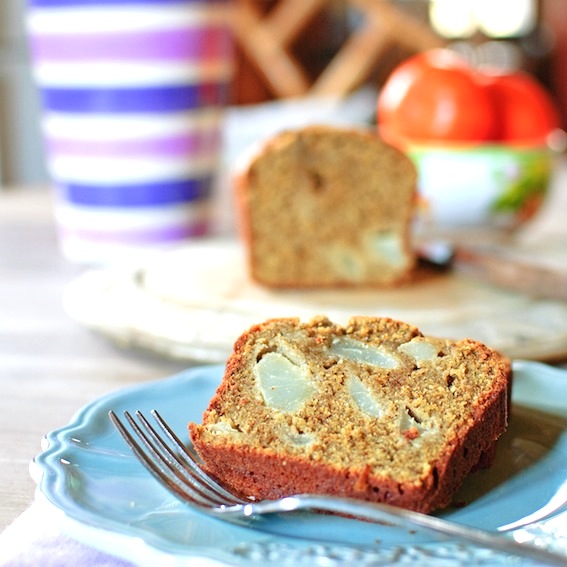
I bought a variation of this ‘moelleux aux poires’ in a patisserie when we were last skiing. Anything tastes good after a day on the slopes, particularly with Léo, but this was still delicious when I made it at home.
Ingredients
3 pears, cut into eight
1 tablespoon rum
1 vanilla pod
100g cane sugar
50g butter
50g coconut oil
3 eggs
75g rye flour
75g buckwheat flour
50g powdered almonds
1 teaspoon baking powder
1 teaspoon bicarbonate of soda
Preheat the oven to 180°C. Poach the pears in a little water with the rum and vanilla pod. Blend the butter, coconut oil and sugar until fluffy. Add the eggs one by one, and then the flour, baking powder, bicarbonate of soda and almonds and combine well. Add the drained, poached pears and gently incorporate into the mixture. Transfer to a pre-buttered medium-size loaf tin and bake for 30 minutes, or until a skewer inserted into the centre comes out clean. -
Apricot and ginger muffins and drug-free pharmacists

A few years ago, I wrote an article about a much-revered institution in France: The Pharmacy. Yesterday, having popped into our local one for some toothpaste, I found myself in the incongruous position of dispensing advice to the pharmacist on how to treat her debilitating cold. She was quite adamant about not wanting to use ‘nasty chemical drugs’ that made her feel drowsy and dried out. I found her resolve amusingly disloyal in view of her job – rather like a butcher promoting a vegetarian diet – but I was even more astonished when she went on to say that she tries to avoid pharmaceuticals at all costs: Talk about doing yourself out of work! Anyway, I spent so long dealing with her fervent drug phobia and streaming orifices (I set her up with a concoction of herbs and some essential oils to sniff and rub on) that it was only when I reached home that I realised that I’d come away empty-handed… Natural remedies: 1, pharmaceutical profits: 0.
Ingredients (makes 12)
60g salted butter, softened
60g coconut oil, softened
150g spelt flour
2 organic eggs
60g ground almonds
1 teaspoon baking powder
80g cane sugar
50ml milk
200g apricots, cut into quarters and lightly poached
2 teaspoons ginger, freshly grated
Preheat the oven to 180°C. Cream the butter and coconut oil for about four minutes. Add a spoonful of flour, beat again, then add the eggs, beating further until the mixture is light and fluffy. Add a little more flour to prevent curdling. Gently fold in the remaining flour, ground almonds, baking powder, cane sugar, and milk. Lastly, fold the poached apricots and grated ginger into the mix. Spoon into muffin trays and bake for 25 minutes.

-
Chickpea pizza base (gf) and branching out

A few days ago I received an email from a soft furnishings company saying that they would ‘love to write a guest post’ for my blog. This was followed by an email from an online gaming company suggesting the same thing. Call me parochial, but I’m still struggling to understand the relevance; gluten-free sofas, buckwheat light shades and deep-fried poker? Is this perhaps just the next step in the lateral thinking that claims courgettes are the new spaghetti and cauliflower the new rice? Still, I’m baffled, even in my capacity as the queen of non sequiturs (I’m always launching into totally unrelated conversational hemispheres – one minute you’re telling me about your holiday and the next I’m grilling you on how to teach a horse to pirouette).
So here’s a deliciously light chickpea pizza base that might or might not make for stunning cushion covers or perhaps put you in mind of a roulette wheel…
Ingredients (makes two 15cm pizzas)
150g chickpea flour
½ teaspoon bicarbonate of soda
a pinch of salt
Fresh rosemary leaves
200ml water
I clove garlic, crushed
1 tablespoon olive oil
1 tablespoon ghee (or you could use butter)
Combine the flour, bicarbonate of soda, salt and rosemary in a medium-sized bowl. Gradually add the water, whisking continuously to form a paste. Add the garlic, and olive oil and leave the batter to stand at room temperature for about 30 minutes. Melt half of the ghee in a 15cm frying pan and add half of the batter. Fry on both sides until golden brown. Repeat with the remaining ghee and batter. Add your toppings of choice and cook in a hot oven for 15 minutes. -
Mango and ginger kulfi and fire-proof mouths
When I lived near Paris, an English friend and I used to frequent a wonderful little Indian restaurant where we invariably ordered kulfi and halwa for dessert. I’m sure they used to cringe and don their heat-proof clothing and goggles as they saw us approach because we always ordered everything extra extra hot, which is unusual in France where Indian restaurants tend to be more subtle than in the UK. I’m all for subtle; subtle is usually a good thing, but not when it comes to Indian food when my tastebuds demand strident, lurid and brash. Eating Indian food is an extreme sport for me: bungee jumping for the palate.
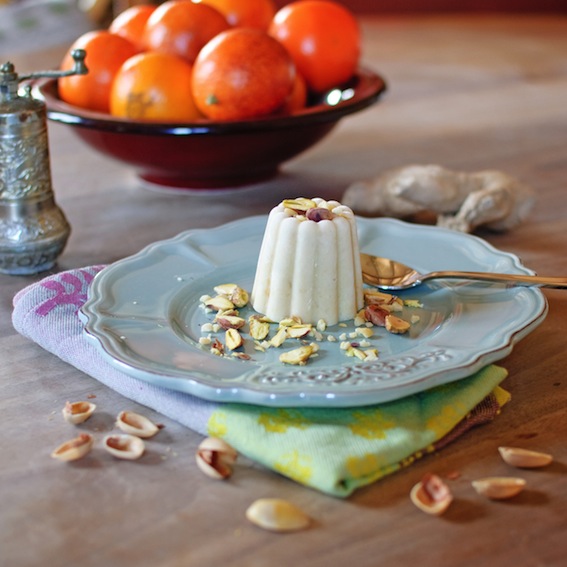
This ice cream is divine and absolutely perfect after a brazen vindaloo – it puts out the fire like applying aloe vera to sunburn. It is usually made with condensed milk instead of coconut cream.
Not only is ginger deliciously tangy and refreshing, it is also a potent antibacterial, antifungal and anti-inflammatory, as well as being an excellent antioxidant source. It aids digestion and helps prevent nausea and motion sickness as well as headaches, respiratory infections and arthritic pain.
Ingredients (makes about 12 mini moulds)
400ml coconut cream, any excess water removed
400ml Greek yoghurt
1 large mango, peeled and pureed
25g almonds, finely chopped
25g pistachios, finely chopped
1 tablespoon honey
1 teaspoon fresh ginger, grated
1 teaspoon cardamom seeds, ground
Place all the ingredients in a large mixing bowl and combine well. Pour the mixture into silicon muffin moulds (I used a mixture of muffin moulds and canelé moulds). Freeze for at least two hours. Take out individual portions and leave to defrost slightly at room temperature about 45 minutes before serving. Delicious served with halwa. -
Halwa and ice skating for dogs
Until today, I neither shared nor understood Java’s enthusiasm for the cold white stuff that suddenly appeared the other morning. Mind you, she’s so foolish that I don’t understand much about her at all. I refused to go out all day on Monday in the hope that it would disappear. It didn’t, and there was even more of it this morning so, after much coaxing, I agreed to accompany Bossy and Java on a walk. I soon found out that if I ran very fast and then suddenly stopped, Java (who copies everything I do) was taken by surprise, skidded, lost her balance and fell over (what’s not to like?). How anyone with four legs can actually fall over is beyond me – it just goes to show how silly she is. Bossy lost her balance a few times too *canine snigger*, but in her case it’s more understandable as she only has two legs and I suppose she’s busy trying to control her mouth, always going at full throttle. These little bonuses mean that I’ve decided that the white stuff is not so bad after all. I may even look into skiing lessons…

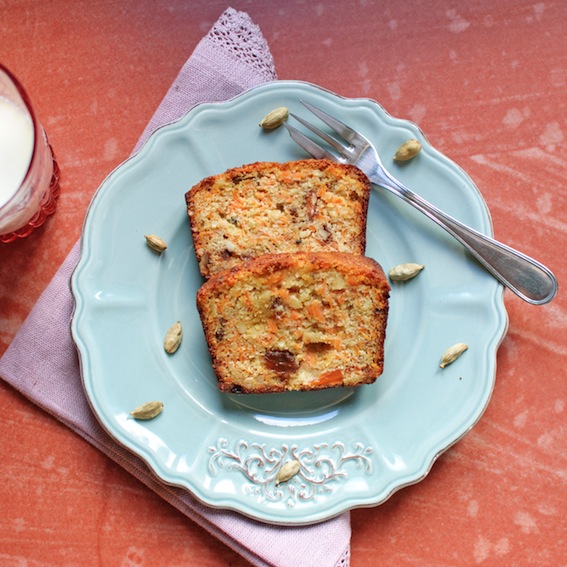
Halwa is a deliciously fragrant Indian dessert cake. It contains ghee, or clarified butter. Having had all dairy residue simmered off, ghee is suitable for people with dairy allergies. It is a rich source of omegas 3 and 9 as well as butyric acid which has been shown to decrease inflammation, particularly in the intestines. It is also an excellent source of vitamins A, D, E and K.
Ingredients (serves 12)
350g carrots, grated
50g raisins
50g almonds, chopped
50g pistachios, chopped
5 tablespoons ghee, melted (you could replace this with butter or coconut oil)
2 tablespoons honey
3 eggs, whisked
200g almond flour
½ teaspoon bicarbonate of soda
1 teaspoon cardamom seeds, crushed
Preheat the oven to 180°C. Combine the carrots, raisins, almonds, pistachios, ghee and honey in a mixing bowl. Gradually add the almond flour, bicarbonate of soda and cardamom seeds to the whisked eggs and blend until homogenous. Add the flour/egg mixture to the carrot/nut mixture and combine well. Transfer to a prepared medium-sized baking tin and bake for 40 minutes or until a skewer comes out clean.


