-
Smoked mackerel pâté and a broken cleaning lady

Smoked mackerel pâté We have broken our cleaning lady. Or to be more exact, the dogs have broken her. She’s never been their biggest fan; she believes that a dog’s place is outside and silent at all times. Personality and opinions, particularly dogmatic ones, should not be tolerated. If you’ve been reading my blog for a while, you’ll know that this just isn’t how we roll with Hugo and Java. Or at least, it isn’t how Hugo and Java roll with us.
I do see that it must be frustrating for her, especially when all the dogs within a two kilometre radius rock up for a ‘social’ when she’s trying to hose down the floors. They seem to sense the optimal impact moment to put in an appearance. And, in fairness, I do always say that cleaning our house is a bit like mucking out a stable. Anyway, this morning the hounds outdid themselves. The mild weather meant that the windows were open and Java, terrified witless by the vacuum cleaner, kept jumping out of the window, spent just enough time outside to dirty her feet and returned into the house through the front door. Ad infinitum.
Hugo, who had been invited (you don’t give Hugo orders; you make suggestions) to stay outside in a bid to reduce the carbon paw print, availed himself of the open window in the other direction to come back into the house (filthy paws and all) in order to launch a vicious assault on his long-standing nemesis, the hoover.
Happily, I wasn’t there this morning to witness this outrageous exhibition of doggie hooliganism. I did come back in time to be greeted by two manic, crack cocaine-smoking dogs and Luc administering medicinal Armagnac to treat the cleaning lady’s shattered nerves.
Health benefits of mackerel
Mackerel is packed with omega-3 essential fatty acids, which are associated with a multitude of benefits. Mackerel is also a great source of vitamin B12, selenium, niacin and phosphorus, amongst a range of other essential vitamins and minerals.
Recipe for smoked mackerel pâté (serves 6)
- 400g smoked mackerel, skin removed
- 1 ripe avocado
- 2 shallots, peeled
- 1 clove of garlic, peeled
- Juice of 1 lemon
- 1 tablespoon olive oil
- 4 tablespoons horseradish
- Sea salt and freshly ground black pepper
- 1 teaspoon paprika
Place all the ingredients in a food processor and combine until smooth. Chill for at least two hours and serve with either crispy French bread or raw vegetables (carrots, celery, fennel…)
-
Chicken soup and unruly hair

Chicken soup My hair is a free-for-all, to be chewed on, judged and discussed without compunction or reserve. I’m asked on a regular basis if it’s natural (because you think I would I chose it?), if it’s wet, if it’s dry, if it’s just been to the hairdresser and if it hasn’t. In some parts of the world, people come and stroke it like a strange woolly pet. A rather uncharming old lady who lives nearby actually uses the word ‘mop’ when referring to it, which she does every time I see her. And Luc said the other day ‘it just really suits you – it’s chaotic’. This was meant as a compliment (wtf?). The assistant in a posh haircare shop not long ago suggested, without a hint of irony, that I could ‘always try using a comb’ when I asked for advice on how to tame it. And to add insult to injury, Hugo chews on it in much the same way that he chews on Java’s ears.
Health benefits of chicken soup
A number of studies have been conducted on the usefulness of chicken soup (aka Jewish penicillin) in warding off and treating cold and flu viruses. It appears that the soup inhibits the movement of neutrophils, the most common type of white blood cell that defends against infection. The theory is, that by inhibiting the migration of these infection-fighting cells in the body, chicken soup essentially helps reduce upper respiratory cold symptoms by reducing inflammation.
The researchers couldn’t identify the exact ingredient or ingredients in the soup that made it effective against colds but say it may be the combination of vegetables and chicken that work together.
Make what you will of the research, but at the very least, chicken soup with vegetables contains lots of healthy nutrients, is easy to digest, increases hydration and tastes delicious.
Recipe for chicken soup
- 1 tablespoon olive oil
- 2 onions, peeled and chopped
- 2 shallots, peeled and chopped
- 3 cloves of garlic, crushed
- 2 leeks, washed and cut into rounds
- 1 fennel bulb, washed and cut
- 1/2 butternut squash, peeled and cut into cubes
- 4 carrots, peeled and cut
- 200g cabbage, shredded
- 1 red pepper or chilli pepper, cut into strips
- 2 sprigs of thyme
- 1 teaspoon fresh ginger, grated
- 2 teaspoons turmeric
- 1.5 litres chicken stock
- 2 tablespoons Pernod (optional)
- 300g pre-roasted chicken, skin removed and shredded
- 100g frozen peas
- 2 serving of pre-cooked brown rice
- Sea salt and freshly ground black pepper
Gently brown the onions, shallots, garlic and leeks in the olive oil in a large saucepan or casserole dish. Once browed, add the fennel, butternut squash, carrots, cabbage and chilli pepper and continue to cook for a few minutes. Add the thyme, ginger, turmeric, chicken stock and Pernod and bring to a simmer. Once the vegetables are almost cooked, add the chicken and frozen peas and continue to cook for another ten minutes. Add the brown rice towards the end of cooking, season with the salt and pepper and serve piping hot.
-
Kale crisps, obscenities and dog-shaped holes

Kale crisps

The Tallish One (I had to rename The Tall One as The Noisy One is now a good 4cms taller) and I have decided that Bossy is a bad influence on animals and also, I suspect, small children. She and Noisy went to London last week and, while she was gone, everyone, even Java, fell into line. Relatively speaking of course. Even the horses were less tiresome than usual. Animals really do have a sixth sense for authority; The Tallish One has it, Bossy just doesn’t. She makes a mean kale crisp though, so I think we’re going to hang on to her for the moment.Bossy hadn’t been on UK soil for more than half and hour before having an almighty ding-dong with a traffic warden (apparently something to do with her being a ‘toxic tyrannical tw@t’). So much so that the traffic warden ran after her yelling ‘don’t you dare walk away while I’m reprimanding you’. If you know Bossy, you can imagine how well that went down. The thing is, Bossy swears a lot. It’s actually one of the few things she’s really good at; I would probably go as far as to say she’s a Master of Blasphemy. She’s also got quite a talent for really pissing people off. Anyway, if you want to learn to eff and blind in English or French, Bossy’s your girl.
In other news, we found a Java-shaped hole in the wisteria canopy under Léo’s first-floor bedroom window, and a rather bemused Java shaking herself off on the ground beneath. I feel certain that Bossy must be to blame in some way – I’m just not sure how yet.
Health benefits of kale
One thing is sure: kale is so full of goodness that if it could talk, it certainly wouldn’t swear. As a vegetable it is a bit of an overachiever with its protein, fibre, vitamins A, C, K and B vitamins. It also contains minerals – potassium, calcium and zinc as well as omega 3, lutein and zeaxanthin.
Recipe for kale crisps
- 200g kale, rinsed and cut into strips, large stems removed
- 1 tablespoon olive oil
- Sea salt, freshly ground black pepper
- Espelette pepper or paprika
Preheat the oven to 150°C. Put the kale in a large bowl and add the oil. Massage it into the leaves, then toss with the seasoning. Spread out in a single layer on two large baking trays and bake for about 20 minutes, checking from time to time that it is cooking evenly. Leave to cool and eat!
-
Beef Rendang and pernickety males

Beef Rendang I inadvertently surround myself by fussy men. My father was very tricky to buy presents for, and I always ended up buying him books which was an interesting challenge. Well-written, knowledgeable, lively, original and slightly wry biographies about Winston Churchill or Napoleon were usually a good bet, and most things by Philip Roth or Ian McEwan usually passed muster. Books that tried to be too witty or too clever would be cast aside in disgust, as were novels by PD James who never ‘got to the bloody point’ quickly enough. It was with great sadness that I recently saw there was a new Churchill biography out because I’ll never know what he thought of it.
Luc and Léo are inordinately difficult to shop for because they’re both strangely obsessed with the weight of all shoes and clothing. Léo also has an aversion to pink, yellow and anything patterned. And not only must everything be feather-light, any zips or buttons must be ultra rapid to avoid, god forbid, slowing him down. Luc is a big fan of parachute silk and doesn’t care if his clothes make him look like gay Hawaiian televangelist, as long as they’re diaphanous. Mon dieu!
But it is Hugo that takes the biscuit (unless they’re dog biscuits which he spits out). His bedding is a source of sleepless nights for everybody. We are currently testing bed number four as the first three were not to his liking, which he made very clear. I do understand because I’ve had unpleasant experiences at times with uncomfortable bedding, but I don’t show my exasperation by growling and huffing and puffing all night.
Little Java is a breath of fresh air. Although I suspect she must have a preference for cashmere cushions (who wouldn’t?), she sleeps anywhere and on anything. She also eats absolutely everything (including dressed salad, mustard and melon, which, as dog owners will know, is incredibly random). There is literally nothing that makes her unhappy. Except gunfire; gunfire unhinges her, which is ironic as she was born and bred to be a gundog…
Recipe for Beef Rendang (serves 4)
- 1 onion, peeled and chopped
- 5 shallots, peeled and chopped
- 4 cloves garlic
- 1 stalk lemongrass, chopped
- 1 teaspoon turmeric (or fresh turmeric, grated)
- 4 fresh chillis, washed and chopped
- 1 teaspoon fresh ginger, grated
- 600g braising steak, cubed
- 2 tablespoons coconut oil
- 1 cinnamon stick
- 6 cardamon pods
- 4 kaffir lime leaves
- 500ml coconut milk
- 1 lime, juiced
- Sea salt and freshly ground black pepper
Place the onion, shallots, garlic, lemongrass, turmeric and chills into a food processor and blend to obtain a smooth paste. Add the meat to the paste, mixing well and leave to marinate in the fridge for at least a few hours. Heat the coconut oil in a casserole dish and fry the meat/paste mixture for a few minutes until well browned. Add the cinnamon stick, the cardamon (releasing the seeds from the pods beforehand) and the kaffir leaves. Add the coconut milk, lime juice and seasoning and bring to a gentle simmer. Cook for about an hour and a half, stirring frequently. The meat should be tender and the sauce reduced and rich.
-
Shiitake mushrooms and furtive barbarians

Shiitake mushrooms It will soon be mushroom season, although for the moment it’s still too hot and dry here; Luc is on damp ground watch like a crazy Frenchman. Oh, hang on… I did find a lone, perfect cep yesterday though, which was grabbed from my hand and in a frying pan asphyxiating in olive oil and garlic before I was through the door. I never go foraging without my vicious, spiky walking poles, ostensibly to move away leaves without having to bend down, although really to maim greedy cep-stealing fingers. There’s something about looking for mushrooms (mushrooming?) that turns people into furtive barbarians. Bump into someone who is blatantly foraging and they become incredibly defensive: ‘Me? Mushrooms? Can’t stand the mouldy bastards! I’m just hanging out in the middle of the woods, catching a few rays and bonding with the slugs’.
Even armed with my lethal walking stick, I won’t be finding any shiitake mushrooms around here; they grow wild in mountainous regions of Asia and absolutely nowhere else. Scientists have discovered a possible correlation between typhoon wind patterns and the scattering of shitake spores dispersed from one country to the other. The medicinal properties of shiitake mushrooms have been studied since the Ming Dynasty when Chinese elders considered the shitake to be the ‘elixir of the life’.
Shiitakes are unique because they contain all eight essential amino acids. They are also a rich source of vitamin D, B vitamins and selenium and other minerals. They also contain linoleic acid which aids weight loss and builds muscle. It also has bone-building benefits, improves digestion, and reduces food allergies and sensitivities.
Shiitake mushrooms contain beta-glucan, an immune booster and soluble dietary fibre that’s also found in barley, rye and oats. The lentinan they contain strengthens the immune system and helps to fight off disease and infection. Research suggests that shiitake mushrooms may help fight cancer cells and also help heal damage caused by anticancer treatments. The mushrooms have also been shown to induce apoptosis, the process of cell death. They also contain L-ergothioneine, a potent antioxidant with unique cell-protective properties.
Lastly, these wonderful mushrooms have been shown to have anti-vital, anti-bacterial and anti-fungal properties, effective against a wide range of mould, yeasts, and fungi. It would appear that they even have the ability to kill off the dangerous organisms without affecting the healthy organisms.
-
Gascon garbure and how to put a hen to bed

Gascon garbure We’ve had issues with foxes lately. When I say ‘issues’, obviously I mean that the vicious, gluttonous bastards have been mistaking our hens for chicken McNuggets and snacking on them before breakfast. The hens used to sleep in the barn, which worked well because horses and hens are natural companions. Both being prey animals, I suppose they have a mutual understanding of what it is to be persecuted all day; I always imagined them spending their evenings having a good old moan about ill intentioned predators and the day’s run-ins and close shaves. Anyway, the remaining hens, understandably traumatised by Nuggetgate, have since been transferred to enclosed premises: The old bread oven. Frankly, if I were a hen, I’m not sure how comfortable I’d feel about drifting off next to the gaping metal mouth of a huge oven. Luckily though, they’re not the brightest and seem happy enough in their new home.

After a week or so of ‘training’ which involved haphazardly running around the fields at dusk with spades and horsewhips (us), the hens now understand that they should put themselves to bed in their new quarters and no longer in the horses’ barn. All of them, that is, except one. At bedtime she comes to sit resolutely on the boot room table squawking VERY loudly until Luc succumbs and carries her to bed. Just leave it to us to either acquire or create a noisily needy, attention-seeking, high maintenance hen…

How worried should I be about Luc’s apparently blissful expression?
This hearty soup is a typical peasant dish from Southern Gascony. The vegetables used depend on the season, and in the old days the meat used would have depended on what was to hand. The most luxurious version is made with confit of duck, which is what I usually use, although you could too make it with chicken. I love the fact that there is a certain amount of fat in the soup, because it means that the nutrients from the vegetables are more readily absorbed.
There are many recipes for garbure, but I adapted this one from Jeanne Strang’s recipe in ‘Goose Fat and Garlic’.
Recipe for Gascon garbure (serves 6)- 2 small leeks
- 250g potatoes
- 125g celery
- 4 carrots
- 125g turnips
- 1 large onion
- 4 cloves of garlic
- 250g white haricot beans (previously soaked if using dried)
- 250g salt belly of pork
- 1.25 litres water
- 0.5 litre white wine
- bouquet garni
- Sea salt and freshly-ground black pepper
- 1 teaspoon piment d’Espelette (or paprika)
- 1 Savoy cabbage
- 6 pieces of confit de canard
Chop all of the vegetables except the cabbage and dice the pork. Place the chopped vegetables, beans and pork in a large pot or casserole dish, cover with the water and wine and bring to the boil, then skim and add the bouquet garni and seasoning. You will need to adjust the salt depending on what meats you are using. Simmer over a low heat for two hours, then shred the cabbage and add to the pot along with the confit de canard. Cook for a further 30 minutes and serve with French bread. Bon appétit!
-
Asparagus: The great spring cleaner
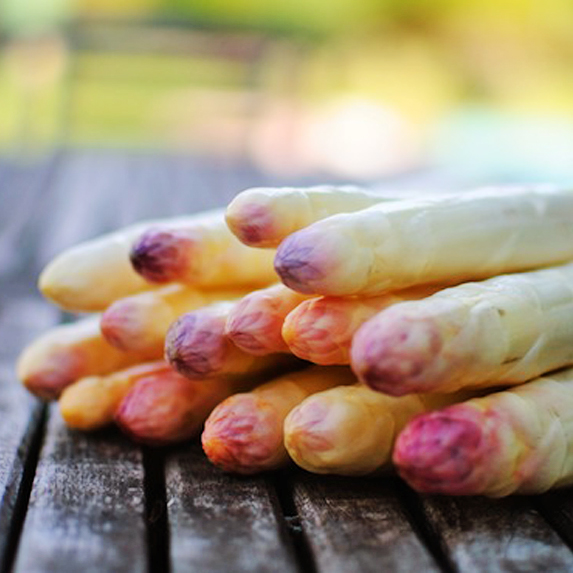
White asparagus It’s asparagus season which, for me, results in really bizarre, almost psychedelic dreams. Every Spring I hope this will be the year I can eat asparagus to my heart’s content without the added bonus of technicolour horror films. I suppose it could be related to its powerful detoxifying properties. I would be interested to hear if anyone else suffers from this.
Consuming seasonal produce provides unequalled support for our health. And at this time of year, when we need to be detoxified and invigorated after a winter of excesses and heavy, rich food, asparagus is unrivalled.
White asparagus, reputedly cultivated in France since the renaissance, was dubbed the ‘food of kings’ by Louis XIV, aka the Sun King, who grew asparagus year-round in hothouses at Versailles and ate them dipped in a soft boiled egg. Ironically enough, white asparagus must be covered with soil and protected from the sun at all times or it produces chlorophyll which makes it turn green or purple. White asparagus is particularly delicate and well-suited to the light, mineral-rich, sandy soils of this region, the Landes, in southwestern France.
Asparagus is nutrient-dense and high in vitamins A, B, C, E and K, as well as potassium, iodine, chromium and zinc. It is also an excellent source of rutin, a flavonoid that prevents small blood vessels from rupturing. It should be noted that the fat-soluble vitamins (A, D, E and K) should be eaten with healthy fats to be efficiently absorbed, which is why asparagus is best eaten with melted butter, vinaigrette or dipped into an egg yolk like the Sun King.
Asparagus also has antioxidant and anti-inflammatory properties which may help reduce chronic health problems such as type II diabetes, heart disease and cancer. The antioxidant glutathione has been shown to slow the ageing process and break down free radicals, protecting your skin from sun damage and pollution. Glutathione also plays a pivotal role in immune function.
With its high levels of the amino acid asparagine, asparagus also acts as a natural diuretic, ridding the body of excess salt and fluid, which is very beneficial for people with oedema and high blood pressure. Researchers have also discovered that asparagus is useful in the treatment of urinary tract infections by reducing pain and swelling.
The high inulin content of asparagus feeds and promotes the healthy gut bacteria that are responsible for better nutrient absorption and better digestive, immune and mental health. Finally, asparagus is an extremely good source of fibre, which moves through the digestive tract trapping excess fat, sugars, bacteria and toxins to remove them from the body.
-
Trout with almonds and an eight-kilo water baby

Trout with almonds As a discerning Frenchman-in-the-making, Léo has strong opinions about the taste, quality and provenance of the water he drinks. At lycée, he often plays football at lunchtime with his classmates and, after playing on Friday, they were thirsty and nipped to the supermarket where he spotted an eight-litre bottle of his preferred water on special offer. Although they were due back in class, he couldn’t resist, and he and his friends had to haul this vast bottle back over almost a kilometre and up several flights of stairs.
The vat was treated like a new class member and given its own desk and chair and became quite the talking point, much to the teacher’s exasperation. Over the next couple of days, it accompanied them everywhere, including the canteen at lunchtime where it had its own place at the table. When Léo was telling me this story, I was reminded of an experiment where men were asked to carry a five-kilo bag of flour around with them all day, pretending it was a baby. They had to feed it, change its nappy, put it down to sleep and generally do their best not to kill it. So now I feel like the grandmother of a giant blue, intellectually precocious water baby called Volvic…
In other news, I think that Java, who couldn’t be accused of intellectual precociousness, might need reading glasses. Either that or she’s wilfully disobedient, which I’m sure can’t be the case. Léo says a lobotomy is the only answer, but in view of the whole big blue water baby paternity thing, I’m not sure his opinion’s valid.

We are eating more trout and less salmon these days because, although I love wild salmon, it’s not always easy to find and is also expensive. Farmed salmon has three times more fat than the wild variety and a large proportion of this fat is the pro-inflammatory Omega 6, as opposed to the more beneficial Omega 3 fatty acid. It is the couch potato of fish and the quality of its fat speaks volumes.
Recipe for trout with almonds (serves 2)
- 100g salted butter
- 2 tablespoons fresh chives, chopped
- 2 tablespoons fresh parsley, chopped
- 1 tablespoon lemon juice
- 2 whole trout, cleaned and gutted
- Sea salt and freshly-ground black pepper
- 1 teaspoon paprika
- 80g flaked almonds
Preheat the oven to 180°C. Melt half of the butter and combine with the fresh herbs and lemon juice. Cover the trout generously and then set into a baking dish and add the seasoning. Bake for about 25 minutes or until the fish crumbles when prodded with a fork. Melt the remains of the butter and gently fry the flaked almonds until golden brown. Pour over the cooked fish and serve.
-
In memory of Isabelle

A month ago a very old friend of mine lost her 18-year-old daughter, Isabelle, to EHE (epithelioid hemangioendothelioma) after a long and very brave fight. EHE is little-known, rare and vastly underfunded form of cancer, and my friend and her family are now determined to raise both awareness and funds to perhaps help prevent others from suffering a similar tragedy. So this is for Claire-Anne, OJ and Sebastian; in memory of your beautiful daughter and twin sister, Isabelle. This is their story:As some of you know, 12 months ago our world was blown apart when our 17 year old daughter Isabelle, following two years of increasing neck pain, was diagnosed with an extremely rare cancer epithelioid hemangioendothelioma (EHE for short). Instead of enjoying friendships, worrying about end of school exams and planning her future life after school, she was thrust into a world of hospitals, IV drips, pain and fear.
In March 2017 she underwent major surgery to her neck and spine. From May-July she received radiation and proton treatment which removed the cancer but left her virtually unable to swallow. In August she started having agonising chest pain, only to then be told the cancer was now in her left lung. As a result in September she started receiving aggressive chemo, which led her to spend weeks in hospital due to the side effects and numerous complications. In short, to quote Isabelle, ‘life sucks’.
EHE is a rare vascular tumour that arises from the lining of blood vessels. It can appear almost anywhere in the body, but common sites include the liver, lungs, and bones. The cause of EHE is presently unknown, and no proven treatments exist. EHE tumours can behave differently from one patient to the next, with some being stable for years while others progress quickly. The cancer often metastases throughout the body and possesses the ability to transform into an extremely aggressive state with little or no warning. In short, EHE is an unpredictable disease.
The EHE Rare Cancer Charity is fighting back by funding research into finding a cure and provides invaluable support and information to patients and families like us, whose lives are affected by this devastating disease. Sadly however, very rare cancer research gets no funding from governments, none from the pharmaceutical companies, and almost zero even from the big cancer charities.
Companies and foundations will help but only if we continue to show that we are raising funds too.
Donating through JustGiving is simple, fast and totally secure. Your details are safe with JustGiving – they’ll never sell them on or send unwanted emails. Once you donate, they’ll send your money directly to the charity. So it’s the most efficient way to donate – saving time and cutting costs for the charity.
Thank you Claire-Anne, OJ and Sebastian.
Please click here to donate -
Stir-fry scallops and decorating hens

Stir-fry scallops Java has a boyfriend. In fact, she has two. One lives about a kilometre away to the east, and the other a kilometre to the west. At the moment they have different visiting times but, as one of them in particular is making himself more and more at home ‘chez Java’, it’s inevitable that one day they’ll turn up at the same time and I’m afraid it won’t be pretty. Especially if drama llama Java has anything to do with it.

Meanwhile, Hugo is delighted because it gets her off his back for a bit; when either of them turns up, he shrugs a gallic canine shrug, sighs with relief and leaves them to it. There are only two prerequisites to be Java’s dogfriend: speed and stamina (although Hugo would no doubt say stupidity was another one). ‘Dates’ consist of running around the house at break-neck speed for hours on end, stopping only occasionally either to change direction or to slurp noisily from the pool. If they tire before she’s had enough, she barks at them manically. A catch she is not – just ask Hugo.
In other news, I noticed the other day that a couple of the hens had blobs of Farrow and Ball’s ‘Folly Green’ paint on their wings. Thinking that they’d just been hanging out too long in the workshop, I rinsed them down and forgot about it until Luc started to rant that the hens’ ‘tattoos’ had faded. Apparently he’d been colour-coding them according to how many eggs they lay. No doubt this information was to make its way onto a complicated spreadsheet to determine whether they’re paying for their keep, and if not, whether their next port of call should be a Le Creuset casserole dish. As he knows that I refuse to cook any beast that I’ve fed and built up a relationship with, it seems rather futile, but whatever floats his boat. And spreadsheets seem to.
These scallops seemed to float everyone’s boat when I last made them. I served them with rice, but they would be delicious with noodles too.
Recipe for stir-fry scallops (serves 4)
- 4 tablespoons sesame oil
- 10 mushrooms, peeled and sliced
- 1 red onion, peeled and sliced
- 2 small carrots, peeled and sliced
- 75g greens peas
- 1 red pepper, sliced
- 500g scallops
- 2 cloves garlic, crushed
- 2 teaspoons fresh ginger, grated
- 1 teaspoon chilli powder
- 4 tablespoons soya sauce
Heat the sesame soil in a large frying pan or wok, add the mushrooms, onion, carrots, peaks and pepper and stir fry until tender. Add the scallops, garlic, ginger and chilli powder and stir fry for about two minutes or until the scallops become opaque. Add the soya sauce heating for a further minute and serve. I served with a combination of wild rice/thai rice.