-
Fish curry (and absolutely not a hen in sight!)

I’m a great fan of spicy food in very hot weather. Actually I’m a fan of spicy food in cold weather too, but the arguments in favour are less convincing.
Spices help to kill bacteria that develops in hot weather when fridges are unavailable. Certain spices, such as chilli also help kill off intestinal parasites which tend to develop in warm weather. They also stimulate appetite and digestion, both of which become sluggish when it’s very hot. They make you sweat (although this may not really sound like a good thing), which is your body’s way of cooling down and as a final bonus spices boost serotonin levels which makes you happy 🙂
So even if it’s 10 degrees and cloudy with you today, you’ll find this easy, delicious and healthy.
Ingredients (serves 4)
4 filets of white fish (I used hake)
1 onion
2 cloves of garlic
Freshly grated ginger
2 tomatoes
1 cinnamon stick
1 cup of peas
Handful of cashew nuts
Handful of raisins
1 cup of coconut milk
Fresh mint
1 fresh chilli
1 tblsp coconut oil
2 cups of vegetable stock
Seasoning – curry powder, sea salt, pepper, cumin seeds
Melt the coconut oil in a frying pan and gently fry the onions and garlic until golden brown. Add the fish and the chopped tomatoes and keep frying gently for few minutes. Add the stock and then the spices, ginger, cinnamon stick, raisins, cashew nuts and peas. Bring back to a gentle simmer. Cook for about 15 minutes and then add the coconut milk and freshly chopped mint. Serve! -
Spicy strawberries and dunking hens

To follow on from my previous post, my husband decided that the softly softly ‘I’m listening’ approach was not going to be the way forward with our moody, hormonal hen. Anyone who has met my husband will appreciate that this is said without even a trace of irony. So bottom-dunking in a bucket of cold water three times it was. The cussing was impressive, but in fairness, so were the results; she has lost the will to phantom nest and is back to scutteling around happily after her friends, no doubt wishing much harm upon the mad dunker in her mind. Problem solved you might think. Perhaps, but the horses who had been witness to the unceremonious bucket-dunkings are now traumatised and scared witness of their master. They do 0-60 faster than I ever thought possible as soon as he approaches, leaving hens, humans and dogs in their wake. They can rest assured though; we don’t own, and aren’t about to own buckets big enough for him to dunk their hindquarters in.
This has absolutely nothing to do with stawberries of course, for which I’m about to give you details of an original and ultra-healthy way to serve…
Ingredients
Strawberries
Yacon syrup
Juice of half a lemon
Fresh mint
Chilli powder
Grated ginger
Black pepper
Prepare the strawberries by cutting off the leaves, rincing and cutting into two. Place in a bowl and then add the syrup, lemon juice, grated ginger, mint and peppers. Chill for at least an hour and serve with greek yoghurt.
The combination of antioxidents in the strawberries and peppers, the alkalising effect of the lemon juice, the anti-inflammatory action of the ginger and the many virtues of yacon syrup makes this dish practically medicinal. Consume without moderation. -
Coronation chicken and adolescent hens
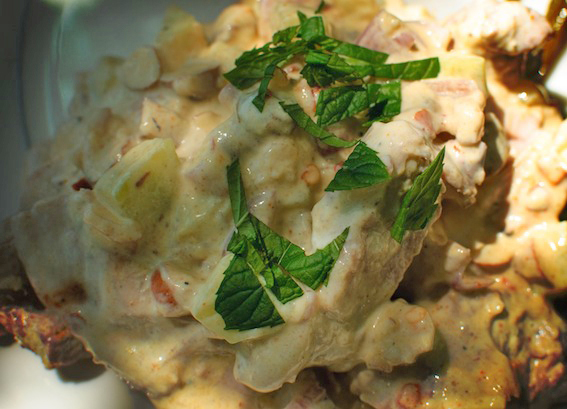
This was topical a week ago, but I’ve been rather over-stretched. Amongst other things, the horses flooded their barn (our mare enjoys turning on taps with her nose), and one of the hens is in the midst of a phanton pregnancy. Actually our mare’s passion for taps might be a blessing in disguise. The flooding reached the hens’ nest which meant that the phantom nester had to abandon ship (not without much cussing) and go back to being a hen that struts around (with wet feet!), as opposed to a hen that skulks in bed, hissing at anyone that approaches and only getting up once a day for food. This, I assume is the hen equivalent of a ‘fags and booze run’. Thinking about it, maybe she’s just hit adolescence and it’s not a phantom pregnancy at all…This coronation chicken is made with Greek yoghurt as opposed to mayonaise, which makes it a healthier option, without sacrificing any of the creamy taste or texture.
Ingredients (serves four)
4 chicken breasts
1 glass red wine
butter
bay leaves
2 greek yoghurts
2 tablespoons mango chutney
1 shallot
2 cloves garlic
fresh grated ginger
chopped cucumber
seasoning (salt, pepper, curry powder, cumin)
half a cup of sultanas
half a cup of chopped almonds
fresh mint
Poach the chicken breasts in the wine, a little water and melted butter (there should be enough liquid to just cover them), seasoning and bay leaves. Strain and put aside to cool.
Mix the yoghurt, mango chutney, chopped shallots, crushed garlic, grated ginger, seasoning (plenty of curry powder), sultanas, almonds and chopped cucumber and add the cooled poached chicken. Mix well and then chill for at least two hours. Add the fresh mint and serve. -
Vagrant rhubarb cake

We have a garden full of nomadic rhubarb. Originally I had inadvertantly planted it over our sewage system, so my husband moved it and it randomly became the ‘pièce de resistance’ by the edge of the pool; I don’t know what that was all about. As much as I love rhubarb, it isn’t the plant of exceptional beauty that you might expect to see in such a prime location, so it was moved again – to the vegetable patch, oddly enough. This time, the dog took exception to its location and dug it up in a fit of frenetic hysteria one night when we weren’t looking. I decided enough was enough and maybe rhubarb just wasn’t meant to be in our garden and chucked it unceremoniously onto the compost heap, where it took root of its own accord and has prospered ever since.
Rhubarb is a little tart (particularly ours, as it gets around so much!) and really needs more sugar than I’m willing to use. I get around this by stewing it with yacon syrup, which has a low GI and deliciously fragrent caramel taste. Made from the roots of the yacon plant which is indigenous to the Andes, it is used throughout South America for its nutritional properties; it is said to help diabetes as well as renal and digestive problems.
Ingredients
Stewed rhubarb:
4 stalks of rhubarb
2 tbsp yacon syrup
1 cup of water
stem ginger, chopped
1 tsp cinnamon
1/2 cup of raisins
Cake:
1/4 cup of butter
1/4 cup of coconut oil
1 egg
1 tsp vanilla extract
a pinch of salt
2 tbsp yucon syrup
1 cup of chickpea flour
1 cup self-raising flour
1 tsp bicarbonate of soda
1 cup milk
Start by stewing the rhubarb. Peel the stalks and cut into pieces of approximately 2cm. Add the yucon syrup, ginger, cinnamon and about a cup of water. Gently braise for about 20 minutes or until the rhubarb forms a runny jam-like consistency.
Prepare the cake mix by creaming the warmed coconut oil and butter until light and fluffy. Add the yucon syrip until the mixture is blended. Next beat in the egg and vanilla. Sift together the flour, salt and bicarbonate of soda and combine with the milk. Add little by little to the egg/fat mixture until well blended. Finally fold in the stewed rhubarb and spoon into a greased cake tin. Bake in a preheated oven for about 40 minutes at 180°C. -
Navarin of chicken

I know that, strictly speaking, this should be navarin of lamb. I did briefly hover over the lamb counter, but before I’m ever able to pass from hover to purchase so many images of sweet, fluffy new-born lambs dancing in the long spring grass come to mind that I just can’t do it. Mind you, now that we have hens and I see them living their free-range lives, chicken will no doubt be off the menu soon too!
From an idealistic perspective I should probably be a vegetarian, but I remain entrenched in my conviction that we are meant to eat at least a small amount of meat. I’ve also seen too many miserable-looking vegetarians for it to be an attractive proposition; why is it that they so often look grey and dour?
The term ‘navarin’ is really a reference to the vegetable content of the dish and not the meat, so here is my Navarin for Sensitives Souls:
Ingredients (serves 4)
4 chicken wings and 4 legs
4 spring onions
10 baby carrots
4 baby leaks
6 new potatoes
4 baby turnips
1 courgette
cup of peas
olive oil
seasoning (salt, pepper, chicken stock)
bay leaf, rosemary, fresh mint
2 glasses of dry white wine
Slice the onions and gently brown in a casserole dish in the olive oil. Add the chicken pieces and seasoning and brown gently for a couple of minutes. Add the wine, chicken stock and herbs. Bring to a gentle simmer and add the carrots, leaks, turnips and potatoes. Place in a preheated oven (180°C) for an hour and then add the peas and sliced courgettes, making sure that the liquid level in the dish is still at least 3cms. Cook for a further 20 minutes and add the fresh chopped mint just before serving. -
Almond chocolate cake

You may have noticed that I never use normal flour in my recipes. This isn’t only because eating refined wheat flour is about as nutritious as snacking on yesterday’s newspaper, but because I’m wheat-intolerant. It’s not something I harp on about a) because it’s boring and b) because I’ve noticed that not ‘tolerating’ is something that brings out the devil in a lot of people. I’ve lost count of the number of times people have offered me something that is quite patently going to have me doubled up in agony within the next twelve hours and refused to take no for an answer when I decline: ‘Oh go on, I’ve just made it, a little bit won’t hurt, surely…’ It’s as if I’m saying no to be awkward, or to be interesting or different. Err no, if I wanted to be awkward I’d ask you to serve it to me sprinkled with powdered rhino horn, and if I wanted to be interesting or different I’d dye my hair indigo and take up mud pit belly flopping.
This cake, regardless of your ‘wheat status’, is divine. It will leave you wondering why you ever made chocolate cakes with wheat flour. The fact that it uses powdered almonds means that, for a chocolate cake, its GI is quite low and that it contains valuable nutrients. It also has a fairly low sugar content.
Ingredients
5 eggs
130g cane sugar
140g powdered almonds
60g butter
60g coconut oil
125g dark chocolate (preferably 90% coco)
pinch of bicarbonate of soda
1 tsp baking powder
Preheat the oven to 150°C. Melt the chocolate with the butter and coconut oil. Once melted, add to the sugar, egg yolks, almonds, bicarbonate of soda and baking powder. Whisk the egg whites until stiff. Fold the egg whites into the chocolate mixture and pour into a 20cm cake tin. Bake for 45 minutes.
-
Cod with basil and tomatoes

A lady fishmonger served me this morning and, instead of enquiring into the corpulence of the people I was going to cook for, took the time to explain this delicious recipe to me. There was a massive queue, but she certainly didn’t let this deter her from such minutiae as the exact size to cut the basil leaves and a description of the delectable aroma that would waft from the oven after about five minutes’ cooking. She even took the time to wish me a ‘bon appétit’ before turning to her line of, by this time, fuming but drooling clients. It’s a terrible cliché, I know, but I do maintain that one of the things I love most about the French is that they have their priorities well and truly in order.
Ingredients (serves four)
4 cod filets
12 cherry tomatoes
1 tbsp mustard
Olive oil
10 basil leaves
handfull of pinenuts
1 cup of wholemeal breadcrumbs
1 clove of garlic
sea salt and pepper
Preheat the oven to 200°C. Cover the cod filets with olive oil and place in an ovenproof dish. Season and then brush the filets with mustard before tossing them in the breadcrumbs and sliced basil leaves. Cover the tomatoes (cut in two) with breadcrumbs and then add to the dish. Sprinkle the chopped garlic and pinenuts over everything and cook for 15 minutes.
Bon appétit! -
Cod in chickpea batter (gf)

Cod in chickpea batter When I asked for cod filet for three this morning, the fishmonger asked if it was for three normal people, or three rugbymen. I had replied that it was for three normal people and then wondered if this wasn’t perhaps stretching the truth a bit.
In southwestern France, we live amongst constant reminders of the rugby-playing heritage. Many refer to the region as l’Ovalie, which means the land of the oval ball, and one Landaise priest has even dedicated his chapel, Notre Dame du Rugby, to his passion! Towns and villages are deserted whenever there’s a match on, and weekends in hospital emergency rooms are not for the faint-hearted; they’re bursting with sights of broken and bloody noses, limbs and assorted extremities and sounds of blubbering girlfriends.
Back to my normal fish. Delicious as it is, cod can be a bit bland. Although that could be due to my overextended tastebuds which are singed on a regular basis by very spicy food. This chickpea batter is both healthy and delicious and an excellent vehicle for herbs and spices. Chickpea flour is far healthier than refined wheat flour as it’s packed with vitamins (particularly folic acid), minerals and protein-building amino acids. It also has a very low GI and is very tasty.
Recipe for cod in chickpea batter (for 4 normal people)- 4 cod filets
- 50g chickpea flour
- 1 cup of water
- 1 garlic clove
- olive oil and coconut oil
- seasoning (salt pepper, paprika)
- pinch of bicarbonate of soda
Combine the chickpea flour and bicarbonate of soda with enough water (roughly a cup) to make a batter similar to a pancake batter. Add the seasoning and crushed garlic clove, then dip the cod filets in the batter, making sure they are covered all over. Cook in about half a centimetre of olive and coconut oils on a medium hob (cooking oil should never smoke) for about five minutes on each side. The end result should be golden brown and crisp!

Cod in chickpea batter -
Salt and Pepper

We have two hens called Sel and Poivre (Salt and Pepper). We bought them in the hope of being able to teach Hugo, our dog, that chickens are to be admired from a respectable distance and not eye-balled viciously, whilst sinking sharp canine teeth into their necks. He had taken to sloping off to the neighbouring farms to ‘play’ with their hens in a way that would have earned him an ASBO if he lived in the UK.
Six weeks on and the hens are still alive, which is nothing short of miraculous when I think back to the way he greeted their arrival. But the hens’ biggest passion is the horses; they preach at the alter of all things equine. If the horses are lying down in the sun, so are they; if the horses are eating hay in the grange, the hens will be pecking away next to them. And when the horses gallop around the field, they follow as fast as their little legs will carry them.
Anyway, we moved the horses down the road a couple of days ago to ‘mow’ a neighbouring field, and the hens (who live in the horses’ stabling) went into a sharp decline. To such an extent that one of them (Salt) stopped laying. I’m not quite sure how that works, but I’ve been assured by People Who Know that hens, contrary to appearances, are really quite emotional beings. We brought the horses back this evening (I was getting hungry!) and they were met by two very very happy ladies. They’re cuddling up as I type.
The original aim of this post was actually to point out the fact that eggs are Very Good News from a nutritional point of view, and not go into our poultry’s state of heart in such detail. So, eggs contain substantial quantities of high-quality protein and most vitamins (with the exception of vitamin C) and minerals; valuable components in a healthy diet. From a culinary point of view, as well as being healthy and delicious, they are incredibly versatile – they can be boiled, poached, fried, scrambled or made into omelette, quiche, tarts, sauces, mousses…
From your point of view as well as the hens’, please buy free-range. -
Tunisian meatloaf
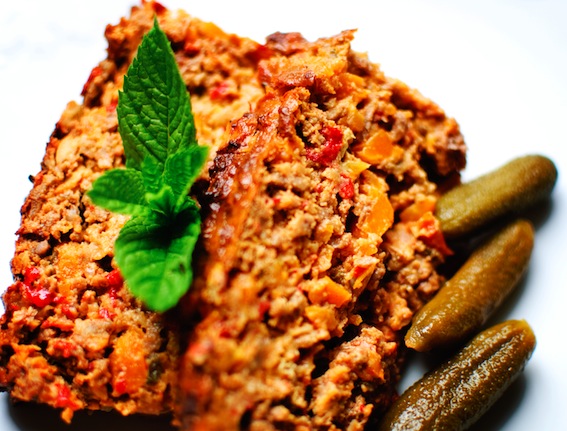
Although I never let slip a chance to take a cheap pop at vegetarians (our horses, for example – how could anyone in their right mind just eat grass all day?), I’m not exactly a flesh-ripping carnivore myself. In fact, the better meat is disguised, the happier I am.
It’s complicated serving meat in this house. My husband and son, in true French male style, get inconsolably hysterical if they think it’s overcooked and I ‘come over queer’ if it’s underdone. Hugo, the labrador, is extremely conciliatory (or greedy?) and eats it either way.
This fragrent meatloaf ticks all the boxes; vegetables for me so that I forget I’m eating meat, and just enough meat for my carnivourous husband and son to satisfy their Neanderthal instincts.
Ingredients (serves six to eight)
2 onions
3 carrots
1 aubergine
2 garlic cloves
3 medium tomatoes
Olive oil
200g pre-cooked chickpeas
300g minced beef or lamb
3 eggs
1 tbsp Lee and Perrins sauce
Parsley
Rosemary
Bay leaf
50ml tomato ketchup
seasoning to taste (seasalt, pepper, cumin, coriander, cayenne pepper)
Cut the aubergine into slices and leave to ‘sweat’ out the moisture with seasalt. Brown the vegetables (including the aubergine) in olive oil in a large frying pan cooking over a medium heat for about 20 minutes. Add the rosemary and seasoning and set aside. Combine the meat, beaten eggs, Lee and Perrins sauce and ketchup in another bowl. Roughly blend the vegetable mixture, chickpeas and fresh parsely until it forms a lumpy paste (ie not blended too much) and add it to the meat mixture. Spoon the combined mixture into a loaf tin and cook for about an hour and a half in a medium oven (180°C). Leave to sit for ten minutes before slicing.
May be served hot with couscous cooked with mint, sultanas and peas and a hot tomato sauce, or cold with crisp green salad and gherkins.


