-
Chicken tagine with prunes and almonds and black labrador narration

Hello! It’s Hugo writing today’s recipe. I have a feeling the bossy, yellow-haired one often refers to me as the ‘neurotic canine’ or some such. She’s a fine one to talk — you should have seen the state she was in when I was ill recently *evil cackle*. I’m not going to say anything bitchy about her though because she takes me for a nice long walk everyday, if I do abandon her the second we set out, only coming back to shake my dripping, muddy self all over her. This tagine was paw-licking-good, although I might suggest that next time she remove the prune stones. I don’t mind crunching on bones, but stones are for girls. In fact, I spat them out and left them for the hens!
Ingredients (serves 4)
3 tablespoons of olive oil
2 medium onions, chopped
3 cloves of garlic, crushed
8 chicken thighs
Juice of half a lemon
1 teaspoon fresh ginger, grated
2 teaspoons cinnamon
1 teaspoon turmeric
1 teaspoon coriander
Sea salt and freshly ground black pepper
Bay leaf
Two generous tablespoons of orange marmalade (or apricot jam)
400g dried prunes
200g almonds, roughly chopped
500ml chicken stock
Fresh coriander to servePreheat the oven to 180°C. Gently brown the onions, garlic and chicken in the olive oil in a medium-sized casserole dish. Once golden brown (after about eight minutes), add the lemon juice, seasoning and spices and continue to brown for a further five minutes. Add the marmalade (or jam), prunes, almonds and chicken stock and bring to a gentle simmer. Cook in the oven for about an hour and a half or until the sauce is beginning to caramelise slightly.I served this with spicy cauliflower. -
Spelt apple cake and discomfiting headwear
I had assumed that I’d become immune to embarrassment, thanks to a long haul desensitisation programme courtesy of my husband. It just wasn’t humanly possible to blush every single time someone fell victim to his uninhibited candour (‘if I had feet like yours, I wouldn’t wear open-toed shoes’ springs to mind).
But for some reason, in his Basque terrorist guise when we went out to lunch today, he inadvertently excelled himself. Obviously I have nothing against Basque terrorists per se. After all, nobody can wear a beret quite like a Basque. And their food is beyond divine. Of course, they hit a low point when they started blowing things up, but nobody’s perfect. But the beret, a promotional gift from our local DIY store with their logo written across the front in BRIGHT RED LETTERS, proved to be a cringe too far. I appear to have become, amongst other things, a beret snob 😳
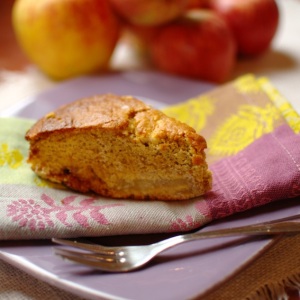
This apple cake is as simple as it gets, but no less delicious for it and certainly nothing to be ashamed of; I’ve had enough shame for one week 😉
Ingredients
2 large apples, peeled and sliced
handful of raisins
1/2 teaspoon cinnamon
150g cane sugar
200g spelt flour
1 teaspoon baking powder
1 teaspoon bicarbonate of soda
2 eggs, beaten
1 pot of yoghurt (125g)
75ml melted virgin coconut oil
75ml melted butter
Preheat the oven to 180°C. Poach the apples and raisins in a small amount of water. Add the cinnamon. Once the apples are soft (about 15 minutes), drain the excess cooking juice and set aside. Combine the sugar, flour, baking powder and bicarbonate of soda, then add the yoghurt, eggs and melted coconut oil and butter. Mix well. Stir in the poached apples and cook in a medium-sized cake tin for 30 minutes. -
Easy fisherman’s pie (gf) and assorted ailments
I have been anything but a Healthy Epicurean this past week 🙁 If I ever give tips on flu-dodging, please feel free to ignore – I obviously don’t know what I’m talking about. My endless witterings about optimal vitamin D levels and the like, have proved to be as useless as they are boring. Having said that, so far, neither husband nor son have caught it, so maybe I’m just better at dispensing advice than implementing it. True to form, poor Hugo developed piroplasmosis, a potentially fatal tick-borne canine disease, as a mark of sympathy. One syringe full of antidote and two raw steaks later and he was raring to go again. I only wish the same could be said for me #whingemoan 🙄
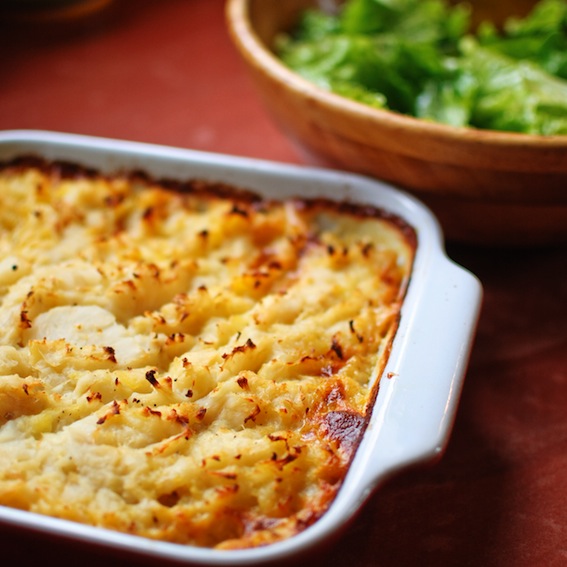
I adapted this fish pie from a recipe by Tana Ramsay. My version is gluten-free.
Ingredients (serves 4)
300g white fish (cod or haddock), skinned and boned
200g salmon, skinned and boned
150g prawns, peeled
200ml milk
200ml vegetable stock
1 tablespoon olive oil
1 large onion, chopped
3 leeks, sliced
2 carrots, peeled and chopped
4 mushrooms, peeled and sliced
3 large potatoes, peeled
half a celeriac, peeled
knob of butter
Sea salt and freshly ground black Pepper
1/2 teaspoon paprika
150ml double cream
4 tablespoons grated cheese (cheddar, compté, parmesan)
Preheat the oven to 190°C. Place the fish and prawns in a frying pan and cover with the milk and stock to poach (for approximately ten minutes). Fry the onion, leeks, carrots and mushrooms in olive oïl to soften. Cut the potatoes and celeriac into large chunks and boil until tender. Drain and mash with a knob of butter and the seasoning.
Add the drained fish to the fried vegetables and double cream and combine well. Place this mixture in an ovenproof dish. Spoon the mashed potato/celeriac over the top, sprinkling the grated cheese on top. Cook for about 30 minutes until the potatoes and cheese are golden brown and bubbling. -
Raspberry and apple tart with almond topping and crabby electronics
I’ve had a very busy week accomplishing lots of useful things: I grilled two computers (one was struck by lightning, which wasn’t really my fault; the other was struck by impatience, which was.) My credit card was chewed up because I think I’m capable of talking and typing my PIN number simultaneously. A non-identified metal object fell off the bottom of the car and I burned out the motor of the Kitchenaid (which is quite a feat as they’re meant to be indestructible.) I am typing this very cautiously on my ipad, fully expecting it to spontaneously combust at any minute. If I don’t post for a while you’ll know why 😉
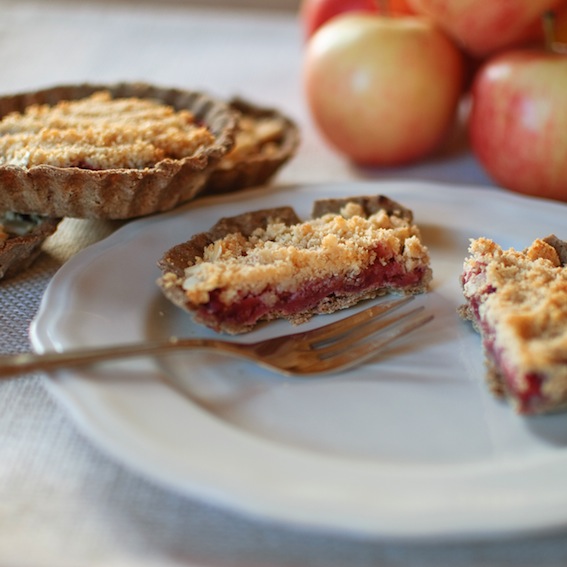
I did however manage to make these tarts without exploding the oven, so that was really quite encouraging. 🙂
Ingredients for pastry (serves 6-8):
150g buckwheat flour
70g spelt flour
50g butter
50g virgin coconut oil
Roughly 6 tablespoons of cold water
Ingredients for filling:
2 apples, peeled and sliced
60g raspberries
1 teaspoon cinnamon
Ingredients for topping:
60g powdered almonds
30g virgin coconut oil
15g cane sugar
10g almond flakes
To make the pastry, begin by cutting the butter and coconut oil into small cubes. Add to the flour in a mixing bowl and add a pinch of sea salt. Blend by hand until the mixture becomes crumbly. Add the cold water, mixing rapidly with a spoon. Remove the mixture from the bowl onto a lightly floured surface. Knead until you obtain a ball of pastry (if the mixture isn’t ‘sticky’ enough to form a ball, you may need a drop more water). Wrap in a clean cotton tea towel and leave to ‘rest’ in the fridge for about two hours. This relaxes the dough and makes it easier to use.
Preheat the oven to 180°C. Roll out the pastry on a clean, lightly floured surface and fill the tart tins. Precook the pastry for 12 minutes.
Poach the apples and raspberries in a little water, adding the cinnamon to the fruit. Prepare the topping by rubbing the coconut oil into the powdered almonds, before adding the sugar. Assemble the tarts once the pastry is pre-cooked by filling each pastry case with the poached fruit and then covering with crumble topping and almond flakes. Put back in the oven for 15-20 minutes, or until the topping is beginning to brown. -
Aubergine lasagne (gf) and potentially badly-behaved tennis mothers
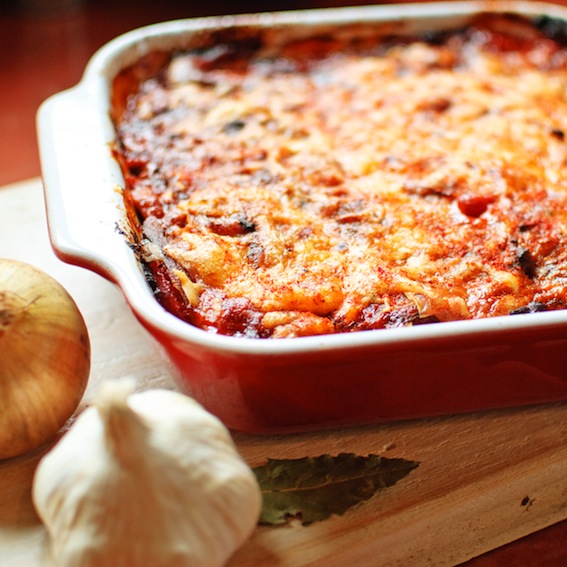
Léo, my son, played in a tennis tournament yesterday. For me, this resulted in an acute attack of what I can only describe as Internal Tourettes. In my head, I morphed into a sort of raging maniac. Believe me, it wasn’t pretty; move over Tiger Mother – you’ve got competition! My shameless unsportsmanlike mind cheered at double faults, hissed and snarled at anyone deigning to applaud theenemyopponent and yelled things that I’m certainly not going to commit to type. And yet, there I sat with a beatific smile that said ‘it’s the taking part, not the winning that counts’. Yeah right . This was definitely one of those occasions that called for unbridled hypocrisy, something I’ve apparently mastered to a T.
This lasagne is suitable comfort for scrupulously gallant players who might or might not have been defeated by up-themselves whippersnappers 😉
Ingredients (serves six)
2 medium-sized aubergines
1 tablespoon olive oil
1 large onion, peeled and chopped
2 cloves of garlic, chopped
1 carrot, chopped
500g minced beef
400g tinned tomatoes
4 tablespoons tomato purée
1 teaspoon tabasco
1 teaspoon Worcestershire sauce
50ml red wine
1 bay leaf
1 sprig of rosemary
Sea salt and freshly ground black pepper
200g Mozarella, finely sliced
100g Parmesan, shaved
Peel the aubergines and then cut into roughly 3mm slices. Leave them to ‘sweat’ out their moisture for about an hour by sprinkling with sea salt. Meanwhile, you can begin to cook the meat. Gently fry the onion, garlic and carrot in olive oil in a large frying pan for about five minutes. Add the minced beef and continue to brown for about 5 minutes. Add the tinned and puréed tomatoes, herbs and seasoning and stir well, making sure to break up the mince. Add the wine and gently simmer until the liquid has reduced and the sauce is concentrated and fairly homogenous (roughly 45 minutes).
Rinse the salt from the aubergines, which should by now have shed most of their excess water and pat them dry. Take a good-sized roasting dish and layer the meat, aubergines and cheese (in that order) several times, finishing with a generous layer of Parmesan cheese. Bake in an oven pre-heated to 180°C for about an hour, or until the cheese is bubbling and turning golden brown. -
Spelt bread
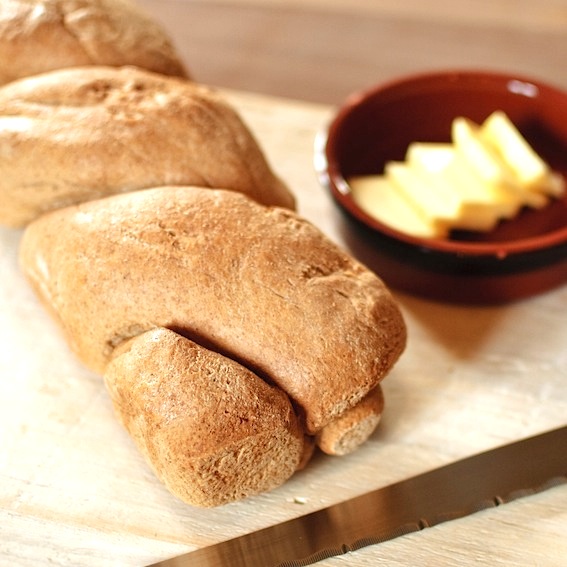
I envy mothers who disingenuously exclaim ‘I have such problems with my childrens’ eating habits: they just can’t get enough caviar/oysters/organic broccoli…’. Obviously when I say envy, I mean it in a thoroughly irascible, need-to-suppress-violent-urges sort of way. My son is passionate about bread (he’s partial to ketchup too actually, but I don’t think we really need to go there ;-)). He’s been besotted with bread since his first teeth appeared and his enthusiasiam shows no signs of abating. This spelt bread meets with his approval and believe me, he’s something of an expert in the matter.
Spelt is a tasty and healthy alternative to wheat and has a delicate nutty flavour. It’s actually an ancient grain that has come back into favour as more and more people have problems digesting wheat. Spelt has a tough outer husk, meaning that it can protect itself from attack and making it a very suitable candidate for pesticide-free production. Not only does it have more vitamins and minerals than wheat flour, it also has a higher protein content. Although spelt contains gluten, it is in a more fragile form and therefore easier to digest than wheat gluten, which is why people with a wheat intolerance are often able to eat spelt flour.
Ingredients (makes one small loaf)
250g spelt flour
5g active dry yeast
1 teaspoon salt
1 tablespoon olive oil
150ml lukewarm water
Begin by diluting the yeast in a few drops of water. Add to the flour and salt and then add the lukewarm water. Add the olive oil and mix well with a wooden spoon and then either knead by hand or mechanically for about ten minutes, until the mixture becomes like plastic. Leave to rise in a warm (25-35°C), draft-free place, covered with a damp tea towel for 45 minutes. The dough should double in volume. Knead again and shape into the desired form. Place on greaseproof paper, cover with the damp tea towel and leave to rise again for about 1h 15 minutes. Transfer to a lightly oiled baking tray and bake in a hot (225°C) preheated oven for 30 minutes. -
White watermelon jam and tacky kitchen floors
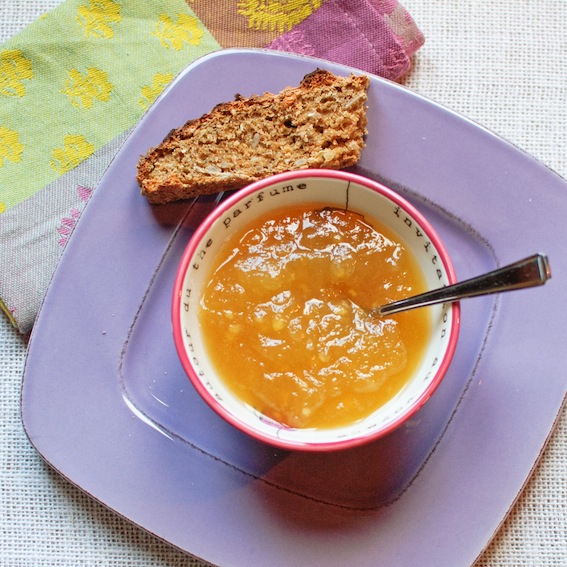
My poor kitchen has undergone another hostile takeover; my husband is in the midst of his biannual jamathon. I lose the use of my kitchen in September to fig jam and in January to white watermelon jam. God forbid we should grow any other jam-suitable fruit – I don’t think my nerves are sufficiently robust. I just don’t have the patience to make it myself – all that peeling and de-pipping would have me gnawing my limbs off. The truth is, once Luc, my husband, enters the kitchen he becomes a bit of a prima donna, and asOCDtidy as he usually is, the kitchen is left in a very sorry state. The floor tiles become hazardous and moving around becomes fraught with danger and an immense effort. You either have to unstick your foot vigourously after each step, or take long circuitous routes around puddles of sugary water. I’m wrung out just thinking about it. Of course, it goes without saying that the final result is beyond divine and after all, I was born to mop kitchen floors 😉
Ingredients (makes four or five jars)
1 white watermelon
250g cane sugar
1/2 lemon, grated and juiced
20g fresh ginger, grated
1 tsp cinnamon
Cut the watermelon into quarters, then peel and remove the seeds. Cut the flesh into cubes and put into a large pan. Add the sugar, ginger, lemon and cinnamon and gently heat to draw the moisture from the fruit. Simmer for between an hour and a half and two hours, or until desired consistency is obtained. This jam is fairly runny due to the relatively low sugar-content. Transfer into sterilised jam jars while still hot.
Watermelons are rich in many essential nutrients such as vitamins A, B1, B6 & C, pantothenic acid, biotin, potassium, and magnesium. They also fight cancer, relieve kidney disorders, reduce high blood pressure and the risk of heart problems, boost the immune system and help keep the eyes healthy. Get chopping ! -
Chocolate and pear tarts, compulsive behaviour and chainsaws
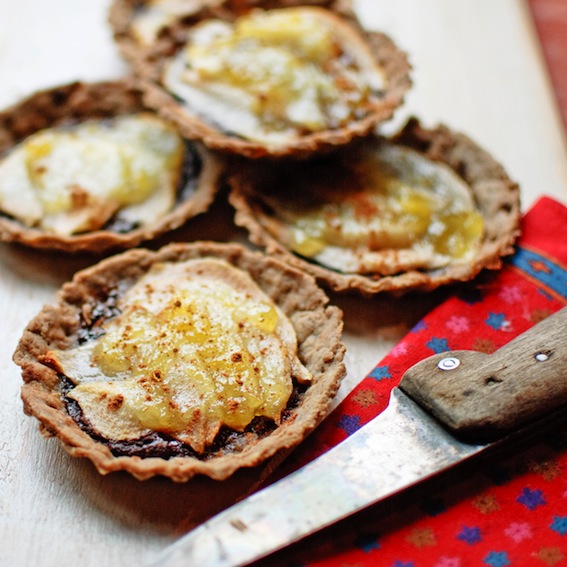
This will be the last pear/chocolate recipe for a while, I promise. I appear (!) to have become slightly obsessed with this heavenly combination, but that’s still no excuse for being a bore. Talking of bores, I’ve been having wild cow-related issues this week. We’ve had a lot of very strong gales which, if you live here, translates into the need to travel everywhere with a chainsaw (pine trees are quite vulnerable and fall easily in high winds). Personally, I never go anywhere without mine – you just never know when it’s going to come in handy. Which brings me back to wild cows; I have spotted several within uncomfortably close range recently. When I reported my ‘sightings’ to the local Mairie, the information was met with a definite ‘course you did, dearie’ sort of look, which I thought was a bit audacious, especially in view of the contents of my car boot 😉
The pastry for this tart is wheat-free, but not entirely gluten-free, spelt containing a small amount.
Ingredients for pastry (serves 6-8):
150g buckwheat flour
70g spelt flour
50g butter
50g virgin coconut oil
Roughly 6 tablespoons of cold water
Ingredients for filling:
40g dark chocolate (min. 70% cocoa)
1 tablespoon rum
15ml cream
1 large pear
3 tablespoons watermelon, pear, apple or ginger jam
To make the pastry, begin by cutting the butter and coconut oil into small cubes. Add to the flour in a mixing bowl and add a pinch of sea salt. Blend by hand until the mixture becomes crumbly. Add the cold water, mixing rapidly with a spoon. Remove the mixture from the bowl onto a lightly floured surface. Knead until you obtain a ball of pastry (if the mixture isn’t ‘sticky’ enough to form a ball, you may need a drop more water). Wrap in a clean cotton tea towel and leave to ‘rest’ in the fridge for about two hours. This relaxes the dough and makes it easier to use.
Preheat the oven to 180°C. Roll out the pastry on a clean, lightly floured surface and fill the tart tins. Precook the pastry for 12 minutes.
Melt the chocolate with the rum. Once melted, add the cream and mix to form a smooth sauce. Line the base of each tart with the chocolate. Peel the pear and cut into thin slices. Cover the chocolate base with the pears, overlapping them to cover well. Cover the top with a thin layer of jam and then cook for about 15 minutes. Delicious hot or cold. -
Healthy cheese scones (low-GI)

This week it snowed everywhere in France except here; we got the torrential rain option instead. Yesterday, I donned my guise as a North Sea fisherman (waders are definitely the way forward) to take Hugo for a walk. I squelched my way through sodden fields for 20 minutes before cottoning on to the fact that he wasn’t actually with me. My dog may have ‘issues’, but he’s certainly not stupid. I came home to find him bone-dry and curled up in front of the fire. One nil Hugo.
I used Comté cheese, which I call French Cheddar, to make these scones. I suspect the French might be rather mortified if they heard this moniker, but that’s OK because, as of this week, I am French. This gives me the right, amongst other things, to Cheese Irreverence, so there.
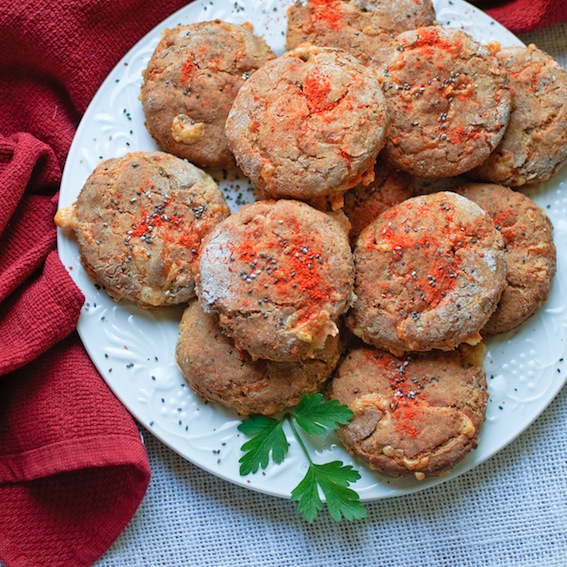
The photo is of the second batch of scones, as my rain-fearing labrador ‘sampled’ the first batch. All of it.
Ingredients (makes 12-15)
150mg spelt flour
100mg buckwheat flour
1 tablespoon chia seeds (optional)
3 tsp baking powder
large pinch sea salt
1/2 tsp paprika
100mg strong cheddar cheese (or Comté, or similar), grated
1 tablespoon olive oil
125 ml milk
1 egg
Preheat the oven to 180°C. Sift the flour, baking powder, chia seeds, salt and paprika into a large bowl. Add the cheese and mix well.
Beat the egg and milk together in a separate bowl and add the olive oil. Pour the milk/egg/oil mixture into the flour mixture and using a metal spoon / fork, mix the dough until it clumps together, but is not too dry. If it seems too dry, add a tiny drop more milk.
Press the dough out on a clean floured surface until it is about 5mm thick, then fold it over ontop of itself (this gives the finished scones the natural “break” to cut open), flatten it again, using the palm of your hand. Do not use a rolling pin as it is too heavy and will prevent the scones from rising.
Use a round cutter to cut out the scones. Place on a baking tray and cook for about 15 minutes or until golden. Serve hot or cold. -
Guest post: Eight herbs and spices with fantastic health benefits

Photo: ©The Healthy Epicurean
Today I welcome Rose Marie Baker, a nutritionist who believes in a responsible lifestyle through healthier eating. When she’s not in the kitchen, you can find Rose reviewing herbs and spices online. Some of her favorites can be found here.
We all want to eat healthier so that we can stay in shape, live longer, and keep our bodies free of unnatural chemicals and pollutants.
The problem is, many of the healthiest foods out there are just kind of, well, boring. At least that’s the opinion of many people, and it’s hard to maintain a healthy lifestyle if you find it bland and tasteless.
What’s the solution? Try some herbs and spices. Tasty and aromatic, these typically ground-up plants and seeds are nature’s way of dressing up your food without adding lots of unnecessary calories and fat. Find the right combination and you can make even the most boring food into a culinary delight. Even better, many herbs and spices actually have quite a few health benefits as well. Here are eight of best ones out there.
Cilantro. Not only is it great tasting (unless you’re one of the unlucky few for whom it tastes like soap), cilantro does a bunch of wonderful things for your body. Because of the large amount of vitamin K in cilantro, it helps blood clot better and makes bones stronger.
Ginger. Most people know that this spicy, delicious root can help with nausea (why do you think so many people drink ginger ale when they feel sick to their stomachs?), but some recent evidence points to the fact that it’s also a pretty decent painkiller, easing muscle soreness and joint pain related to arthritis.
Cinnamon. It’s not often that you can find a food that’s high in fiber, contains no fat or calories, and still manages to do a great job of satisfying our cravings for sweets. Oh, and did we mention that it also may help to lower your cholesterol and help people with type-2 diabetes to better manage their blood sugar levels?
Fennel. With its licorice-like flavor, lots of people find the taste of fennel to be pleasing. But what they like even more is the fact that it can help to ease heartburn and assist with digestion issues like gas and bloating.
Turmeric. This jack-of-all-trades spice has been used to help people suffering from everything from skin problems to depression to liver disease. Many of these applications don’t have conclusive evidence showing that they work, but there is quite a bit of research showing that it can help with heartburn and arthritis pain.
Cumin. This diabetic-friendly spice not only works to regulate blood-sugar levels, just like cinnamon, it’s also a great source of iron, calcium, and magnesium- and it fights the germs that can cause ulcers.
Rosemary. With its high levels of antioxidants and rosmarinic acid, rosemary can be a great help in protecting against inflammation. Many people also believe that it can boost your memory and learning by producing acetylcholine.
Holy basil. Yes, that’s right. Not just basil – holy basil. With a name like that, how could it not be good for us? Commonly used in the treatment of people suffering from high cholesterol, research indicates other benefits, such as alleviating asthma, upper respiratory infections, and diabetes. Experts argue that these effects are due to the compounds of the herb reducing swelling and pain.
These eight herbs and spices represent only the tip of the iceberg when it comes to healthy spices, and aren’t even necessarily the best ones out there. There are at least another dozen herbs that could just as easily make that claim. That means that you have a lot of healthy (and tasty) options available to you.