-
2013 in review
The WordPress.com stats helper monkeys prepared a 2013 annual report for this blog.

Here’s an excerpt:The concert hall at the Sydney Opera House holds 2,700 people. This blog was viewed about 34,000 times in 2013. If it were a concert at Sydney Opera House, it would take about 13 sold-out performances for that many people to see it.
-
Spelt yule log (bûche de Noel) and an unidentified thigh thief

I can’t believe I’m admitting to this, but our Christmas lunch was stolen by an unidentified creature. We had put the guinea fowl, which had been slaughtered, plucked and frozen by our neighbour in November, to defrost on top of a very tall fridge in the grange. At the time, it was the proud owner of two wings and two thighs. Anyway, bad plan because when I went to get it the next morning it was minus a thigh. As we don’t have a cat, I can’t imagine what sort of animal could have climbed a slippery surface that high; it definitely wasn’t Hugo because he suffers from vertigo. My money’s on a carnivorous giraffe. Admittedly there aren’t many in Southwestern France, but it’s the only thing that makes sense. Luc, my husband, was all for cooking and serving it as an amputee delicacy, claiming that the cooking process would kill any lingering giraffe germs, but I put my foot down and we located a beautifully intact capon in a shop in the village, conveniently open on the 25th December no doubt in case of such incidents.
This ‘bûche de Noel’, which is similar to a roulade, is the traditional French Christmas dessert. It should be kept under lock and key IN THE HOUSE until you’re ready to eat it!
For the sponge:
Ingredients
4 free-range eggs
180g cane sugar
1 teaspoon vanilla extract
160g spelt flour
1 teaspoon baking powder
Raspberry jam to fill
Preheat the oven to 200°C and prepare a Swiss roll tin by lightly greasing and lining the base and sides with a large sheet of greaseproof paper, pushing it into the corners. Beat the eggs, vanilla extract and sugar together until thick and creamy and then add the spelt flour and baking powder, incorporating well. Spoon the mixture into the tin and bake in the preheated oven for nine minutes. Once baked, remove from the oven and immediately roll into a spiral on a floured-surface. Unroll and spread generously with raspberry jam. Roll again and set aside.
For the butterceam icing:
Ingredients
125g butter, softened
60g cane sugar
2 egg yolks
2 teaspoons of coffee powder, diluted in two teaspoons of water
Pour the sugar into a saucepan, lightly moisten with a few drops of water and cook for about six minutes, stirring constantly. Stop just before the mixture caramelises. Beat the egg yolks and add the hot sugar little by little until the mixture whitens. Beat the butter well and gradually add the egg yolk/sugar mixture. Finally, add the coffee, incorporating well. Cover the rolled cake with the buttercream, spreading with a spatula, decorate with walnuts and glazed cherries and leave to cool for at least an hour in the fridge before serving. -
Simple coconut chicken curry and a fine way to drive

No doubt in retribution for the gentle mockery in my last post, I received a speeding fine this morning in the post. Or to be precise, my husband received a speeding fine, which absolutely thrilled him. The irony is that I was flashed coming back from a very active skiing weekend and traffic cop-in-the-making, Léo, was fast asleep and not in a position to attend to his functions. Of course, the problem with radar tickets is that you can’tflirtnegotiate your way out of them. If I’m stopped by an actual live policeman, I play the ‘oh gosh I’m so sorry officer —it must have been a slip of the foot during a fleeting blonde moment’ card. Shiny grey metal boxes, however, are not nearly as indulgent with lame excuses.
I like my curry the way I like my driving: fast and hassle-free. It is none the less delicious for it though.
Ingredients (serves four)
1 tablespoon coconut oil
4 chicken breasts, cut into chunks
1 onion, thinly sliced
2 cloves of garlic, crushed
4 carrots, peeled and cut
2 green chillies, chopped
1 tablespoon of peeled, grated fresh ginger
1 kaffir lime leaf (or bay leaf)
1 cinnamon stick
½ teaspoon turmeric
3 teaspoons cumin seeds
1/2 teaspoon sea salt
1/2 teaspoon freshly ground black pepper
100ml chicken stock
100ml coconut milk
Gently fry the onion, garlic and chicken in the coconut oil for a few minutes in a medium-size casserole dish. Add the seasoning and spices (cumin seeds, salt, pepper, ginger, turmeric, cinnamon stick…) and continue to brown, stirring frequently. Add the carrots and chillies and then the chicken stock and coconut milk. Simmer for about 20 minutes and then serve with basmati rice, naan bread, chickpea pancakes or just a green salad. -
Rum and raisin carrot cake (gf) and frustrated traffic wardens
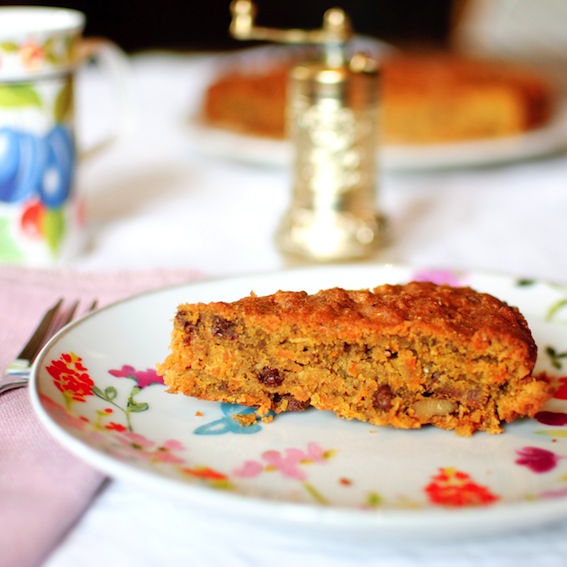
Word is out that I’m a bit of a rebel behind the wheel. Unfortunately I’m also married to, as my father puts it, a ‘repressed traffic warden’. He does have a point — how many people do you know that tell their guests to go and repark their cars within the confines of meticulously-placed traffic cones? (I blush to admit that we own traffic cones.) After our trip to San Sebastian, where I received more than one dressing-down for my mutinous driving, in particular U-turning, I’m now getting reflections from Léo’s friends. I drove one of them to his music lesson the other day and, in the time it took to drive about half a kilometre, he gleefully pointed out that I had entered the car park ‘the wrong way’, driven too close to the pavement and stopped in a disabled parking space. What can I say?
This carrot cake, although healthy and no-doubt sickeningly law-abiding, is deliciously moist and fragrant.
Ingredients
3 eggs
100g coconut sugar
2 teaspoons vanilla extract
200g ground almonds
100g dessicated coconut
2 teaspoons ground cinnamon
2 teaspoons freshly grated ginger
100g walnuts, roughly chopped
100g raisins
2 tablespoons rum
70g coconut butter, melted
70g butter, melted
200g carrots, grated
Preheat the oven to 140°C and prepare a 24cm cake tin. Place the raisins in a small saucepan and cook in the rum for about five minutes. Break the eggs into a mixing bowl, add the coconut sugar and vanilla extract and beat well. Add the ground almonds, coconut and spices, combining well. Stir in the melted butter and coconut oil, the walnuts and the raisin/rum mixture. Finally add the carrots and mix until everything is well combined. Transfer the mixture to the cake tin and cook for between 50 and 60 minutes (a fork should come out clean once cooked). -
Petits pots au chocolat (chocolate pots), abject terror and an egg dearth

Hugo’s in a bit of a bad place at the moment. He frequently wakes to the resonance of hunting rifles (beyond unsettling for a dog of his delicate mental constitution) and will only deign to go outside if accompanied. On Sunday morning, no doubt in his eternal quest for reassurance, I found him in bed with Léo. Needless to say, he had not been greeted with open arms.
Since the hens, although of sound mind, are enjoying a long sabbatical, I had to concoct an egg-free chocolate mousse solution. This is it:
Ingredients (makes 6 small pots)
150g organic dark chocolate (min 70% cocoa solids)
200ml coconut cream, chilled
20g salted butter
1 teaspoon rum (optional)
2 tablespoons agave syrup
5g agar agar
Whip the coconut cream well until it becomes fluffy. Break the chocolate into small pieces and melt it and the butter in a bain marie with the rum and agave syrup. Meanwhile, dissolve the agar agar in a small quantity of hot water (4 tablespoons), bring to the boil and simmer for a few minutes. Combine the whipped cream and chocolate mixture thoroughly. Then add the agar agar, mixing well. Transfer to small pots (or cups) and chill in the fridge for at least three hours before eating. -
Pot-au-feu (French beef stew) and disruptive mothers

Tennis tournament season is back and, once again, I’m in the market for a gag. If I don’t find one (and let’s face it, there seems to be a dearth of reasonably stylish ones), I’ll have to stop accompanying Léo to matches until I learn to control my gratuitous and unhelpful comment reflex, which never fails to kick in. I can only be thankful that the majority of the other spectators don’t understand English; I won’t go into details as I wouldn’t want to sully reputations, particularly mine. The strange thing is that neither Léo nor I are particularly competitive, but there’s something about people either criticising or applauding (I don’t know which is worse) my son’s ‘faults’ that brings out the devil in me.
This is a simple version of ‘pot-au-feu’, a traditional French dish which, strictly speaking, should include several different cuts of meat as well as oxtail. In any case, it is very comforting after a day spent in the cold having your nerves ripped to shreds! It used to be that the pot containing the stew would stay cooking over the fire nearly all winter, with bits and pieces being constantly replaced. Usually the ‘bouillon’ or sauce is eaten as soup and the vegetables and meat as a main course with mustard and pickles, although I like to eat the two together.
Ingredients (serves 4)
1 tablespoon olive oil
2 onions, sliced
2 cloves of garlic, chopped
Vegetable stock (roughly 500ml)
1kg stewing beef, cut into large cubes
4 leeks, washed and sliced
1 red pepper (optional), cut into slices
1 stick of celery, cut into four pieces
6 small carrots, cut into 3cm pieces
2 swedes or turnips, peeled and quartered
¼ white cabbage, sliced
4 small potatoes, peeled
Bouquet garni (parsely, thyme, bay)
Sea salt and freshly ground black pepper
1 teaspoon piment d’espelette (or paprika)
Preheat the oven to 150°C. In a fairly large casserole dish (Dutch oven) brown the onions and garlic very briefly in the olive oil. Add the beef and continue to brown for a couple of minutes. Add all the vegetables (except the potatoes) and then enough vegetable stock to cover. Add the seasoning, herbs and spices and bring to a gentle boil. Transfer to the oven and cook for about three hours, checking from time-to-time that there is sufficient liquid (the vegetables should be covered). Add the potatoes and cook for a further hour. -
Raw honey and learning when to stop talking

We went to a local Christmas market this weekend and, while I was busy buying my own bodyweight in locally-produced Landaise honey, Léo was busy consuming his bodyweight in garbure (a duck and vegetable soup typical of Southwestern France). The quantities of food that Léo consumes and the enthusiasm with which he does so, are becoming acute sources of embarrassment to me — you would honestly think that he wasn’t fed at home. Sometimes, for example, we drop into a local café at about 11am for a cup of coffee and he orders a three-course ‘menu du jour’. I desperately feel the need to justify his appetite and end up woefully tying myself in knots with comments like: ‘I do feed him at home you know! In fact I feed him extremely well!’. On realising that this sounds horribly pretentious, I might add: ‘When I say extremely well, obviously I mean, you know, normally. Well not out-of-a-packet normally, but, errr, very healthily’. Of course I end up sounding like a furiously back-pedalling crazy person who should probably learn when to shut up.
Anyway, back to honey. Honey has been used for its healing properties since biblical times when it was used, amongst other things, to treat diphtheria. Physicians of ancient times, such as Aristotle, Hippocrates and Cornelius made reference to its healing qualities. A recent Russian study showed that beekeepers in Georgia who consumed raw honey and pollen on a regular basis frequently lived to over 100, a few even living as old as 150.
Raw honey is honey that has not been heated, pasteurised or processed in any way. It is alkaline-forming and contains a multitude of vitamins, minerals, amino acids, enzymes and powerful antioxidants as well as other natural nutrients. It also contains the enzyme amylase, which aids in the digestion of starch. A piece of toast spread with honey, for example, is more easily digestible than a piece of toast without as the enzymes in the honey ‘predigest’ the starch. (Beware of pasturised honey, which is more or less equivalent to refined sugar.)
Raw honey has anti-viral, anti-bacterial and anti-fungal properties. It promotes general health as well as digestive health and also strengthens the immune system. It helps to control allergies and is an excellent remedy for skin wounds and all types of infections. It can also stabilise blood pressure, balance sugar levels, relieve pain, calm nerves and has been used to treat ulcers. It is an expectorant and has anti-inflammatory properties which means that it is useful in the treatment of respiratory conditions such as bronchitis and asthma.
The different varieties of honey have varying properties as well as quite distinctive aromas. Here are a few:
Acacia, a light and clear honey, is one of the most popular and sweetest honey varieties because of its mild delicate floral taste. Due to its low sucrose content, it is a good choice for diabetics. Acacia cleanses the liver, regulates the intestine, and has an anti-inflammatory action on the respiratory system.
Buckwheat honey is a dark, full-bodied and rich in iron. It contains a higher percentage of antioxidants than other honeys and is perhaps the strongest and darkest of all varieties.
Heather honey is thick, amber in color and has one of the strongest and most pungent flavours. It is fragrant and floral with a very lingering aftertaste that is almost bitter. Prized since ancient times due to its medicinal properties, heather honey is extremely high in protein.
Linden honey is pale yellow in colour with a distinctive yet delicate fresh woody scent. Due to its sedative quality, it is effective in the treatment of insomnia and anxiety. It may also be used to treat colds, coughs and bronchitis.
Pine Tree honey is not overly sweet, has a strong aroma and is rich in minerals and proteins.
Thyme honey’s healing benefits are second to none. It is currently being used in hospitals in France for its infection-fighting, powerful antioxidant properties. A 2009 Greek study found thyme honey to reduce the viability of both endometrial and prostrate cancer cells..
Wildflower honey can vary in colour from very light to dark its flavour ranges from light and fruity to tangy and rich, depending on the mix from the different seasonal wildflowers.
Raw honey should not be given to children under a year old as they lack the stomach acid to de-activate any bacteria. -
Leek crumble and Hugo’s story
by Hugo, Canine Correspondent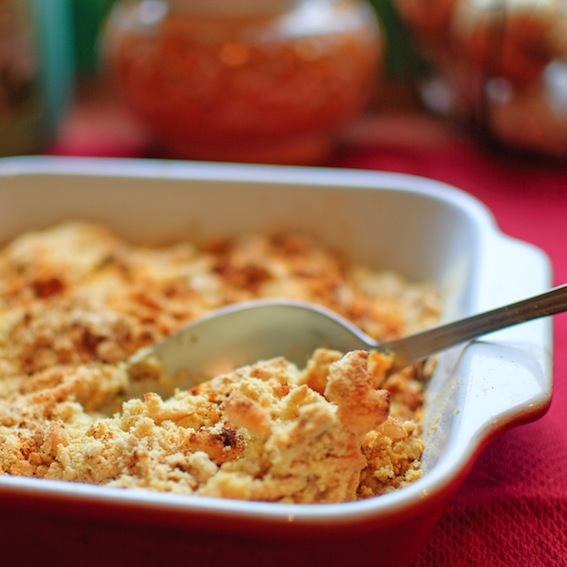

I’m not a naughty dog. I do have my limits though and when Bossy and Noisy recently loaded their bags into the car and made it clear that I wasn’t going to accompany them, I reached mine. I dragged my rug out to the car and made myself a little nest amongst the suitcases, but they ended up leaving without me all the same. The trouble is this: no Bossy, no proper meals! (He gets invited to eat with the neighbour). Worse still, no camembert at lunchtime (I have my own special supply). So I ran away. Actually I ran further than I meant to and ended up getting lost. Apparently I was about 6 kms away. A very nice lady found me and made me a big bowl of pasta — I must have looked very thin, sad and hungry, which was almost certainly due to ACD (acute cheese deprivation). 🙁 The kind lady also took lots and lots of photos of me and kept stroking me and saying how handsome I was. It took her quite a long time to track down Bossy’s husband, because I’d also lost my collar with my ‘phone number on it. Anyway, Bossy and Noisy reappeared quite soon after I had arrived back home and, going by the look on Bossy’s face, she’ll think twice before heartlessly abandoning me in a camembert-free environment again *manipulative snigger*.
This savoury crumble is an adaptation of a Marcus Wareing recipe. It’s a meal in itself really, although it could also be served as an accompaniment.
Ingredients (serves 4)
2 red onions, quartered
1 garlic clove, peeled and crushed
4 leeks, washed and sliced into 2 cm rounds
4 mushrooms, peeled and sliced
50g butter
50g spelt flour
200 ml chicken or vegetable stock
200ml milk
50g roquefort cheese, crumbled (any blue cheese will work)
1 tablespoon French mustard
Sea salt, freshly-ground black pepper
1/2 teaspoon paprika
For the crumble topping:
100g spelt flour
75g chickpea flour
25g butter
1 tablespoon olive oil
100g comté cheese, grated (or another hard cheese)
Sea salt and freshly ground black pepper
Preheat the oven to 180°C. Gently fry the onions, garlic, leeks and mushrooms until lightly cooked (about 5 minutes). Place in an ovenproof dish and set aside. Melt the butter in a medium-sized saucepan and then add the flour, combining well to form a paste. Gradually add the stock and then the milk, whisking well all then time to prevent lumps from forming. Continue to cook until,the sauce is quite thick and then add the mustard, seasoning and cheese. Mix well until the cheese has melted and pour over the vegetables.
To make the crumble topping, mix the flour and seasoning together and rub in the butter and then stir in the olive oil. Add the grated cheese, mixing well and spread over the leeks and sauce. Bake for about 25 minutes until the topping is golden brown. -
Plum honey cake and one-way city
We went to San Sebastian (Donostia) during the recent school holidays. San Sebastian, just over the border from France in Spain’s Basque country, is home to the first University of Gastronomy and boasts an exceptionally high concentration of Michelin-starred restaurants, as well as some of the best tapas — or pintxos — bars to be found.
We stayed in a hotel on one of the hills dominating the bay. The views from the balcony were absolutely stunning and this was, as I later found out, the best way to appreciate the town. I am no wimp when it comes to challenging city driving: I learned to drive in London and then for many years enjoyed regular and complicated tangos around the insane Arc de Triomphe ‘Etoile‘ roundabout with 70 other highly strung Parisians. But, after a number of near misses, San Sebastian’s complex one-way system got the better of me and I ended up conceding defeat. Léo took great delight in keeping a tally (with a rather abrasive running commentary) of my hugely illegal manoeuvres, details of which I would rather forget. And then, as if the stress at the idea of never ever being allowed to turn left again as long as I lived wasn’t enough, I got a call from home to say that Hugo had run away. More on that next time – my nerves are still in shreds! 😉

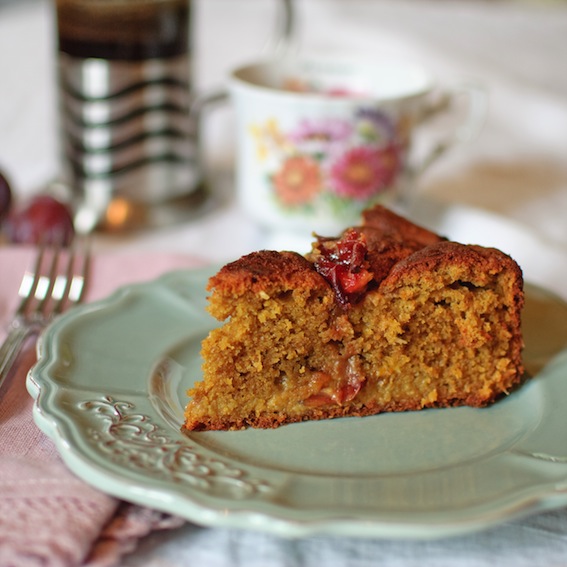
This cake is another little gem from Amber Rose’s book, ‘Love, Bake, Nourish’. The honey makes it deliciously, fragrantly soothing and I recommend you never drive anywhere without a large slice for arduous traffic situations.
Ingredients (serves 8)
180g spelt flour
2 teaspoons baking powder
130g ground almonds
½ teaspoon ground cinnamon
½ teaspoon ground cardamon
5 large free-range eggs
120g butter
120g organic coconut oil
180g honey
400g plums, stoned and quartered
Preheat the oven to 180°C and prepare a 22cm loose-bottomed cake tin. Mix the dry ingredients and set aside. In a separate bowl, beat the egg yolks, softened butter and coconut oil and honey until thick and smooth. Gently fold into the dry ingredients. Whisk the egg whites in a clean bowl until stiff and then fold into the mix making sure they are fully incorporated. Finally stir in the plums and transfer the mixture to the greased tin. Bake for 45 minutes or until a skewer poked into the centre comes out clean. Leave to cool before serving.
-
Guest post: Patient, heal thyself (part 3)
I had intended to continue sharing my recent benefits from switching in April to the ‘Eat Right 4 Your Blood Type’ plan, when last weekend put my intentions on hold. However, there was the added benefit of an experience important to all of us who need to watch what we eat, so I will share some of what occurred in this post.
While helping my partner erect an aluminum (aluminium, for those northwest of here) and plexi winter garden house, I suffered what appeared to be the beginnings of a heart attack. Germany has one very important aspect to their health care which I applaud: if the call is of a serious nature, an ambulance with a doctor on board is also dispatched to the scene. I won’t take you through the hooking up of a colourful assortment of tubes and such, and just say that after Mr. Toad’s Wild Ride through the German countryside, I arrived at a hospital with a highly-regarded cardio unit, where I spent several hours on monitors and bleeding into little glass tubes, on demand.
Upon determining that I was not in immediate danger, I was sent upstairs to a room, where they brought me the evening’s repast. Before continuing your digestion of this post, I suggest making certain that you are in a comfortable chair, as what I am about to share will stagger the imagination of most, and might even cause one to stagger in a literal sense. A caution has been made.
Dinner, for a person who has just arrived in the hospital’s cardio wing, and was under strict monitoring, was: two slices of bread, a slice of Emmentaler cheese (like Swiss cheese), three assorted slices of cold cuts, including salami, bologna and one that was unidentifiable, to me, and three tablespoons of watery yogurt. There were also two packets of mustard and a small cube of butter. No, I didn’t miss anything and I even looked under the tray, to be certain of this.
If you are a Type A person and you have already started the program, and know what the dos and don’ts are, you would recognize only the yogurt as being of any benefit, while the rest of the lot are absolute ‘don’ts.’ I mentioned this to the night nurse who remarked, ‘Everybody gets the same. No special treatment.’ Having passed two very elderly women in wheelchairs, as they were bringing me to my room, I wondered how they expected these two souls to be nurtured back to good health on such a meagre and very unhealthy diet.
Serving the least amount of food, with no regard to nutrition, is endemic in German hospitals and I have personally witnessed this in three other medical establishments. I have also asked physicians how they expect their patients to heal without proper nutrition, but they just shake their heads in a ‘it’s not my problem’ way. It is not a German attribute to rock the boat, so it is likely the insurance plan most patients are subscribed to determines costs for such things. It goes to prove the point that when bean-counters enter the picture, all compassion disappears. But, I digress.
Due to many issues, I had a sleepless night, one of which was being denied a sleeping pill, because, as the night nurse put it: ‘You are asking too late.’ Had I known my roommate could rattle the rafters with his snoring, I might have asked when I came to the room. But, unarmed with such important information, I was left without the necessary tool to overcome this obstacle and spent the night awake.
In the very early morning hours, nurses came to take blood and chose to poke a new hole in my other hand, although all previous blood samples had been taken from the hand with the nifty accoutrement that had been attached to me in the comfort of my best chair, the day before. Then, a young male nurse came to take my blood pressure, after which he presented a needle. When I asked what it was for, he told me it was to prevent thrombosis’ to which I replied: ‘No.’ I saw no need to have this additional toxin in my body, when I was still ambulatory and was not bedridden. He was perplexed, but he didn’t force the issue.
Later in the morning, one of the cardio doctors came to see me and spent some time telling me that I had not suffered a heart attack, stroke or anything severe enough to leave a telltale message in my system. The numbers they were giving me were the same as I had received from my cardio specialist, during my annual checkup in June, so I breathed a sigh of relief, and told her I wanted to go home. I was immediately counseled on the possible ‘consequences’ of such a decision, in view of their desire to keep me for observation and further tests, all of which I had experienced in June, and passed with flying colors. I then told her about my sleepless night, which seemed to go right past her, without reaction or comment.
The young doctor was adamant that I stay put, so I shared with her the details of my morning meal, which was: a slice of what looked like a mixed deli meat, two bread rolls, two packets of processed jelly, a cube of butter and three tablespoons of yogurt. I then continued with a description of the all important mid-day meal that had been brought to me, which was a vegetable consume, including remnants of carrots, potatoes and beans with a long, beef sausage placed in the middle of the bowl, a packet of mustard and two pieces of stale bread. After sharing these details with her, I told her about my eating plan and how it had cleared up two issues for me, which all of the ingredients the hospital had offered were sure to bring back to the fold. She shrugged in a kind of ‘what do you want me to do about it’ way, although I surmised that she was already thinking in her mind that there had to be some prescription that would do the trick rather well, in place of nutritious food.
When I asked her how she felt about serving the kind of food that was presented, to a person presumed to have a heart issue (after all, the did want to keep me for observation), she changed the topic back to the issue of ‘the possible consequences of going home.’
I thought about it and came to the realization that if I stayed there for the recommended period of time, taking the drugs they wanted me to ingest, in spite of showing no symptoms requiring drugs, and eating their food, I would have other serious issues returning to my life. I opted to leave, after telling her that I would much prefer to expire at home, eating healthy food, rather than in a hospital’s cold, dispassionate environment, while slowly being poisoned. She was not amused.
There were forms to fill out, more cautions expressed and then I was able to step outdoors, in the cool, dark afternoon, accompanied by my partner, who had brought one of our fun cars as a treat, in which to bring me home. The first breath of fresh air was rejuvenating and I continued to feel better during the ride home, in spite of my lack of sleep.
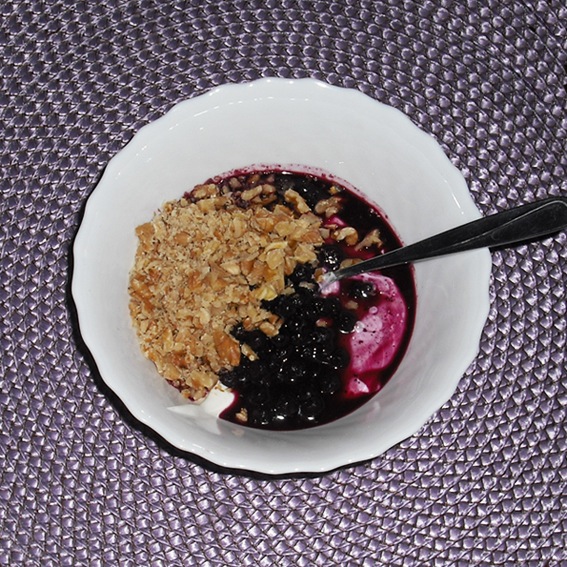
For that first meal upon my return to our home, I chose a breakfast meal of freshly chopped walnuts, Greek yogurt and blueberries. I also added a small dollop of maple syrup, which has been my sweetener of choice for more than thirty years. In the photo, you will see that I used frozen blueberries, as we are out of season for fresh, here, and I rather like having them year round. Frozen also allows me to vary the types of berries I use during the winter months, and allows me to thaw just what I need to avoid any spoilage, as well as providing a sugar-free juice from the thawing process.
I did see my GP this week and he reviewed the information about my adventure and came to the conclusion that, since this was a one-off event, that I should take it easy, lessen my work load some and give stressful situations a boot in the behind. I do have a tendency to work like I am still twenty-three, which is not to my benefit, now, and I had been overdoing it for a couple of weeks, even though I was experiencing a cold. My instinct tells me that it was just overloading the system with commitments and physical stress that caused my body to stop functioning at its optimum. When pressed for a reply, my GP begrudgingly admitted that leaving the hospital was a good idea, in this circumstance.
The point of sharing this experience is to demonstrate that in all cases, we will be responsible for our own health, even in an environment that is supposed to consider all aspects of our health its foremost concern.
