-
Spelt kuglof and strange dog diets

My husband ceremoniously whipped up and presented Hugo with an an egg-white omelette yesterday. What was that all about do you think? I mean, just how bizarre is it to make an egg-white omelette for a big black labrador? As if the poor mutt doesn’t have enough issues to last a lifetime. Anyway, in a fit of rebellion I poured cream over his kibbles last night (Hugo’s, not my husband’s); he needs to learn to live a bit.
Kuglof (kouglof, kougelhof, kugelhof, kugelopf, kugelhopf or kouglouf) is typically found in Alsace, Germany, Switzerland and Austria. Traditionally it is baked in an earthenware mould with a central funnel, although there are now silicon or aluminium moulds available.
Ingredients
75g raisins
4 tablespoons rum or kirsch
15g bakers yeast
200ml lukewarm milk
500g spelt flour (or plain if you prefer)
1 teaspoon sea salt
75g cane sugar
2 eggs, beaten
75g butter, softened
75g coconut oil, softened (or just use 150g butter)
20g almond flakes
1 tablespoon icing sugar to decorate
Place the raisins in a small bowl and cover with kirsch or rum. Set aside to soak. Mix the yeast with 100ml milk and a tiny bit of flour and leave to double in volume. Mix the remaining flour, salt, sugar, eggs and milk. Beat or knead for about 15 minutes. Add the butter and coconut oil, mixing well. Next add the yeast and knead or beat until the dough becomes detached from the bowl. Cover with a damp tea towel and leave the rise for an hour in warm place (between 25-30°C). Reduce the dough to original volume by gently tapping. Add the soaked raisins and mix. Butter the mould and evenly distribute the flaked almonds in the bottom. Add the dough and leave to rise until it reaches the edge of the mould. Cook for 45 minutes in an oven preheated to 200°C. Once cooked, remove from the mould and decorate with icing sugar. -
Spelt brioche and a water-locked house
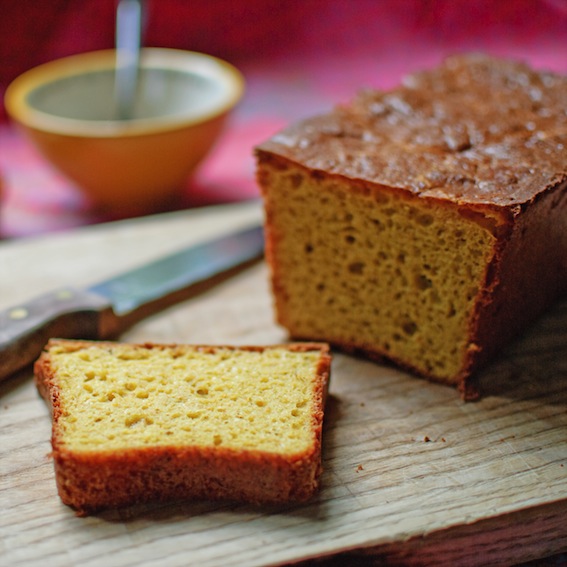
We had almost as much rainfall overnight as we usually have during May and June combined. Here it doesn’t rain, but it pours; the house was surrounded by an impressive moat this morning that I don’t recall being there when we signed on the dotted line. We now also boast a second river, which sounds fine in theory, but is not so practical in reality as we’re not very well-equipped boat-wise. Hugo took one look outside this morning and went back to bed, sighing heavily, the hens are developing webbed feet and learning to swim and I was out early drying off the horses with my hairdryer. All-in-all an appropriate morning for brioche.
Ingredients
300g spelt flour (or plain flour if you prefer)
100g butter, melted
100g coconut oil, melted (you can substitute this for a further 100g of butter)
1 teaspoon sea salt
1½ teaspoons dry bakers’ yeast
2 tablespoons cold water
4 eggs, beaten
40g cane sugar
Dilute the dry yeast in 2 tablespoons’ luke-warm water and set aside for 10 minutes. Mix the flour, yeast, salt, sugar, beaten eggs, melted butter and oil. Either knead by hand or beat in a mixer (better if you’re lazy). The dough must stay elastic in consistency so add a drop more water, if necessary. Leave the dough to rise in the mixing bowl for about an hour at a temperature of between 25-30°C (it should double in volume). Beat and knead the dough and leave to rise for a further hour. Beat and knead again and put the dough in the loaf tin. Leave to rise one last time. Preheat the oven to 200°C and cook for 25 minutes. -
Mini salmon terrines and getaway strategies

It’s starting to be tricky to escape in the car alone; Motoring is Hugo’s absolute favourite. He prefers the front seat and I have, in the past, resorted to belting him in rather than take on the chore of coaxing him out of the car. Naturally, he takes it very badly if I kick him out. If, on the other hand, I leave him in the car and need to stop off somewhere, he presses on the horn with his chest if he feels I’ve ‘abandoned’ him for too long. He also dribbles on the seat. So it’s a toss-up between his being put-out and potentially depressed at being ditched, and my being mortally embarrassed by a high-maintenance, disruptive dog and wet front seat. I’m spoilt for choice.
This salmon terrine is an attempt to recreate a dish we had in our hotel in the Pyrenees this winter, as requested by Léo. It is, according to him, ‘quite edible’; Praise indeed. 🙂
Ingredients (makes 6 mini terrines)
2 salmon filets (250g)
juice of half a lemon
25g butter
150ml cream
1 clove garlic, crushed
1 shallot, chopped
½ teaspoon ginger, freshly grated
1 bay leaf
1 tablespoon Pastis
sea salt and freshly ground black pepper
1 teaspoon paprika
4 tablespoons of diced cucumber
4 leaves of fresh mint
2g Agar-Agar powder
Place the salmon filets steeped in lemon juice in a frying pan and add the butter and cream. Bring to a gentle simmer and add all the other ingredients with the exception of the Agar-Agar, cucumber and mint leaves. Simmer for about 10 minutes, until the salmon is cooked through and the liquid partly evaporated. Once cooked, add the mint leaves, blend briefly in a food processor and set aside. Dissolve the Agar-Agar in a small amount of water and bring to the boil (according to the instructions on the packet). Once boiled, mix into the salmon with the diced cucumber and distribute the mixture into moulds (I used silicon muffin moulds). Compact the mixture well. Refrigerate for at least a couple of hours and serve chilled.
-
Canelés de Bordeaux
There is an exquisite patisserie called Pariès in Bayonne, which is the capital of the Basque country in south-western France. They recently produced a book of their recipes, which Idrooled overdiscovered the other day. Bayonne is famous for its chocolate, amongst other things, and was one of the first places in Europe to produce chocolate in the early 17th century. There is always a deliciously rich, chocolate-laden aroma in the streets of the city centre. It’s sometimes worth just strolling around there to get a fix!
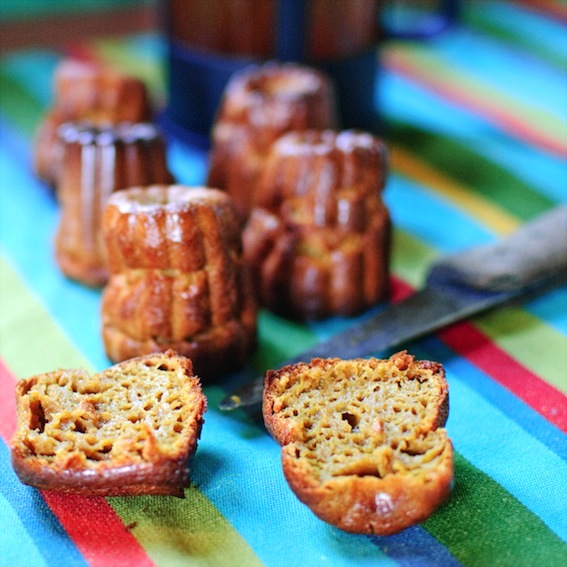
I will be sharing some of the chocolate recipes from this absolute gem of a book, but today I made another regional speciality: canelé [kan-ul-ay]. A canelé (or cannelé) is a small French pastry with a moist custard-like centre and a dark, thick caramelized crust. It is the shape of a striated cylinder approximately 5 cms in height and is a specialty of Bordeaux.
These contain too much sugar for me to claim that they’re positively good for you. Having said that, I made them with cane sugar and spelt flour (of course!) and as they contain rich, ‘real’ ingredients they are most definitely a healthier choice as a treat than anything in packaging! I had to make a second batch to photograph because the first batch disappeared far too quickly; They’re that moreish!
Ingredients (makes about 12)
You will need a special canelé mould to make these. The best are made from copper, although I used silicon.
400ml milk
20g salted butter
2 egg yolks
1 egg
140g sugar (I used cane sugar)
120g flour (I used spelt flour)
1 vanilla pod
10cl rum
A little extra butter for greasing the moulds
Beat the egg yolks, egg and sugar in a mixing bowl. Add the flour and vanilla and continue to mix gently. Bring the milk to the boil in a saucepan, remove from the heat and immediately add the butter. When the milk has cooled to lukewarm, add to the other ingredients in the mixing bowl. Mix well. Leave the mixture to rest in the fridge for at least 24 hours, 48 hours if possible. This is important as the mixture must be as ‘airless’ as possible or it will rise during cooking. Also for this reason, it must always be mixed gently, taking care not to add too much air.
To cook the canelés, preheat the oven to 220°C. Remove the mixture from the fridge and very gently stir the (what will now be separated) batter until homogenous. Add the rum at this stage too. Fill the buttered moulds about 7/8 full. Cook for 10 minutes at 220°C and then turn the oven down to 190°C. Cook for a further 40 minutes. Leave to cool before eating. -
Olive, red pepper and anchovy cake and a volatile hoarder

To follow on from this post, unfortunately our black hen died. Hens seem to be so vulnerable to attack from disease, foxes, dogs and perhaps even other hens. I imagined she was suffering from depression when maybe she was just sad to be sick. 🙁
We were (when I say ‘we’ I suppose I mean ‘I’ as, unlike me, neither husband nor son obsesses about our animals) rather worried about the white hen who had disappeared suddenly. We eventually found her over a week later under two enormous bales of hay in a little-used barn, sitting on no fewer than 23 eggs; The little minx had obviously been hiding, laying and hoarding! Don’t ever let it be said that hens can’t multitask. So to add to our animals’ extensive list of mental disorders, we now appear to be the proud owners of a compulsively hoarding hen. Can anyone tell me where I can get my hands on an animal that doesn’t have ‘issues’?
This savoury cake is based on an old French recipe and goes beautifully with soup or hors d’oeuvres. It’s quite light and crumbly and, being made with spelt flour, healthy, wheat-free and low GI.
Ingredients
175g spelt flour
1 teaspoon baking powder
1 teaspoon bicarbonate of soda
1 teaspoon paprika
1 pot of yoghurt (125g)
3 organic eggs, beaten
100ml olive oil
50g red pepper, finely chopped
40g black olives, stones removed
50g sun dried tomatoes
6 anchovies
Preheat the oven to 180°C. Combine the flour, baking powder, bicarbonate of soda and paprika and add the eggs and yoghurt, mixing well. Continue mixing and add the olive oil until you obtain a homogenous paste. Stir in the other ingredients and once well combined, spoon the mixture into a medium-sized, oiled loaf tin. Cook for about 40 minutes, or until a fork comes out clean.
-
Spelt flour crêpes and the chaos theory according to Hugo
by Hugo, Canine Correspondent

In the interests of transparency (have you noticed the trendy lingo I’m picking up?), I asked to write today’s blog because I don’t think that the Bossy One is always very honest with you.
The way she presents her recipes would have you believe that she’s a domestic goddess (I heard that on the television), when in fact, nothing could be further from the truth. The havoc she creates in the kitchen is quite something. Not that I’m not complaining because the more the food ends up on the floor, the happier I am. 🙂
Today’s recipe, for example, should really read something like this:
Sift the flour, salt and bicarbonate of soda into a mixing bowl, use a large shovel to scoop up the ingredients that somehow landed outside the bowl, whilst simultaneously trying to recover from violent coughing and sneezing fit caused by inhaled flour. Make a well in the centre and break the eggs into it, mutter obscenities and pick the broken bits of eggshell out with your fingernails. Whisk the eggs, little by little incorporating the surrounding flour. If you use an electric whisk, you can be sure that a substantial amount of mixture will end up on the surrounding walls, sometimes even the ceiling. Combine the almond milk and water and add little by little to the flour/egg mixture. Turn the whisk to SLOW before pouring in liquid, otherwise it will ricochet alarmingly which isn’t good because it causes more mad muttering (I can also do alliteration :-)). Once all the liquid has been added, continue to whisk until you obtain a smooth batter, the consistency of thin cream (yeah right; in her dreams!). Push back messy hair, smothering small amount of ‘smooth’ ( 😆 ) batter over face.
I won’t go on because she can be a bit sensitive when it comes to criticism, even if it is constructive, and I’d like to continue this writing lark. I will leave you with this thought though: this is a simple recipe – just imagine the scenario with a complicated one 😉

Thank you for your kind words Hugo, I think I’ll take over now. This is based on Delia Smith’s recipe for ‘basic pancakes’, which I have adapted to use with spelt flour and almond milk.
Ingredients (makes about 10 crêpes)
110g spelt flour
pinch of salt
pinch of bicarbonate of soda
2 large eggs
200ml almond milk
75ml water
butter or coconut oil for cooking
Sift the flour, salt and bicarbonate of soda into a mixing bowl, make a well in the centre and break the eggs into it. Whisk the eggs, little by little incorporating the surrounding flour. Combine the almond milk and water and add little by little to the flour/egg mixture. Once all the liquid has been added, continue to whisk until you obtain a smooth batter, the consistency of thin cream.
To cook the crêpes you will need a shallow frying, or preferably a crêpe pan. Melt the butter or coconut oil making sure that the base of the frying pan is coated. Pour a small amount of batter into hot fat in the pan, tipping from side to side to distribute evenly. Cook until golden brown on both sides.

-
‘Barigoule’ baby artichokes and rubber bands for life

Last week a courier service mistakenly delivered an envelope containing 1,580 rubber bands to our house. They were in fact destined for the UK, so they hadn’t even got the right country, which is really no recommendation when you’re an international courier service. Bearing in mind that we live well off the beaten track, about six kilometres from the nearest village, I had the following conversation with the misguided driver this morning:
Driver : ‘Hello we were wondering whether you still had the envelope containing 1,580 rubber bands delivered to you last week by mistake?’
Me : ‘Yes. I kept the envelope – I was going to add them to my collection.’
Driver : ‘I have to come and pick the package up this afternoon and wondered whether you could bring it to the nearest village?’
Me : ‘Sure, I’ll make a 12km round trip to save you the trouble. Shall we fix a time now or later for you to come to me and muck out the horses and vacuum the house?’
In the end, he did reluctantly concede that it was probably part of his job description to drive out to us to pick up the envelope and anyway, he would definitely rather do that than muck out my horses. I don’t think he ‘got’ the irony though and probably just thinks that I’m a batty, lazy, rubberband-hoarding hermit! Not that it really matters what he thinks because this conversation was six hours ago and he still hasn’t managed to find us :lol:.
Artichokes are an excellent source of fibre and also contain plenty of folic acid and vitamins C, K and B complex. They are also a rich source of antioxidants and minerals such as copper, calcium, potassium, iron, manganese and phosphorus.
This makes a delicious starter or even on its own as a light meal.
Ingredients (serves 4)
4 tablespoons of olive oil
2 medium sized onions, sliced
4 cloves of garlic, peeled and crushed
8 baby artichokes, stems and outer leaves removed and chopped lengthways
4 rashers of smoked bacon, sliced
1 bay leaf
150ml white wine
water to cover vegetables
sea salt and freshly ground black pepper
1 teaspoon piment d’Espelette (or paprika)
Brown the onions and garlic in a casserole dish (Dutch oven) in the olive oil. Add the artichokes, being sure to turn and coat them well with olive oil, and the bacon and continue frying for a few minutes. Add the wine and seasoning , cover and continue to simmer for about 45 minutes. There should be just enough liquid to cover the artichokes so you will probably need to add some water. Towards the end of cooking, remove the lid and reduce the liquid by about half. -
Alcoholic pears and chocolate sauce
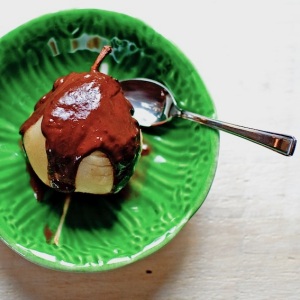
Did you know that alchohol doesn’t completely evaporate when you use it for poaching? No? Neither did I. I poached some pears in calvados yesterday morning to make this and, once they were cooked, I was tempted, Alice in Wonderland-style, by the delicious-looking poaching juice that had ‘drink me’ written all over it. Big mistake. I’ll leave to your imagination the damage done by a hefty measure of calvados on the empty stomach of someone who gets tipsy on anything more than a glass of wine (in the evening, with food). Just how ‘blonde’ can you get? Yesterday wasn’t a productive day, but it was a happy one!
I suppose that pear alcohol, such as Poire Williams, would work well too. If you try it, please let me know because I’m certainly not taking the risk 😉
Ingredients (serves 4)
4 pears, peeled carefully
25ml calvados
1 teaspoon cinnamon
50g of dark chocolate (min. 70% cocoa solids), in small pieces
120ml green tea
Place the pears in a casserole and fill with just enough water to cover them. Add the calvados and cinnamon and gently simmer for 20 minutes. They are cooked when you can stick a knife in with no resistance. Harder varieties, such as Conference will need to be poached longer than say, Williams. Drain well, taking care not to damage them.
Bring 120ml of green tea to the boil in a small casserole. Then add the chocolate pieces and stir well until the chocolate has all melted and you have a homogenous consistency. Serve the pears with the chocolate sauce poured over the top.
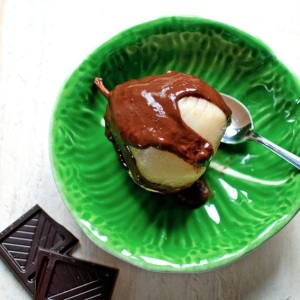
This dessert has been suggested for While Chasing Kids’ ‘skinny parade’. -
Leek and Bayonne ham quiche (gluten free)

If the 1980s bestseller ‘Real Men don’t Eat Quiche’ is anything to go by, you might want to refer to this as egg, leek and ham pie if you feel that might go down better with the men at your table. Of course, strictly speaking, I suppose it’s a tart and not a pie, but I’d put money on the fact that a man who won’t eat quiche won’t be buying into ‘tart’ either. Anyway, enough wittering, I believe in calling a quiche a quiche and if the neanderthals eating at my table don’t like it they can go and shoot their own dinner 😉 My alpha-male husband is actually the exception that confirms the rule – he worships at the altar of The Quiche.
The pastry is made with buckwheat flour, which not only makes it gluten-free, but healthier and tastier than regular pastry; it even stays crisp when served cold. And even if you don’t fancy quiche, it makes a superb base for apple, or any other fruit tart too.
Ingredients for pastry (serves 6-8):
220g buckwheat flour
80g butter
20g virgin coconut oil
Roughly 5 tablespoons of cold water
Ingredients for filling:
3 leeks, washed and chopped
2 shallots, sliced
1 tablespoon of olive oil
75ml chicken or vegetable stock
Sea salt and freshly ground black pepper
1/2 teaspoon paprika
1 egg
150 ml double cream
2 thin slices of Bayonne ham (or Parma ham), cut into strips
50 mg Cheddar, Parmesan or Comté cheese, grated
To make the pastry, begin by cutting the butter and coconut oil into small cubes. Add to the flour in a mixing bowl and add a pinch of sea salt. Blend by hand until the mixture becomes crumbly. Add the cold water, mixing rapidly with a spoon. Remove the mixture from the bowl onto a lightly floured surface. Knead until you obtain a ball of pastry (if the mixture isn’t ‘sticky’ enough to form a ball, you may need a drop more water). Wrap in a clean cotton tea towel and leave to ‘rest’ in the fridge for about two hours. This relaxes the dough and makes it easier to use.
Preheat the oven to 180°C. Roll out the pastry on a clean, lightly floured surface and fill the tart tin or tins. Buckwheat pastry contains no gluten, which makes it very fragile. You’ll find that you have to treat it delicately and possibly fill in the cracks with remaining bits of pastry by pressing gently. I tend to use individual tart tins. Precook the pastry for 12 minutes.
For the filling, begin by frying the leeks and shallots in olive oil in a small frying pan. Add the stock and braise for about 20 minutes, or until the leeks are well-cooked and the stock is absorbed. Break the egg into a small bowl and add the cream and seasoning (salt, pepper, paprika). Beat well to form a homogenous mixture. Place a few small strips of ham on the pastry base, spoon the leek mixture over that, add some grated cheese and then pour the egg and cream mixture over the top. Cook at 180°C for 20 minutes, or until the top is golden-brown in colour.

-
Toulouse sausages with Puy lentils and exiled hens

Our hens are in exile; they have been forced from their homeland by an overabundance of horses. Four was fine, desirable even; it created a cosy ‘chicken sandwich’ environment. But the newly-arrived pony was the final straw – she’s a Quadruped Lout Too Far and a tiny bit scornful perhaps at the deference required to lay an egg.
So they’ve set up camp on the fourth-floor shelf of the workshop on some torn-up sheets. Not without much shrill, dyspeptic screeching, I might add. I feel a bit bad that all they found for their nest was old sheets and not pashminas, but such is the life of a hen. I only discovered their new hideout because, reaching for an old sheet to clean my saddle, I unwittingly scrambled an egg at my feet. I assume they think that the workshop is horseproof – I’m afraid they’re in for a surprise 😉
Puy Green Lentils (grown on the vocanic soil of the ‘Massif Central’) are prized above other lentils for their strong peppery flavor and firmness, even after cooking. High in fiber and protein, they also contain dietary fibre, folate, vitamin B1, and minerals. As if all that isn’t enough, they also have a very low GI (glycemic index).
Ingredients (serves four)
4 Toulouse sausages
1 tablespoon olive oil
1 small red onion, peeled and chopped
3 cloves of garlic, peeled and finely chopped
5 mushrooms, peeled and sliced
3 medium sized carrots, peeled and cut into 3cm pieces
1 tin (400g) of plum tomatoes
200g of Puy lentils
2 sprigs of rosemary
1 bay leaf
250ml chicken stock
seasoning to taste: sea salt, fresh black pepper, paprika
Preheat the oven to 150°C. If you have a griddle pan, griddle the sausages briefly. If not, searing them will do just as well. Gently fry the onions, garlic and mushrooms in olive oil to soften them. Add the griddled/seared sausage, the plum tomatoes and carrots and continue to heat. Add the lentils, chicken stock, herbs and seasoning and bring back to a gentle simmer. Cook in the oven for about 45 minutes, checking from time to time that there is enough liquid – the lentils absorb an enormous amount.


