-
Oatcakes and small lazy animals

Oatcakes 
Bossy is currently embracing her inner sloth (her excuse is that she has the flu). I would like to say it makes for a peaceful house, but I’d be lying. She screamed at the Tallish One (you may remember I can’t call him The Tall One anymore because The Noisy One has overtaken him by 10cm) this morning to ‘call the doctor and order him to get rid of this f**king bullshit virus’. So that was reasonable; silent, or even gracious, she is not. Apparently she has very low blood pressure (not that you notice, mind you), which gets worse when she’s ill, which amusingly enough means that when she tries to stand up she collapses. This has the advantage of shutting her up momentarily, although it doesn’t make her any less stroppy. I wouldn’t like for her to actually hurt herself collapsing (she has quite a lot of form with collapsing and broken bones), but needs must.It is a well-known fact that when you’re ill, you need a sturdy dog to sit on your feet to keep you warm (and give you pins and needles and cramp). As I’m sure you’re all aware, I take my duties very seriously and carry out this role to the fullest, however time-consuming and unpleasant it may be. The trouble is, Java thinks it might be her duty too (when it suits her and when she’s not off doing things of little consequence). This means that we both end up sitting on Bossy who gets thoroughly overheated and panicky and red in the face and I have to throw Java off and we all end up in a growling, feverish heap on the floor. I’m absolutely wrung out; I hope we’re back to business as usual soon because this flu malarky is getting on my nerves.
Oats contain beta glucans which are very beneficial for the immune system (ha!)
Recipe for oatcakes (makes about 12 oatcakes)
- 225g rolled oats
- 60g chickpea flour (or any other flour)
- 1/2 teaspoon bicarbonate of soda
- 60ml olive oil
- Large pinch of salt
- 80ml hot water
Preheat the oven to 190°C. Combine the oats, flour, bicarbonate of soda, olive oil and salt well and then gradually add the hot water until you have a thick doughy mixture. Roll out the mixture and use a cookie cutter (or upturned glass) to make the cakes. Place the cakes on a greased baking tray and bake for 20 minutes or until golden brown. Leave to cool.
-
The perfect omelette

The perfect omelette I managed to live for over half a century without knowing how to cook an omelette properly. Or at least in a way that avoided husband and son sharing eye rolls and ostentatious dry heaves.
Speaking of exasperation, there are a few culinary fads that really boil my noodle: egg white omelettes (just eat the whole egg or go for the polystyrene option) and spiralised ‘spaghetti’ vegetables (eat spaghetti or eat vegetables, both if you really want to push the boat out, but don’t eat ‘pretend’ food unless you’re a toddler; exactly how idiotic do you think your taste buds are?)Back to The Omelette. There used to be a restaurant, l’Hôtel de la Tête d’Or, on the Mont St Michel in Normandy, which was famous for its omelette. The owner of the hotel, Madame Poulard, attracted tourists from all over, and although there was much speculation about her secret recipe, she always stayed circumspect. I suspect that her secret had more to do with hardware and impeccable timing than the actual ingredients, although apparently we will never know.
In any case, the simplest dishes are often the most delicious, but also the most difficult to get right. During my years of blissful ignorance, I used to beat the eggs a bit, add a touch of seasoning and then fry until most of the runniness was gone. They used to taste OK, although they sometimes looked as if I’d finished them off in the tumble dryer.
In my naivety I didn’t realise that in fact you have to go all sado-masochistic on the poor eggs, furiously beating and whipping them into complete submission. You then have to pitch them, molecules awhirl, from across the room into a blazing furnace of a pan for mere seconds, until the outside is seared and the inside still runny. The experience is athletic, stressful, and affirmative.
As the saying goes, you can’t make an omelette without breaking eggs, sweating profusely, hyperventilating, F-bombing anyone and anything in your way and setting off the smoke alarm…
Recipe for the perfect omelette (serves 1)- knob of butter
- 2 fresh free-range eggs
- Sea salt and freshly-ground black pepper
Melt the butter in a flat-bottomed frying pan over a high heat. Beat the seasoned eggs very fast until they become frothy. Throw the still-frothy mixture into the pan immediately and sear. Fold the omelette in half while the top is still runny. Serve! And breathe…
-
Smoked mackerel pâté and a broken cleaning lady

Smoked mackerel pâté We have broken our cleaning lady. Or to be more exact, the dogs have broken her. She’s never been their biggest fan; she believes that a dog’s place is outside and silent at all times. Personality and opinions, particularly dogmatic ones, should not be tolerated. If you’ve been reading my blog for a while, you’ll know that this just isn’t how we roll with Hugo and Java. Or at least, it isn’t how Hugo and Java roll with us.
I do see that it must be frustrating for her, especially when all the dogs within a two kilometre radius rock up for a ‘social’ when she’s trying to hose down the floors. They seem to sense the optimal impact moment to put in an appearance. And, in fairness, I do always say that cleaning our house is a bit like mucking out a stable. Anyway, this morning the hounds outdid themselves. The mild weather meant that the windows were open and Java, terrified witless by the vacuum cleaner, kept jumping out of the window, spent just enough time outside to dirty her feet and returned into the house through the front door. Ad infinitum.
Hugo, who had been invited (you don’t give Hugo orders; you make suggestions) to stay outside in a bid to reduce the carbon paw print, availed himself of the open window in the other direction to come back into the house (filthy paws and all) in order to launch a vicious assault on his long-standing nemesis, the hoover.
Happily, I wasn’t there this morning to witness this outrageous exhibition of doggie hooliganism. I did come back in time to be greeted by two manic, crack cocaine-smoking dogs and Luc administering medicinal Armagnac to treat the cleaning lady’s shattered nerves.
Health benefits of mackerel
Mackerel is packed with omega-3 essential fatty acids, which are associated with a multitude of benefits. Mackerel is also a great source of vitamin B12, selenium, niacin and phosphorus, amongst a range of other essential vitamins and minerals.
Recipe for smoked mackerel pâté (serves 6)
- 400g smoked mackerel, skin removed
- 1 ripe avocado
- 2 shallots, peeled
- 1 clove of garlic, peeled
- Juice of 1 lemon
- 1 tablespoon olive oil
- 4 tablespoons horseradish
- Sea salt and freshly ground black pepper
- 1 teaspoon paprika
Place all the ingredients in a food processor and combine until smooth. Chill for at least two hours and serve with either crispy French bread or raw vegetables (carrots, celery, fennel…)
-
Commendations and sabbaticals


Bossy’s chronic disorganisation means she’s in her usual pre-Christmas frenzy, so I doubt you’ll be hearing from her any time soon (you lucky, lucky people). As improbable as it sounds, she and her blog have been chosen to feature in Brandballot’s top 150 food blogs for 2018. I suspect it’s thanks to my help, although I’m obviously too gracious to point that out to her. Anyway, in case you’re interested, you can find her blog, and other far superior food blogs hereI’d like to take this opportunity to wish you all a very happy christmas because, as usual, I shall be moving out for the festive period, hopefully before the vulgar tree monstrosity appears. They insist on installing it right next to my bed, flashing lights and all, just to annoy me. The flashing lights play havoc with my already shredded nerves, and the tinsel and glitter make me sneeze; I’m allergic to tasteless bling. All in all the general ambiance becomes unbearable: Gaudy decorations make Java even more hyper than usual (I’ve recently decided she’s really just a barking cat), and Bossy just needs to glimpse a glass of champagne from across the room to become even louder and more tiresome than usual.
Despite my mini sabbatical, I’m not averse to presents. I know that Bossy thinks it’s a bit extravagant, but I’ve asked for a new iPaw; it’s more than justified, what with my ever-increasing workload – which obviously includes piles of fan mail – to deal with.
-
Chicken soup and unruly hair

Chicken soup My hair is a free-for-all, to be chewed on, judged and discussed without compunction or reserve. I’m asked on a regular basis if it’s natural (because you think I would I chose it?), if it’s wet, if it’s dry, if it’s just been to the hairdresser and if it hasn’t. In some parts of the world, people come and stroke it like a strange woolly pet. A rather uncharming old lady who lives nearby actually uses the word ‘mop’ when referring to it, which she does every time I see her. And Luc said the other day ‘it just really suits you – it’s chaotic’. This was meant as a compliment (wtf?). The assistant in a posh haircare shop not long ago suggested, without a hint of irony, that I could ‘always try using a comb’ when I asked for advice on how to tame it. And to add insult to injury, Hugo chews on it in much the same way that he chews on Java’s ears.
Health benefits of chicken soup
A number of studies have been conducted on the usefulness of chicken soup (aka Jewish penicillin) in warding off and treating cold and flu viruses. It appears that the soup inhibits the movement of neutrophils, the most common type of white blood cell that defends against infection. The theory is, that by inhibiting the migration of these infection-fighting cells in the body, chicken soup essentially helps reduce upper respiratory cold symptoms by reducing inflammation.
The researchers couldn’t identify the exact ingredient or ingredients in the soup that made it effective against colds but say it may be the combination of vegetables and chicken that work together.
Make what you will of the research, but at the very least, chicken soup with vegetables contains lots of healthy nutrients, is easy to digest, increases hydration and tastes delicious.
Recipe for chicken soup
- 1 tablespoon olive oil
- 2 onions, peeled and chopped
- 2 shallots, peeled and chopped
- 3 cloves of garlic, crushed
- 2 leeks, washed and cut into rounds
- 1 fennel bulb, washed and cut
- 1/2 butternut squash, peeled and cut into cubes
- 4 carrots, peeled and cut
- 200g cabbage, shredded
- 1 red pepper or chilli pepper, cut into strips
- 2 sprigs of thyme
- 1 teaspoon fresh ginger, grated
- 2 teaspoons turmeric
- 1.5 litres chicken stock
- 2 tablespoons Pernod (optional)
- 300g pre-roasted chicken, skin removed and shredded
- 100g frozen peas
- 2 serving of pre-cooked brown rice
- Sea salt and freshly ground black pepper
Gently brown the onions, shallots, garlic and leeks in the olive oil in a large saucepan or casserole dish. Once browed, add the fennel, butternut squash, carrots, cabbage and chilli pepper and continue to cook for a few minutes. Add the thyme, ginger, turmeric, chicken stock and Pernod and bring to a simmer. Once the vegetables are almost cooked, add the chicken and frozen peas and continue to cook for another ten minutes. Add the brown rice towards the end of cooking, season with the salt and pepper and serve piping hot.
-
Kale crisps, obscenities and dog-shaped holes

Kale crisps
The Tallish One (I had to rename The Tall One as The Noisy One is now a good 4cms taller) and I have decided that Bossy is a bad influence on animals and also, I suspect, small children. She and Noisy went to London last week and, while she was gone, everyone, even Java, fell into line. Relatively speaking of course. Even the horses were less tiresome than usual. Animals really do have a sixth sense for authority; The Tallish One has it, Bossy just doesn’t. She makes a mean kale crisp though, so I think we’re going to hang on to her for the moment.Bossy hadn’t been on UK soil for more than half and hour before having an almighty ding-dong with a traffic warden (apparently something to do with her being a ‘toxic tyrannical tw@t’). So much so that the traffic warden ran after her yelling ‘don’t you dare walk away while I’m reprimanding you’. If you know Bossy, you can imagine how well that went down. The thing is, Bossy swears a lot. It’s actually one of the few things she’s really good at; I would probably go as far as to say she’s a Master of Blasphemy. She’s also got quite a talent for really pissing people off. Anyway, if you want to learn to eff and blind in English or French, Bossy’s your girl.
In other news, we found a Java-shaped hole in the wisteria canopy under Léo’s first-floor bedroom window, and a rather bemused Java shaking herself off on the ground beneath. I feel certain that Bossy must be to blame in some way – I’m just not sure how yet.
Health benefits of kale
One thing is sure: kale is so full of goodness that if it could talk, it certainly wouldn’t swear. As a vegetable it is a bit of an overachiever with its protein, fibre, vitamins A, C, K and B vitamins. It also contains minerals – potassium, calcium and zinc as well as omega 3, lutein and zeaxanthin.
Recipe for kale crisps
- 200g kale, rinsed and cut into strips, large stems removed
- 1 tablespoon olive oil
- Sea salt, freshly ground black pepper
- Espelette pepper or paprika
Preheat the oven to 150°C. Put the kale in a large bowl and add the oil. Massage it into the leaves, then toss with the seasoning. Spread out in a single layer on two large baking trays and bake for about 20 minutes, checking from time to time that it is cooking evenly. Leave to cool and eat!
-
Beef Rendang and pernickety males

Beef Rendang I inadvertently surround myself by fussy men. My father was very tricky to buy presents for, and I always ended up buying him books which was an interesting challenge. Well-written, knowledgeable, lively, original and slightly wry biographies about Winston Churchill or Napoleon were usually a good bet, and most things by Philip Roth or Ian McEwan usually passed muster. Books that tried to be too witty or too clever would be cast aside in disgust, as were novels by PD James who never ‘got to the bloody point’ quickly enough. It was with great sadness that I recently saw there was a new Churchill biography out because I’ll never know what he thought of it.
Luc and Léo are inordinately difficult to shop for because they’re both strangely obsessed with the weight of all shoes and clothing. Léo also has an aversion to pink, yellow and anything patterned. And not only must everything be feather-light, any zips or buttons must be ultra rapid to avoid, god forbid, slowing him down. Luc is a big fan of parachute silk and doesn’t care if his clothes make him look like gay Hawaiian televangelist, as long as they’re diaphanous. Mon dieu!
But it is Hugo that takes the biscuit (unless they’re dog biscuits which he spits out). His bedding is a source of sleepless nights for everybody. We are currently testing bed number four as the first three were not to his liking, which he made very clear. I do understand because I’ve had unpleasant experiences at times with uncomfortable bedding, but I don’t show my exasperation by growling and huffing and puffing all night.
Little Java is a breath of fresh air. Although I suspect she must have a preference for cashmere cushions (who wouldn’t?), she sleeps anywhere and on anything. She also eats absolutely everything (including dressed salad, mustard and melon, which, as dog owners will know, is incredibly random). There is literally nothing that makes her unhappy. Except gunfire; gunfire unhinges her, which is ironic as she was born and bred to be a gundog…
Recipe for Beef Rendang (serves 4)
- 1 onion, peeled and chopped
- 5 shallots, peeled and chopped
- 4 cloves garlic
- 1 stalk lemongrass, chopped
- 1 teaspoon turmeric (or fresh turmeric, grated)
- 4 fresh chillis, washed and chopped
- 1 teaspoon fresh ginger, grated
- 600g braising steak, cubed
- 2 tablespoons coconut oil
- 1 cinnamon stick
- 6 cardamon pods
- 4 kaffir lime leaves
- 500ml coconut milk
- 1 lime, juiced
- Sea salt and freshly ground black pepper
Place the onion, shallots, garlic, lemongrass, turmeric and chills into a food processor and blend to obtain a smooth paste. Add the meat to the paste, mixing well and leave to marinate in the fridge for at least a few hours. Heat the coconut oil in a casserole dish and fry the meat/paste mixture for a few minutes until well browned. Add the cinnamon stick, the cardamon (releasing the seeds from the pods beforehand) and the kaffir leaves. Add the coconut milk, lime juice and seasoning and bring to a gentle simmer. Cook for about an hour and a half, stirring frequently. The meat should be tender and the sauce reduced and rich.
-
Shiitake mushrooms and furtive barbarians

Shiitake mushrooms It will soon be mushroom season, although for the moment it’s still too hot and dry here; Luc is on damp ground watch like a crazy Frenchman. Oh, hang on… I did find a lone, perfect cep yesterday though, which was grabbed from my hand and in a frying pan asphyxiating in olive oil and garlic before I was through the door. I never go foraging without my vicious, spiky walking poles, ostensibly to move away leaves without having to bend down, although really to maim greedy cep-stealing fingers. There’s something about looking for mushrooms (mushrooming?) that turns people into furtive barbarians. Bump into someone who is blatantly foraging and they become incredibly defensive: ‘Me? Mushrooms? Can’t stand the mouldy bastards! I’m just hanging out in the middle of the woods, catching a few rays and bonding with the slugs’.
Even armed with my lethal walking stick, I won’t be finding any shiitake mushrooms around here; they grow wild in mountainous regions of Asia and absolutely nowhere else. Scientists have discovered a possible correlation between typhoon wind patterns and the scattering of shitake spores dispersed from one country to the other. The medicinal properties of shiitake mushrooms have been studied since the Ming Dynasty when Chinese elders considered the shitake to be the ‘elixir of the life’.
Shiitakes are unique because they contain all eight essential amino acids. They are also a rich source of vitamin D, B vitamins and selenium and other minerals. They also contain linoleic acid which aids weight loss and builds muscle. It also has bone-building benefits, improves digestion, and reduces food allergies and sensitivities.
Shiitake mushrooms contain beta-glucan, an immune booster and soluble dietary fibre that’s also found in barley, rye and oats. The lentinan they contain strengthens the immune system and helps to fight off disease and infection. Research suggests that shiitake mushrooms may help fight cancer cells and also help heal damage caused by anticancer treatments. The mushrooms have also been shown to induce apoptosis, the process of cell death. They also contain L-ergothioneine, a potent antioxidant with unique cell-protective properties.
Lastly, these wonderful mushrooms have been shown to have anti-vital, anti-bacterial and anti-fungal properties, effective against a wide range of mould, yeasts, and fungi. It would appear that they even have the ability to kill off the dangerous organisms without affecting the healthy organisms.
-
Madiran wine and unravelling


The production of Madiran wine is spread over three departments of southwestern France: Gers, Hautes Pyrénées and Pyrénées Atlantiques. We visited two chateaux in the region last week. At the first chateau, when I couldn’t face another gory detail of the ‘chatelain’s’ latest surgical procedure, I ended up with my head between my legs to stop myself fainting. I suspect his technique is to regale wine buyers with the minutiae of his latest operation, and when their defences are down (or they’ll do anything to escape), go in for the kill; we had planned to buy 18 bottles of his excellent 2012 and instead ended up with 36!
Our visit to the second chateau was after a very long, hot hike through the vineyards, and I think that we probably arrived looking a bit dishevelled (our sartorial baseline is iffy to begin with). There was an English couple tasting wine, and either they’d been there a while and had forgotten to swill and spit, or they didn’t realise I was English, because the lady rather loudly and randomly commented to her husband that we looked like ‘a rather eccentric French family who didn’t know how to tie their shoe laces’. I thought this was pretty rich coming from someone whose companion was sporting an garish yellow daisy-print sunhat!
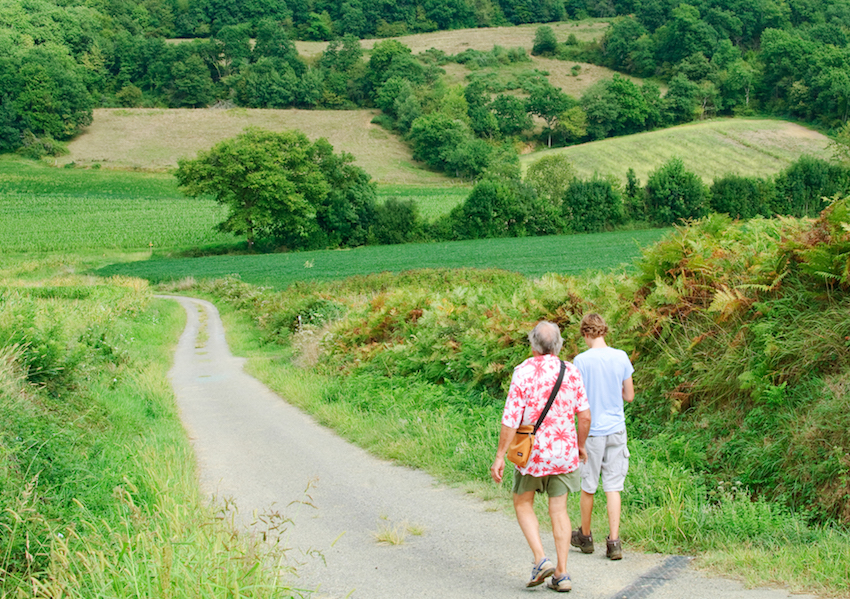
Classic Madirans are robust, earthy and quite ‘tanniny’ (wine critics the world over will be blown away by my wine vocab.), which is just how I like my wine (and men) to be. And the very best are aged in oak.
The polyphenols found in red wine in general play a key role in its health benefits by acting as antioxidants. Grape skins have high concentrations of polyphenols and in particular, procyanidin. Studies show that regions of the world with the greatest longevity also correspond to those with the highest procyanidin content in their wines.
The highest procyanidin content of all is to be found in the wines in the Madiran region and, as it happens, they also have the highest concentration of resveratrol, which is a sort of a natural plant antibiotic. Resveratrol is part of the defense mechanism in vines, which fights against fungus and other diseases. In humans, studies have shown it has anti-cancer, anti-inflammatory, blood-sugar lowering and other beneficial cardiovascular effects.
As Professor Roger Corder, author of ‘The Wine Diet’ explains: ‘One important advantage of choosing wines with a high procyanidin level is that less needs to be consumed to achieve the optimal health benefit. The best results I’ve had in my laboratory have been from Madiran wines. These have some of the highest procyanidin levels I’ve encountered, as a result of the local grape variety, Tannat, and the traditional long fermentation and maceration. In contrast, mass-produced, branded wines sold in many wine bars and pubs generally have disappointingly low levels of procyanidins.’
-
Tropical storms and a tribute

Tian’amen Square, 1972 Sadly my beloved father died in the middle of June. At 83, he was far too young to die; he was supposed to live to 99 like my grandmother.
This is Léo’s tribute to his grandfather: Andante by Mozart, my father’s favourite composer; Beethoven’s Ode to Joy, for his belief in Europe; and from The Planet Suite by Holst, Jupiter, the Bringer of Jollity, because that is exactly what he did.
https://youtu.be/ECakd8cCf5UPerhaps as a nod to my father’s exciting but sometimes extremely perilous life in Africa as Foreign Correspondent, on our return to France at the beginning of July we were catapulted into the deepest, darkest tropics. The mother of all storms caused steam to rise from the grass and the phone lines inside and outside the house to catch fire. It also forced the dogs to take refuge in the shower and brought with it a flourishing tribe of the most noisy, ill-tempered mosquitos I’ve ever experienced.
Getting anything fixed in France during the ‘Grandes Vacances’ is challenging at any time, but even more so when it involves replacing a kilometre of phone cable that serves just one house stuck in the middle of nowhere. Anyway, the upshot was that I spent the month of July bereft, incommunicado, and covered in grotesque insect bites. And to add insult to injury, my Instagram account was hacked by Russian spies.
I hope you are all having a nice Summer. Normal service will be resumed in September (I hope!). xx