-
Toulouse sausages with Puy lentils and exiled hens

Our hens are in exile; they have been forced from their homeland by an overabundance of horses. Four was fine, desirable even; it created a cosy ‘chicken sandwich’ environment. But the newly-arrived pony was the final straw – she’s a Quadruped Lout Too Far and a tiny bit scornful perhaps at the deference required to lay an egg.
So they’ve set up camp on the fourth-floor shelf of the workshop on some torn-up sheets. Not without much shrill, dyspeptic screeching, I might add. I feel a bit bad that all they found for their nest was old sheets and not pashminas, but such is the life of a hen. I only discovered their new hideout because, reaching for an old sheet to clean my saddle, I unwittingly scrambled an egg at my feet. I assume they think that the workshop is horseproof – I’m afraid they’re in for a surprise 😉
Puy Green Lentils (grown on the vocanic soil of the ‘Massif Central’) are prized above other lentils for their strong peppery flavor and firmness, even after cooking. High in fiber and protein, they also contain dietary fibre, folate, vitamin B1, and minerals. As if all that isn’t enough, they also have a very low GI (glycemic index).
Ingredients (serves four)
4 Toulouse sausages
1 tablespoon olive oil
1 small red onion, peeled and chopped
3 cloves of garlic, peeled and finely chopped
5 mushrooms, peeled and sliced
3 medium sized carrots, peeled and cut into 3cm pieces
1 tin (400g) of plum tomatoes
200g of Puy lentils
2 sprigs of rosemary
1 bay leaf
250ml chicken stock
seasoning to taste: sea salt, fresh black pepper, paprika
Preheat the oven to 150°C. If you have a griddle pan, griddle the sausages briefly. If not, searing them will do just as well. Gently fry the onions, garlic and mushrooms in olive oil to soften them. Add the griddled/seared sausage, the plum tomatoes and carrots and continue to heat. Add the lentils, chicken stock, herbs and seasoning and bring back to a gentle simmer. Cook in the oven for about 45 minutes, checking from time to time that there is enough liquid – the lentils absorb an enormous amount.

-
Chicken curry with mango, carrots and sweet potato

We had a ten-month old labrador bitch to stay for the weekend; a real doll. My husband, who can never resist a doll, invited her based on the assumption that such chaos would ensue, I would give him a break from my constant whining for another dog (yellow labrador girl puppy, not that I’ve given it any thought or anything :-). Anyway, ha ha! Big miss on his part. There is nothing like the satisfaction of having a sleeping labrador on either side of your feet in the evening. I do admit that the frenzied partying beforehand was slightly more wearing but, all things considered, all this weekend did was make me even more entrenched in my opinion that owning fewer than two dogs should be illegal 😉
This was concocted whilst dodging eight furry and frenetic legs in the kitchen. Never let it be said that I’m not a skilled multi-tasker. It is full of beta-carotene, making it an excellent dish for the winter. Beta-carotene enhances the immune system by increasing the number of infection fighting cells. It also helps protect the respiratory tract. Foods rich in beta-carotene include sweet potatoes, carrots, mango, apricots, kale, spinach, turnip greens, winter squash, collard greens, cilantro and fresh thyme.
Ingredients (serves four)
1 tablespoon olive oil
1 tablespoon coconut oil
4 chicken thighs
1 onion, thinly sliced
3 cloves of garlic, finely chopped
6 mushrooms, peeled and sliced
1 mango, peeled and sliced
4 carrots, peeled and cut
2 sweet potatoes, peeled and cut into chunks
2 green chillies, chopped
1 tablespoon of peeled, grated fresh ginger
1 cinnamon stick
1/2 teaspoon turmeric
3 teaspoons cumin seeds
1/2 teaspoon sea salt
1/2 teaspoon freshly ground black pepper
200ml chicken stock
Preheat the oven to 150°C. Take a medium-size casserole dish and fry the onion, garlic, mushrooms and chicken in the olive and coconut oils for a few minutes, until they start to brown. Add the seasoning (cumin seeds, salt, pepper, ginger, turmeric, cinamon stick…) and continue to brown stirring frequently to avoid sticking. Add the carrots, sweet potato, mango and chillies and then the chicken stock. Bring to a gentle simmer, stir and put the casserole in the oven for about two hours, checking from time-to-time that there is enough liquid. The result should be tender and just beginning to caramelise. -
Gluten-free crumble topping and luxury for horses

I’m a big fan of pashminas (yes I know, they’re so last decade darling but see if I care) and have always thought they must be one of the most versatile, luxurious garments ever invented. I now have further reason for thinking this; out walking Hugo (the bi-polar canine), I spotted a familiar equine shape in the distance; Texas, my husband’s retired racehorse. We are pretty relaxed about freeing him to graze in the grounds during the day, based on two assumptions: 1) being 30 (positively ancient in horse years), he won’t stray too far and 2) he sometimes needs a bit of ‘downtime’ from the others’ hijinks. Apparently our first assumption is wrong as he was about a kilometre from home. Anyway, off came my pale pink pashmina, which I used first as a lasso and then as a halter and leading rein. You don’t get much more versatile than that. It did the trick and then some; he usually shakes his head in irritation and fusses when being led with a halter but you could see the bliss in his eyes when I slipped the soft cashmere around his neck and he followed me home like a lamb.
Crumble topping is also extremely versatile, although I don’t think you could use it to lead a horse home. It can however be used sweet on fruit crumble or savoury on vegetable or meat dishes. In this case I used the topping for a fruit crumble of pineapple, banana and pear that had been poached in rum and a tablespoon of yacon syrup.
Ingredients -
Duck confit and underachievers

I sometimes suspect I might be a bit of a slacker. I’m always hearing about people ‘power walking’, whereas I walk, or at a push, hike if hiking’s called for. And do I spend ‘quality time’ with my family? We eat lunch and dinner together and sometimes even load/unload the dishwasher (although this does inevitably involve heated discussion), but is this enough to qualify? ‘Foodies’ is a term also frequently used. I enjoy cooking andam a bit greedyhave a good appetite, but does this make me a foodie? I could go on, but will stop before I completely trash myself 😉
If I were a ‘power-walking’ sort of person, I would no doubt confit my own duck. As it is, I buy it in a tin. Quite apart from my ‘underachieving’ status, there’s absolutely no way I could confit a duck that I had built up a relationship with (ie caught a glimpse of whilst still alive).
Duck confit (or ‘confit de canard’) is a speciality of Gascony. Confit is a process of preservation that consists of salt curing a piece of meat (generally goose, duck, or pork) and then poaching it in its own fat. Duck fat is a healthy choice for cooking – it contains 35.7% saturates, 50.5% monounsaturates (high in linoleic acid) and 13.7% polyunsaturated fats (which contain omega-6 and omega-3 oils).
Ingredients (serves four)
4 confit duck thighs (either from a tin or preserved in a jar)
Turn the thighs and solidified fat out into a deep frying pan. Heat on a very low heat to liquefy the fat very gradually. Little by little, drain the liquefied fat from the frying pan into another container and set aside to use as cooking oil for potatoes. Once the surplus fat is drained off, turn the heat up to medium and cook for about eight minutes on each side. The result should be dark golden-brown and very very crisp.
May be served alone with green beans or salad with walnut oil dressing, or with cubed potatoes fried for 15 minutes in the duck fat and garnished with crushed garlic.
And finally, once again for those worried about consuming dishes so apparently high in dietary fat:
‘A high cholesterol diet is not the cause of atherosclerosis. In 50 men with a fourfold increase in dietary cholesterol, two-thirds failed to show an increase in serum cholesterol. Seven patients in another study, while consuming large amounts of beef fat and vitamin and mineral supplements, showed a decrease in average cholesterol levels.’ Roy W. Dowdell, MD, Health Freedom News -
Perfectly scrambled eggs with porcini and smoked salmon

We have just arrived back from a busy and exciting trip to London (where I got some great food ideas – watch this space), but I appear to have returned minus my cooking mojo. It’s amazing how quickly my default-to-lazy kicks in. I couldn’t think what to cook for lunch today and might even have resorted to opening a tin of something if I’d had one to hand #shockhorror 😉 My husband solved the problem by disappearing into the woods and proudly returning with yet another kilo of porcini (yawn). I just about managed to rustle up this plate of Scottish smoked salmon (far and away the best!) and scrambled eggs with porcini, chilli peppers and garlic; a truly eclectic dish! Lėo, my son, on seeing this exclaimed ‘oh great: a picnic lunch!’ He has never yet been known to lose his cheekiness mojo…
Ingredients (serves two)
1 mushroom-obsessed husband. Failing that, a farmers’ market will do.
20g butter
2 medium-size porcini mushrooms, sliced
2 cloves of garlic, chopped
1 chilli pepper, finely sliced
4 large organic eggs
Sea salt and freshly ground black pepper
Break the eggs into a bowl and whisk gently until well combined. Add the seasoning. Fry the sliced mushrooms, garlic and chilli pepper in the half of the butter in a heavy-based saucepan until soft (roughly ten minutes). Pour in the beaten egg mixture and stir briskly with a wooden spoon or fork. It’s extremely important to make sure that the egg doesn’t cook too quickly, or overcook to avoid it becoming dry and flaky. Keep the heat low. Once the egg is almost cooked, remove from the heat and add the remaining butter. Continue to stir with the wooden spoon – the eggs will finish cooking in the heat remaining in the pan. Serve immediately with smoked salmon and a green salad. -
Mini chocolate hazlenut cakes (gluten-free)

I’m stunned: I just read a newspaper article about losing weight that actually made good sense. It advocates walking/skipping/moving yourself in whatever way you fancy over going to the gym. It favours eating full-fat dairy products in moderate quantities over highly processed food and lastly it advises turning your central heating down or off. It’s all based on the principle of turning white fat (lazy fat) into brown fat (active fat). I can’t see it catching on though — ‘Common Sense and Beige Fat’ is hardly bestseller title material is it?
Here are some delicious mini chocolate cakes, to be consumed with moderation after a brisk walk in the fresh air and the central heating down low.
Ingredients (makes 16)
200g dark chocolate (minimum 70% cocoa solids)
150g butter
130g cane sugar
4 eggs, beaten
60g powdered hazelnuts
60g powdered almonds
Pinch of salt
Preheat the oven to 180°C. Melt the chocolate and butter together. Combine the beaten eggs and sugar, gradually adding the powdered almonds and hazelnuts. Add the melted butter and chocolate mixture to the egg mixture and combine well. Pour the mixture into mini cake moulds and bake for 20 minutes. -
Yvette’s choux fritters and the French ‘paradox’

Yvette is our nearest neighbour; a traditional Landaise farmer’s wife and testament to the so-called French ‘paradox’* (the Gascons consume more fat than anywhere else in the world, but have one of the longest life expectancies). Almost everything she eats she has either grown or nutured herself and she has no qualms about cutting off a chicken’s head to make her Sunday roast (unlike yours truly wimply here 😉 ) What’s even more amazing is that she’s still speaking to us, despite being woken up on a fairly regular basis by the thundering of our escaped horses’ hooves, churning up her land.
These little delicacies are light, airy, crisp and moreish – or so I’m told – this version contains wheat flour so I can’t eat them, but I shall be trying out a wheat-free version soon.
Ingredients (makes about 20 fritters)
125 ml cold water
50g butter, cut into small cubes
100g self-raising flour
Pinch of salt
2 teaspoons of vanilla essence
1 tablespoon of sugar
2 eggs
1 tablespoon of rum
1 litre of vegetable oil (grapeseed)
Sugar for decoration
Put the cold water in a medium-sized saucepan together with the butter, sugar, vanilla and salt. Place the saucepan over a moderate heat and stir with a wooden spoon until the butter has melted and the mixture comes up to the boil. Remove from the heat immediately and throw in the flour, whisking well until you obtain a smooth ball of paste that leaves the sides of the saucepan clean (this will probably take about a minute).
Next beat the eggs well, then add them into the mixture, little by little, mixing well. Beat until you have a smooth glossy paste, which you should then leave to cool for about 30 minutes.
Just before cooking, add the rum to the paste and heat a litre of grapeseed oil to 180°C. Cook tablespoon-size balls of paste until they flip themselves in the oil and are golden-brown all over. Toss in the sugar and serve hot or cold.
* I put the word paradox in inverted commas because I don’t believe it to be a paradox at all. It became known as such simply because it went against the grain when trying to prove a link between high-fat consumption, cholesterol and heart disease. See here.
-
Porcini and salmon risotto and Mae West ideology
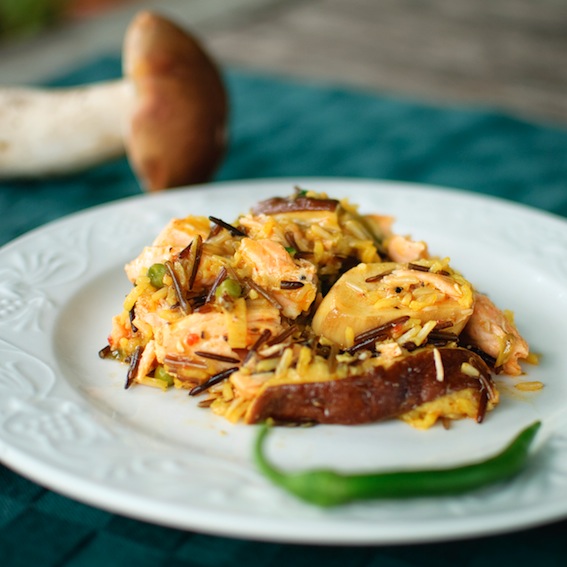
Mae West said : ‘Too much of a good thing can be wonderful’.
Yeah whatever, Mae. Personally I’m starting to struggle with my husband’s on-going obcepsion. The freezer’s bursting at the seams and I’m wondering if we couldn’t dry them and smoke them instead 😉
Petulant scoffing aside, this risotto was pretty luxurious and I know that in a few weeks I’ll be glad of all the ceps in the freezer. I love cooking risotto because it’s so relaxing; you absolutely have to stay and stir because you can be sure that if you so much as answer the ‘phone, it will be at that moment that it sticks. For someone who is usually doing about six different things at once, this is a good excuse to just chill.
Ingredients (serves four)
4 tablespoons of wild rice
1 tablespoon of olive oil
4 medium-sized ceps, sliced
2 cloves of garlic
1 chilli pepper
8 tablespoons of whole basmati rice
1 glass of white wine
250ml of vegetable stock
2 tablespoons of green peas
2 filets of fresh salmon
Seasoning: sea salt, black pepper, saffron
Fresh parsley
Start by pre-cooking the wild rice in salted boiling water for ten minutes. Pour the olive oil into a medium-sized frying pan and gently brown the garlic, chilli pepper and ceps. Add the pre-cooked wild rice and the uncooked whole basmati and continue to fry for a couple of minutes. Pour the glass of white wine into the frying pan, stirring well. Let it sizzle for a moment or two, then add the saffron, stock and seasoning and bring to a simmer. Stir regularly, checking that there is enough fluid (there should always be enough to see gentle bubbling).
Meanwhile, poach the salmon for about ten minutes and set aside. Add the peas to the rice, stirring well. Finally, add the salmon and parsley a few minutes before the rice is cooked (whole basmati usually needs 30 – 35 minutes). -
Endives and ham ‘au gratin’ and cantankerous journalists
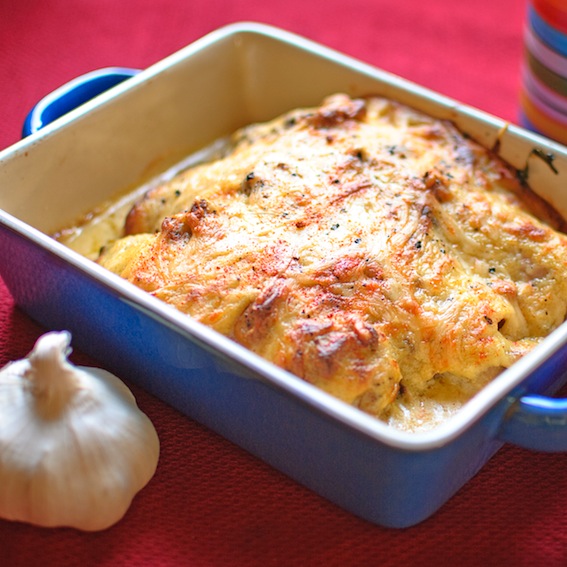
I keep reading articles in the English-speaking press about how miserable the French are at the moment and that morale has never been lower. I can’t help feeling that this is no more than a bit of misguided wishful-thinking on the part of ill-humoured hacks (I’m talking about you, Toby Young), but let me nonetheless reassure everyone that however down-at-mouth the French are, they still know how to eat…
This is a deliciously light and good-humoured dish to serve with a side salad and a wide grin 🙂
Ingredients (serves 4)
8 endives
8 slices ham
200g of grated hard cheese (I use Comté, but you could use Cheddar or Gruyère…)
For the gluten-free béchamel sauce :
30g chickpea flour
15g butter
2 tablespoons’ olive oil
250ml milk
200ml vegetable stock
1 tablespoon mustard
Seasoning to taste: sea salt, black pepper, nutmeg
Boil or steam the endives until cooked (about 15 minutes in salted boiling water or 8 minutes in a steamer). Preheat the oven to 220°C. Once cooked, drain well and try to press out any remaining water. Wrap each endive in a slice of ham and lay in a baking dish.
To make the béchamel sauce, melt the butter and heat the olive oil in a saucepan. Add the flour to the butter/oil mixture and stir rapidly with a whisk until you obtain a mousse-like mixture. Add the liquid (stock and milk) little by little, whisking vigourously to avoid lumpiness. Keep whisking and adding liquid over a gentle heat until there is none left and the sauce thickens slightly – you are aiming for a smooth, glossy, creamy pouring sauce. Add the mustard and the seasoning and leave to heat for a further five minutes over a very low heat, whisking from time-to-time.
Pour the sauce over the ham-wrapped endives and add the grated cheese. Bake for about 20 minutes until bubbling and golden-brown. -
Thai carrot and cumin soup

I love everything about this soup – the taste, the colour, the texture, its warm spicyness… It’s also extremely nourishing and with its combination of healing vitamins (A and C, amongst other things, in the carrots), coconut oil, garlic and ginger, it can be guaranteed to knock a cold on the head in no time. And if you eat enough of it you’ll even end up with a healthy glow 😉
Ingredients (serves 8)
1 tablespoon coconut oil
1 large onion, sliced
3 cloves of garlic, crushed
1 leek, sliced
600g carrots, peeled and sliced
2 litres of vegetable or chicken stock
150g coral lentils
1 teaspoon of fresh, grated ginger
2 teaspoons cumin powder
1 teaspoon chilli powder
Rock salt and ground black pepper to taste
100ml coconut milk
Start by browning the onions, leeks and garlic in the coconut oil. Add the carrots and continue to brown gently for a couple of minutes. Add the stock and bring to a boil, then add the lentils, ginger, cumin, chilli and salt and pepper. Cook until the carrots and lentils are soft – roughly half and hour. Purée, add the coconut milk and serve.


