-
Pea and mint soup and Hugo’s new byline

I recently joined the NUDJ (National Union of Dog Journalists) because Bossy can be inclined to take advantage of my good nature. I also decided that I needed a proper byline and my favourite artist submitted a few pwoofs that you can see above and below. I quite like them, although I do wonder whether they properly portray the fact that I am a sophisticated dog of great intellectual gravitas… I would appreciate your opinions.
I’ve been rushed off my paws even more than usual this week; we are in the throes of a baby deer boom. These baby deer have no sense of territory or propriety, which is quite exhausting. And as if this isn’t taxing enough, a family of ducks has moved in without so much as a by-your-leave. They quack very loudly all night and stop me from sleeping. As I work until at least midnight every night, I need all the rest I can get *bone-tired doggie sigh*. When I get time, I shall write to my union about all this noise and overtime.
To be honest, this pea soup is as dull as ditchwater. I’ve never been keen on green-coloured food because, in my world, green means that it’s gone bad. Still, they all seemed to like it, although the Noisy One appears to share my suspicion of anything green.
I’m sorry this soup doesn’t meet with your approval Hugo, although, as this is a healthy eating blog, you might want to dilute your opinion on green things a little bit for next time? I thought it was a particularly delicious Spring soup and will certainly make it again. Peas are sometimes referred to as ‘nature’s multivitamin’, as they contain no fewer than eight vitamins and seven minerals. They are also a good source of fibre and protein and lower the overall glycemic index of any dish to which they are added.
This soup is adapted from a recipe in Anthony Worrall Thompson’s excellent book, ‘GI Diet’.
Ingredients (serves 4 – 6)
10g salted butter
1 tablespoon olive oil
1 onion, peeled and chopped
2 leeks, washed and chopped
1 garlic clove, finely chopped
275g peas, fresh or frozen
1 large courgette, washed and chopped
1 litre chicken or vegetable stock
Sea salt and freshly ground black pepper
1 teaspoon paprika
1 tablespoon fresh mint, finely chopped
Melt the butter in a large saucepan with the olive oil. Add the onion, leeks and garlic and gently soften. Add the peas, courgette and stock and bring to the boil. Add the seasoning and cook until the peas and courgette are tender (about 20 minutes). Add the mint and purée until smooth. -
Courgette, cheese and chickpea cake (gf)
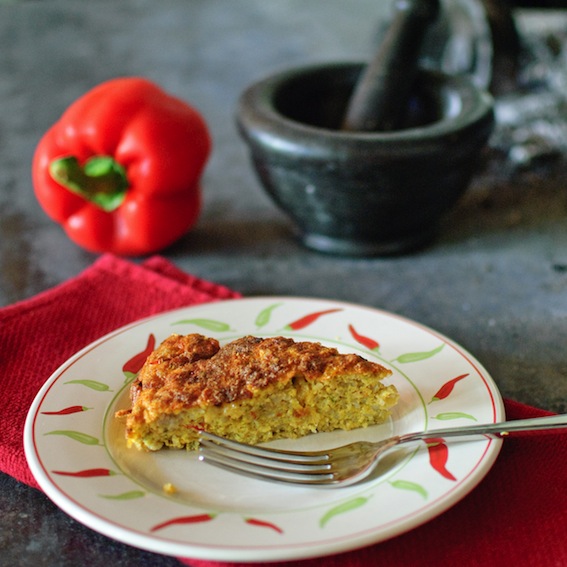
As a follow-on to my previous recipe, I thought I would try a savoury version of the chickpea cake. The result was a protein-rich cross between a paschtida and a savoury flan or cake. In any case, it was very tasty and would make an ideal accompaniment (we ate it with spicy sausages), or could be served on its own with a green salad. This recipe is particularly for Jenna, who is currently in need of quick and easy-to-make gluten-free sustenance.Ingredients (serves 6)
300g chickpeas (garbanzo beans), pre-cooked and rinsed (you can use tinned)
4 eggs, beaten
1 courgette, peeled and finely chopped
½ red pepper, washed and sliced
1 shallot or small onion, peeled and sliced
1 teaspoon bicarbonate of soda
sea salt and freshly-ground black pepper
2 teaspoons paprika
150g hard cheese (I used Comté), grated
Preheat the oven to 160°C. Grease and prepare a medium-sized cake tin, round or square. Pulse the chickpeas in a food processor until they reach a paste-like consistency and then mix in the other ingredients, except the cheese, one at a time, continuing to pulse. Add the cheese last and mix in by hand. Pour the mixture into the cake tin and bake for an hour (a fork inserted into the centre should come out clean). May be served hot or cold.
-
Spelt pilaf and painful toes

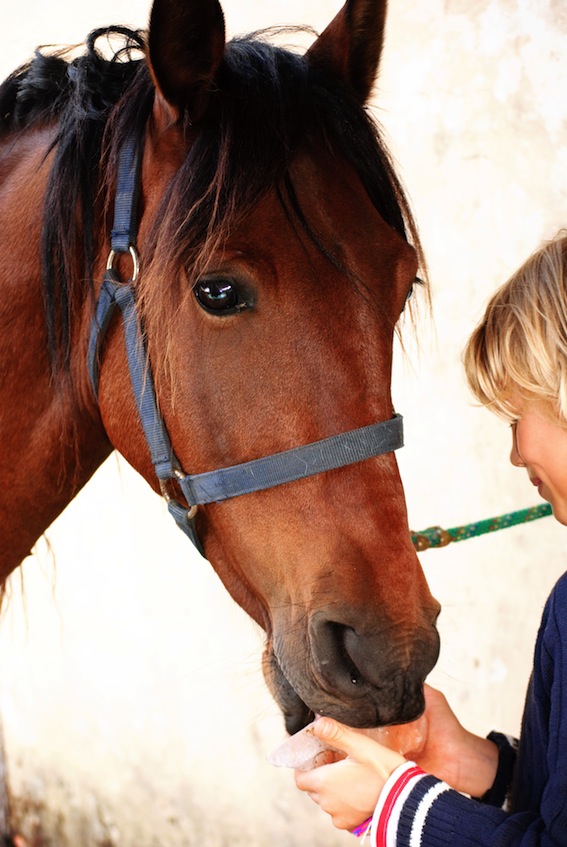
Yesterday, when Castaño, our Exceedingly Naughty Horse, stood heavily on my little toe, I thought my husband’s reaction, ‘don’t worry, it can’t possibly be broken – he’s not very heavy’ (translated: ‘stop moaning and get over it’), could have been a little more sympathetic. I don’t know what his point of reference is, but half a ton of gyrating horse on my little toe certainly felt heavy to me.
Today, while treating our mare’s foot (she managed to stand on the only piece of stray metal within a ten kilometre radius), Luc had his toe stamped on. Castaño, in full-blown ‘joys of Spring’ mode, saw fit to bite the mare’s rear end while she was tied up and, in reaction to the whippersnapper’s blatant audacity, she lashed out behind and stood on Luc’s toe in front. When he yelled at me to get my ‘damned Iberian hooligan’ out of the way, my innate sense of decorum prevented me from saying: ‘it can’t have hurt that much, she’s not very heavy’. Or it almost did anyway. 😉
Spelt grain has a robust, slightly nutty flavour and is high in fibre, B vitamins and minerals. It also contains all nine amino acids. Another considerable benefit of spelt is that it is less likely to cause allergy or intolerance than wheat.
Ingredients (serves 4)
1 tablespoon olive oil
2 shallots, peeled and chopped
2 cloves of garlic, peeled and chopped
200g spelt grain
1 tomato, peeled and cubed
sea salt and freshly ground black pepper
I teaspoon curry powder
750ml chicken or vegetable stock
20g cashew nuts
fresh parsley or basil
Gently fry the shallots and garlic in olive oil in a large frying pan until softened. Add the spelt grain and continue to fry for a few minutes, mixing well so that the grain is covered in olive oil. Add the tomato, stock and seasoning, again mixing well. Leave to simmer for about 30 minutes until the spelt is cooked, stirring from time to time to prevent sticking. Stir in the cashew nuts a few minutes before the end of cooking time and add the parsley or basil to garnish before serving. -
Cheesy cornbread and downwardly mobile dogs
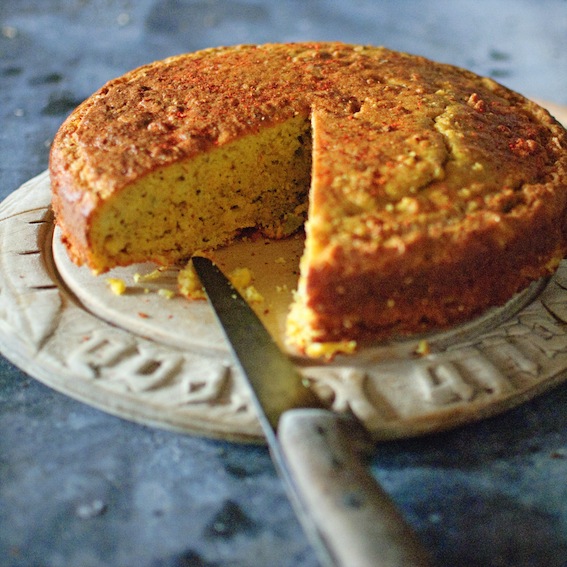

by Hugo,
Canine Correspondent
I’ve been chewing something over for a while now: Why are humans the only race that don’t automatically stretch when they get up? Dogs stretch, horses stretch, cats stretch and even hens who, let’s face it, aren’t the brightest, stretch. Humans like to think they rule the roost, but they’re not always very clever when it comes to basic body-maintenance. Bossy often complains (loudly and at length) about her hurt back and she sometimes goes to the bone doctor. What a lovely job that must be, specialising in bones. I must look into that – I’m sure it would be a good job for me.
Bossy has also taken to lying on a soft blue mat (which makes very satisfactory chewing material) and bending her body into most unhuman positions; she looks a bit silly actually. Apparently it’s called yoga. At first I thought it was just a phrase, but she does it quite regularly. When I have time, I show her how it should be done properly. Usually the Tall One or the Noisy One interrupts to try to talk to her and they get very short shrift indeed. I like to lie on the soft blue mat with her, but she doesn’t seem to like that either. All in all, she’s not very easy to please *desolate doggie sigh*.

Thank you Hugo, not only for writing today’s blog, but also for the invaluable ‘tips’. This cornbread is based on a Jamie Oliver recipe.
Ingredients (serves 10)
60g butter
2 onions, peeled and thinly sliced
1 small tin of sweetcorn, drained and rinsed
4 large free-range eggs, beaten
325g polenta (or cornmeal)
250ml full-fat milk
1 teaspoon baking powder
6 tablespoons spelt flour
sea salt and freshly-ground black pepper
1 teaspoon paprika
140g hard cheese (I used Cheddar and Parmesan), grated
Preheat the oven to 200°C and grease a 22cm cake tin with olive oil. Gently fry the onions in melted butter for about 15 minutes until golden and sticky. Add the sweetcorn and cook for a further five minutes. Remove from heat and set aside. Mix the eggs, polenta, milk, baking powder, flour and seasoning in a bowl. Add most of the grated cheese and mix well. Stir in the onion and corn. Pour the mixture into the cake tin. Bake for 35 minutes, remove from the oven and sprinkle the remaining grated cheese on top and return to the oven for ten minutes. Delicious served still warm from the oven or cold. -
Italian-style green beans and lace-chewing mini goats
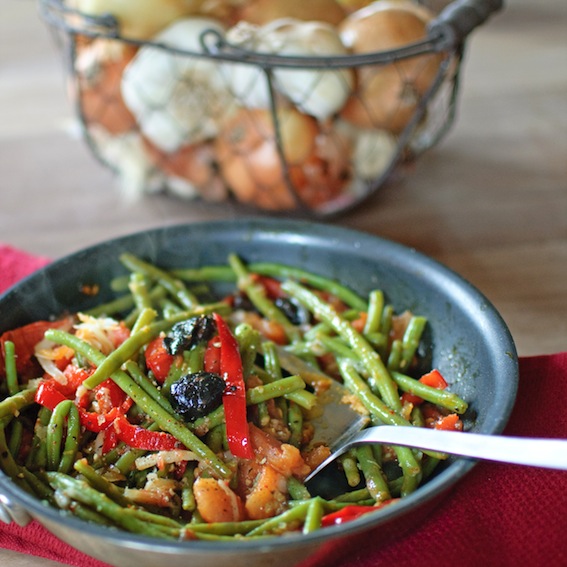
Castaño, our most misbehaved horse, still attends the School for Exceedingly Naughty Horses a couple of times a week and Léo has taken to accompanying us. I’m not sure whether he comes because he’s looking for general naughtiness tips, or whether he’s fallen for the stable’s miniature goat. I suspect it’s the latter; my family and I have an immoderate fascination for mischievous animals and this little she-goat fits the bill very nicely. They spend an hour climbing trees, inspecting muddy ditches, making the horses spook and charging each other with imaginary horns. She invariably takes pleasure in undoing Léo’s shoe laces with her teeth and chewing them to bits. Is ‘chewing the lace’ a goat variation on ‘chewing the cud’ I wasn’t aware of? Anyway, as I appear to lack the foresight to buy several replacement pairs at once, I’ve spent much of the past month on a quest for flourescent green laces. Never let it be said that I don’t live life on the edge.
This dish makes a wonderful accompaniment to fish or meat, or it may be served as a light lunch or supper with a poached egg on top.
Ingredients (serves 6)
1kg green beans
1 tablespoon olive oil
1 onion, peeled and chopped
1 red pepper, sliced
1 tomato, chopped
2 cloves of garlic, finely chopped
handful of pine nuts
12 black olives
6 anchovies
Sea salt and freshly-ground black pepper
1 teaspoon paprika, piment d’Espelette or chilli powder
10g Parmesan cheese, grated (optional)
Precook the beans until ‘al dente’, strain and set aside. Gently heat the olive oil in a large frying pan adding the onions and cooking for a few minutes. Add the sliced red pepper, tomato and garlic and continue to cook until the red pepper and tomato soften. Add the green beans, pine nuts, olives, anchovies and seasoning, gently combining and cook for a few more minutes. -
Cheese soufflé and tyrannical toasters
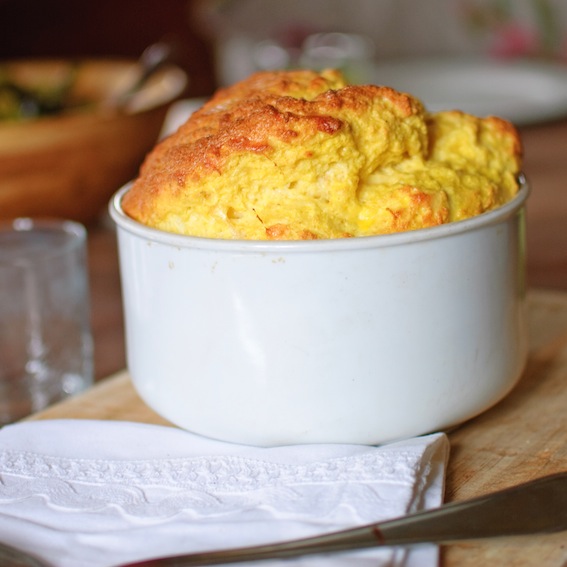
We seem to have inadvertently acquired a toaster with attitude. Big Attitude. To the extent that everyone, including Hugo, is in awe. It’s a mini dictator sitting in the middle of the kitchen snarling at anybody that dares approach. Worst of all though is its incontinence: It spurts and ejects things at random over the floor and countertop, even into the sink. On a bad day, you could be forgiven for imagining that it’s aiming straight at you. And from one day to the next, you don’t know if you’re going to be eating charcoal or still-frozen bread. I make sure to unplug it at night and, if it’s been particularly temperamental, lock the kitchen door because you just can’t be too careful.
I had never made soufflé before and had always imagined it would be a bit hit-and-miss, especially miss. Believe me though, soufflé has nothing on the toaster. In fact, it’s quick and easy to make as long as you stick to three main criteria: make sure the egg whites are properly whisked, use really good quality hard cheese — I used a combination of Parmesan and Comté — and choose timely, obedient guests (I was less successful in this respect and there was much shrill yelling). Soufflés do not take well to waiting around and collapse into an unattractive heap if not consumed immediately, a bit like the cook really.
This is based on a Delia Smith recipe.
Ingredients (serves 4)
3 large eggs, separated
75g grated hard cheese (I used a mixture of Parmesan and Comté)
150ml milk
25g butter
25g spelt flour (ordinary flour would be fine)
½ teaspoon paprika
½ teaspoon nutmeg
½ teaspoon mustard
sea salt and freshly ground black pepper
Preheat the oven to 190°C. Grease and prepare an 850ml soufflé dish. Place the milk, butter and flour in a saucepan over a medium heat and whisk until blended and thickened. Continue to cook over a low heat, still stirring, for a further couple of minutes. Add the mustard and seasoning and then leave the sauce to cool a little before stirring in the grated cheese. Beat the egg yolks and add them to the mixture. Next whisk the egg whites until stiff, then fold gently into the cheese sauce mixture, taking care to keep the structure of the whisked whites intact. Transfer to the prepared soufflé dish and place in the centre of the oven. Cook for 30-35 minutes. The centre should be cooked (i.e. not liquid) without being dry.
To be served with a crisp green salad and a gracious smile. 🙂 -
Sausage casserole and confusing coat conundrums

I have a new ski jacket. While I’m sure you’re over the moon for me, I admit that this is hardly groundbreaking news. It is, however, very confusing for Hugo. For him, the precursors to ‘walkies’ are: my digging around for an embarrassingly long time in a futile attempt to locate my mobile ‘phone, resorting to ringing it (of course it rings in my my pocket), locating vaguely matching left and right shoes and then, in Winter, putting on The Walking Jacket. My new jacket occasions a perplexed ‘head-tilt to one side’ look of utter bemusement, accompanied by a woefully despondent ‘maybe we’re not going for a walk after all’ sigh. He’d better get used to it though — with my matching left and right shoes and new jacket, there’s no stopping me; I’ve become a bit of a fashionista and may even upgrade again next year! 😉
There’s something in this sausage casserole for everyone: high-maintenance fashionistas, fussy children, finicky dogs and hens… It is adapted from a Tana Ramsay ‘Family Kitchen’ recipe.
Ingredients (serves 6)
2 tablespoons of olive oil
1 large onion, peeled and sliced
2 cloves of garlic
6 mushrooms, peeled and sliced
6 Toulouse sausages
60g pancetta, sliced
1 leek, rinced and sliced
Sea salt and freshly ground black pepper
1 tablespoon paprika
2 teaspoons Worcester sauce
1 litre chicken or vegetable stock
6 carrots, peeled and cut into 3cm pieces
6 small potatoes, peeled
200g, cannelloni beans, pre-cooked and drained
½ green cabbage, shredded
Gently heat the olive oil in a large casserole dish (Dutch oven), adding the sausages, onions mushrooms and garlic and fry until golden brown. Add the pancetta and leeks, continuing to brown. Then add the seasoning and stock, followed by the carrots, cabbage, potatoes and beans and bring to a boil. Leave to simmer for about 40 minutes. May be served alone or with bread, couscous, quinoa or basmati rice. -
2013 in review
The WordPress.com stats helper monkeys prepared a 2013 annual report for this blog.

Here’s an excerpt:The concert hall at the Sydney Opera House holds 2,700 people. This blog was viewed about 34,000 times in 2013. If it were a concert at Sydney Opera House, it would take about 13 sold-out performances for that many people to see it.
-
Simple coconut chicken curry and a fine way to drive

No doubt in retribution for the gentle mockery in my last post, I received a speeding fine this morning in the post. Or to be precise, my husband received a speeding fine, which absolutely thrilled him. The irony is that I was flashed coming back from a very active skiing weekend and traffic cop-in-the-making, Léo, was fast asleep and not in a position to attend to his functions. Of course, the problem with radar tickets is that you can’tflirtnegotiate your way out of them. If I’m stopped by an actual live policeman, I play the ‘oh gosh I’m so sorry officer —it must have been a slip of the foot during a fleeting blonde moment’ card. Shiny grey metal boxes, however, are not nearly as indulgent with lame excuses.
I like my curry the way I like my driving: fast and hassle-free. It is none the less delicious for it though.
Ingredients (serves four)
1 tablespoon coconut oil
4 chicken breasts, cut into chunks
1 onion, thinly sliced
2 cloves of garlic, crushed
4 carrots, peeled and cut
2 green chillies, chopped
1 tablespoon of peeled, grated fresh ginger
1 kaffir lime leaf (or bay leaf)
1 cinnamon stick
½ teaspoon turmeric
3 teaspoons cumin seeds
1/2 teaspoon sea salt
1/2 teaspoon freshly ground black pepper
100ml chicken stock
100ml coconut milk
Gently fry the onion, garlic and chicken in the coconut oil for a few minutes in a medium-size casserole dish. Add the seasoning and spices (cumin seeds, salt, pepper, ginger, turmeric, cinnamon stick…) and continue to brown, stirring frequently. Add the carrots and chillies and then the chicken stock and coconut milk. Simmer for about 20 minutes and then serve with basmati rice, naan bread, chickpea pancakes or just a green salad. -
Pot-au-feu (French beef stew) and disruptive mothers

Tennis tournament season is back and, once again, I’m in the market for a gag. If I don’t find one (and let’s face it, there seems to be a dearth of reasonably stylish ones), I’ll have to stop accompanying Léo to matches until I learn to control my gratuitous and unhelpful comment reflex, which never fails to kick in. I can only be thankful that the majority of the other spectators don’t understand English; I won’t go into details as I wouldn’t want to sully reputations, particularly mine. The strange thing is that neither Léo nor I are particularly competitive, but there’s something about people either criticising or applauding (I don’t know which is worse) my son’s ‘faults’ that brings out the devil in me.
This is a simple version of ‘pot-au-feu’, a traditional French dish which, strictly speaking, should include several different cuts of meat as well as oxtail. In any case, it is very comforting after a day spent in the cold having your nerves ripped to shreds! It used to be that the pot containing the stew would stay cooking over the fire nearly all winter, with bits and pieces being constantly replaced. Usually the ‘bouillon’ or sauce is eaten as soup and the vegetables and meat as a main course with mustard and pickles, although I like to eat the two together.
Ingredients (serves 4)
1 tablespoon olive oil
2 onions, sliced
2 cloves of garlic, chopped
Vegetable stock (roughly 500ml)
1kg stewing beef, cut into large cubes
4 leeks, washed and sliced
1 red pepper (optional), cut into slices
1 stick of celery, cut into four pieces
6 small carrots, cut into 3cm pieces
2 swedes or turnips, peeled and quartered
¼ white cabbage, sliced
4 small potatoes, peeled
Bouquet garni (parsely, thyme, bay)
Sea salt and freshly ground black pepper
1 teaspoon piment d’espelette (or paprika)
Preheat the oven to 150°C. In a fairly large casserole dish (Dutch oven) brown the onions and garlic very briefly in the olive oil. Add the beef and continue to brown for a couple of minutes. Add all the vegetables (except the potatoes) and then enough vegetable stock to cover. Add the seasoning, herbs and spices and bring to a gentle boil. Transfer to the oven and cook for about three hours, checking from time-to-time that there is sufficient liquid (the vegetables should be covered). Add the potatoes and cook for a further hour.
